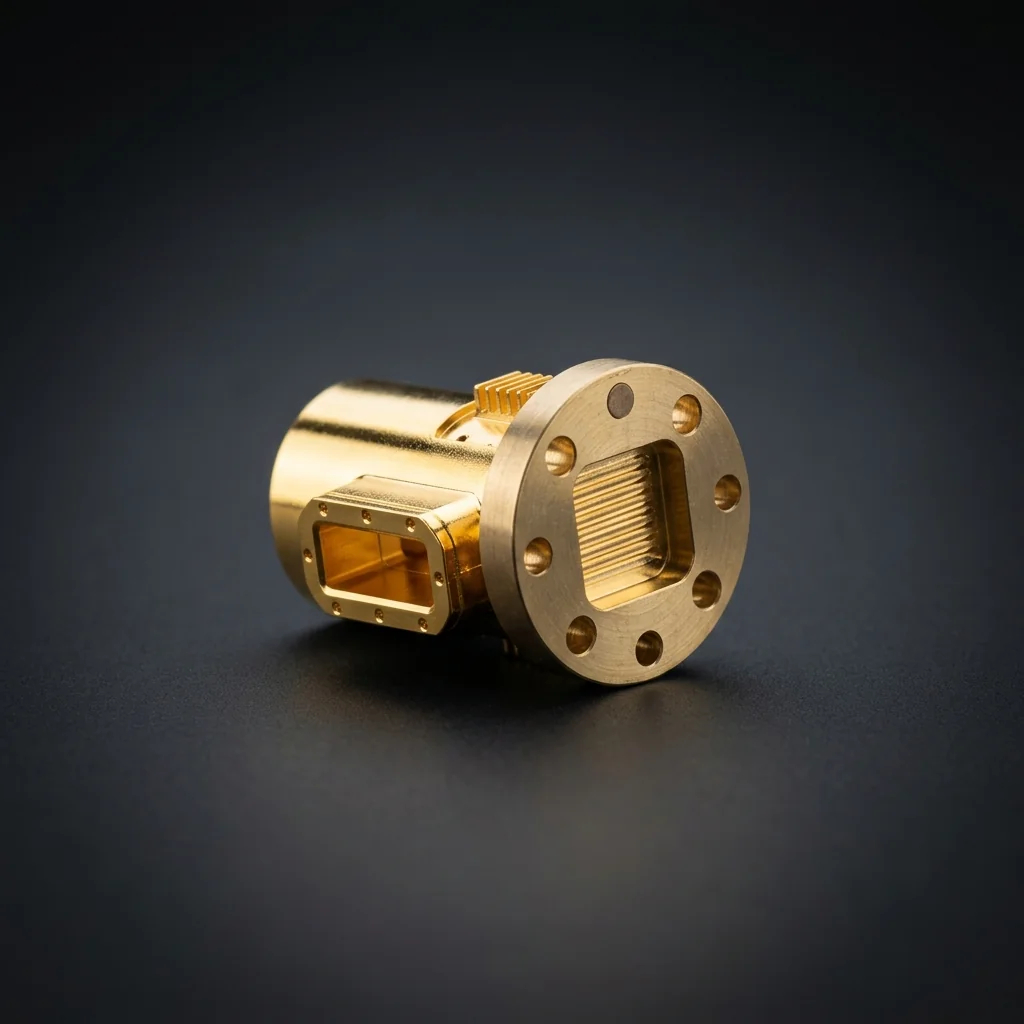
WR-22 Low Power Termination
The WR-22 Low Power Termination is a precision-engineered waveguide component that provides an exact precision match for terminating unused ports during VNA calibration and testing. It is specifically designed for the 33 - 50 GHz frequency range, serving as a critical building block in Q-Band infrastructure.
Low-power terminations prioritize absolute minimum VSWR over heat dissipation, using a highly engineered, delicate absorbing element designed for milliwatt-level measurement accuracy. WR-22 operates in the Q-Band (33-50 GHz), sitting right above the Ka-band. Its 0.224" x 0.112" aperture requires precise CNC machining, as surface roughness begins to significantly impact insertion loss at these frequencies.
Key Features
Compact Form Factor
Designed for bench-top and rack-mounted test setups where space and weight are critical considerations.
Precision Matched Load
Engineered for excellent return loss and VSWR performance across the full operating frequency band.
Laboratory Grade
Meets the exacting standards required for network analyzer calibration and precision RF measurements.
Corrosion Resistant
Gold-plated finish provides long-term environmental durability and consistent electrical performance.
Q-Band Use Cases
Radio Astronomy
Molecular cloud mapping
Q-Band Satcom
Next-gen broadband links
Military Data
High-capacity secure comms
Test Equipment
Vector network analysis
More Low Power Terminations
Frequently Asked Questions
Can a low power termination be used for calibration?+
Yes. Low power terminations are frequently used as the "Load" standard during a Short-Short-Load-Thru (SSLT) calibration on a Vector Network Analyzer, requiring them to have near-perfect return loss (better than 30 dB).
What are the main applications for WR-22 Q-Band components?+
WR-22 is heavily utilized in advanced satellite communications (V-band/Q-band uplinks) to escape the congested Ka-band. It is also a critical band for radio astronomy, specifically for mapping complex molecules in deep space.
How does surface roughness affect WR-22?+
At 50 GHz, the skin depth of copper is incredibly thin (less than 0.3 micrometers). If the interior machining marks of the WR-22 component are larger than the skin depth, the RF current is forced to travel up and down the microscopic ridges, exponentially increasing resistive heating and insertion loss.