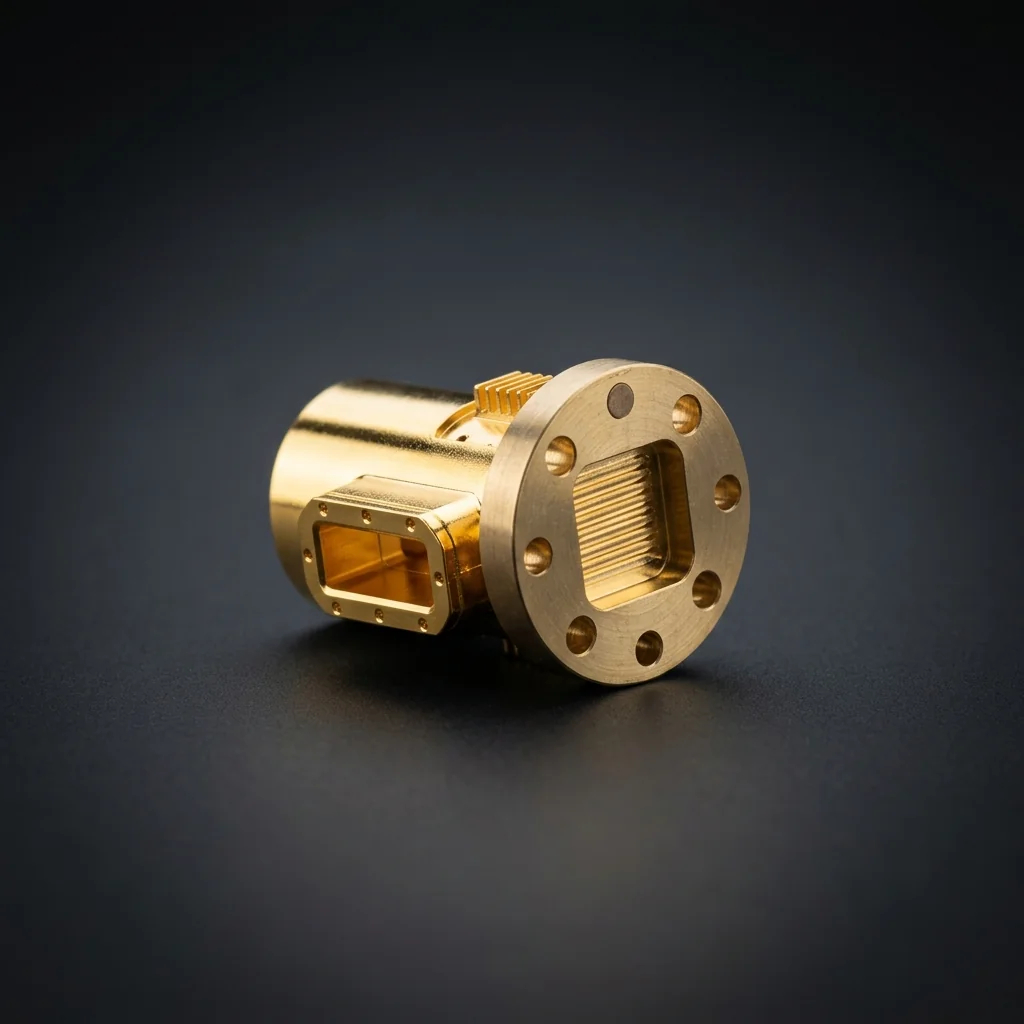
WR-10 Low Power Termination
The WR-10 Low Power Termination is a precision-engineered waveguide component that provides an exact precision match for terminating unused ports during VNA calibration and testing. It is specifically designed for the 75 - 110 GHz frequency range, serving as a critical building block in W-Band infrastructure.
Low-power terminations prioritize absolute minimum VSWR over heat dissipation, using a highly engineered, delicate absorbing element designed for milliwatt-level measurement accuracy. WR-10 encompasses the 75-110 GHz W-Band. It is heavily utilized for 77 GHz automotive radar systems (ADAS), requiring internal waveguide dimensions of precisely 0.100" x 0.050".
Key Features
Compact Form Factor
Designed for bench-top and rack-mounted test setups where space and weight are critical considerations.
Precision Matched Load
Engineered for excellent return loss and VSWR performance across the full operating frequency band.
Laboratory Grade
Meets the exacting standards required for network analyzer calibration and precision RF measurements.
Corrosion Resistant
Gold-plated finish provides long-term environmental durability and consistent electrical performance.
W-Band Use Cases
Automotive Radar
77 GHz ADAS sensors
Passive Imaging
Security millimeter-wave
Defense Seeker
Missile terminal guidance
Materials Test
Dielectric characterization
More Low Power Terminations
Frequently Asked Questions
Can a low power termination be used for calibration?+
Yes. Low power terminations are frequently used as the "Load" standard during a Short-Short-Load-Thru (SSLT) calibration on a Vector Network Analyzer, requiring them to have near-perfect return loss (better than 30 dB).
Why is WR-10 the standard for automotive radar?+
The global standard for Advanced Driver Assistance Systems (ADAS) radar is 77 GHz to 81 GHz. WR-10 components (W-Band) are required for all test, measurement, and calibration systems used in the development and manufacturing of these automotive radar chips.
Can WR-10 handle high power?+
Because the aperture is only 0.100" x 0.050", the electric field density inside WR-10 is extreme even at moderate power levels. While it handles less total power than WR-28, a dry, nitrogen-purged WR-10 component can still safely pass over 100 Watts of CW power before experiencing dielectric breakdown.