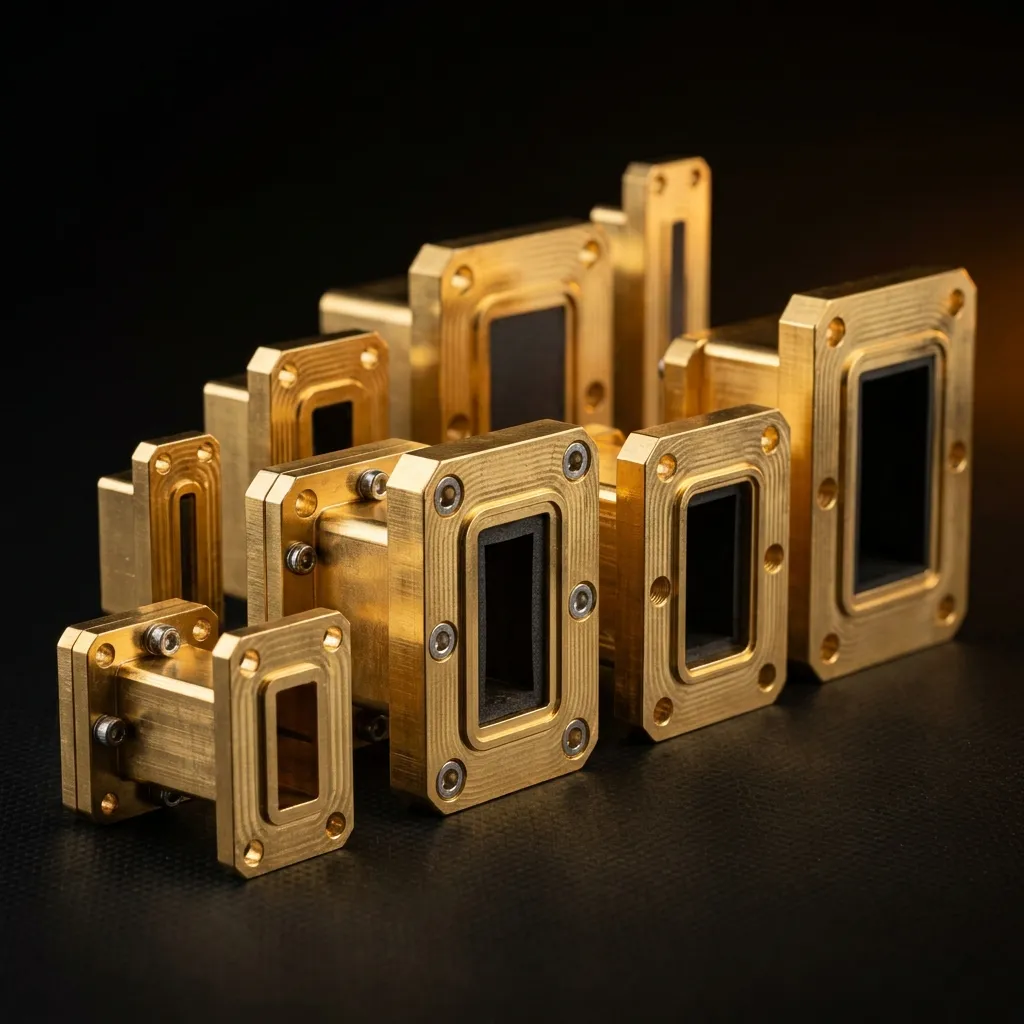
A waveguide termination is one of the simplest components in an RF system. It is a closed section of waveguide loaded with an absorptive material that converts incoming RF energy into heat. It has no active elements, no tuning mechanism, and no signal output. It sits at the end of a port and does precisely one thing: absorbs the signal with minimal reflection.
Despite this simplicity, the termination is one of the most frequently underspecified components in waveguide systems. Engineers spend weeks optimizing LNA noise figures, filter passbands, and antenna gain patterns, then select terminations based on price and lead time. This is a mistake. A termination with poor VSWR at the operating frequency introduces reflections that ripple through the entire measurement or system calibration, producing errors that can be difficult to trace back to their source.
This article examines how waveguide terminations actually work, what separates a precision termination from an adequate one, and why the physics of absorber materials, thermal dissipation, and flange alignment matter more than most system engineers realize.
How a Waveguide Termination Works
A waveguide termination converts the electromagnetic wave propagating in the dominant mode (TE10 for rectangular waveguide) into thermal energy. The conversion must be gradual and impedance-matched to avoid generating a reflected wave back toward the source.
The core element is the absorber. In most precision waveguide terminations, this is a tapered wedge of lossy material inserted into the waveguide channel. The taper geometry is critical. A blunt absorber presents a sudden impedance discontinuity at its leading edge, reflecting a portion of the incident power. A properly tapered absorber introduces the loss gradually, allowing the wave to dissipate over the length of the taper without significant reflection at any single point.
Physics Note: The taper follows an impedance transition profile. A linear taper provides good performance, but an exponential taper offers lower return loss over broader bandwidths because it distributes the impedance change more uniformly along the absorber length. High-performance terminations operating across a full waveguide band (e.g., WR-10, 75-110 GHz) typically use exponential or Klopfenstein taper profiles.
Absorber Materials
The absorber material must have controlled electromagnetic loss properties at the operating frequency. Common materials include:
- Iron-loaded epoxy: Widely used in standard terminations. Iron carbonyl powder mixed with epoxy resin provides controllable loss tangent. Effective from L-band through Ka-band.
- Silicon carbide (SiC) composite: Higher temperature stability than epoxy-based absorbers. Used in medium and high-power terminations where sustained thermal loading is expected.
- Ceramic-loaded absorbers: Aluminum oxide and other ceramic matrices loaded with lossy fillers. Suitable for high-temperature environments and space applications where outgassing is a concern.
- Nichrome thin film: A resistive film deposited on a dielectric substrate. Used in precision low-power terminations where precise impedance control is required.
The choice of absorber material determines the termination's power handling capability, operating temperature range, and long-term stability. A termination designed for laboratory bench measurements at 1 mW has fundamentally different absorber requirements than one specified for 10 W continuous-wave operation in a deployed radar system.
Power Handling: Low, Medium, and High
Waveguide terminations are categorized by their continuous-wave (CW) power handling capability. The power rating is not arbitrary; it is set by the absorber's ability to convert RF energy to heat and transfer that heat to the waveguide body without exceeding the material's thermal limits.
| Category | Typical CW Power | Construction | Cooling Method |
|---|---|---|---|
| Low Power | 0.5 - 2 W | Tapered absorber in compact housing | Passive convection |
| Medium Power | 5 - 50 W | Extended absorber with thermal mass | Conductive heat sinking |
| High Power | 50 - 500+ W | Water-cooled or fin-cooled body | Forced convection or liquid cooling |
Thermal Design in High-Power Terminations
A 100 W CW termination at W-band (75-110 GHz) must dissipate 100 watts of thermal energy in a waveguide channel that measures just 2.54 mm x 1.27 mm (WR-10). The volumetric power density is extreme. The absorber temperature rises until thermal equilibrium is reached with the surrounding waveguide body and cooling system.
OFHC (oxygen-free high thermal conductivity) copper waveguide bodies are standard for high-power terminations because copper's thermal conductivity (approximately 400 W/m·K) provides an efficient heat path from the absorber to the external surface. Aluminum bodies, while lighter, have approximately half the thermal conductivity and are generally limited to medium-power applications.
Design Rule: The power rating of a termination assumes a specific ambient temperature and cooling condition. A termination rated for 50 W CW at 25°C ambient with natural convection may only handle 30 W at 55°C in a sealed enclosure. Always derate the power specification for the actual installation environment.
VSWR: The Primary Performance Metric
The voltage standing wave ratio (VSWR) of a termination quantifies how well it absorbs the incident signal. A perfect termination absorbs 100% of the power, producing VSWR of 1.00:1. A practical termination always reflects some fraction of the incident power due to impedance mismatches at the absorber taper, at the flange interface, and within the absorber material itself.
| VSWR | Return Loss | Reflected Power | Typical Application |
|---|---|---|---|
| 1.05:1 | 32.3 dB | 0.06% | Calibration-grade standard |
| 1.10:1 | 26.4 dB | 0.23% | Precision measurement termination |
| 1.20:1 | 20.8 dB | 0.83% | General-purpose system port |
| 1.50:1 | 14.0 dB | 4.0% | Non-critical applications only |
The difference between a 1.05:1 and 1.20:1 termination may seem minor in isolation. But consider its effect on a VNA measurement. A port termination with 1.20:1 VSWR creates a residual reflection that limits the effective directivity of the test setup. Any device under test with return loss better than approximately 21 dB cannot be accurately characterized because the measurement uncertainty from the termination's own reflection approaches the signal being measured.
VSWR Across Frequency
A termination's VSWR is not constant across its rated bandwidth. It varies with frequency due to changes in the absorber's electromagnetic properties, mode behavior near waveguide cutoff, and standing wave effects from mechanical discontinuities. Precision terminations are specified with a maximum VSWR across the full waveguide band, not just at a single frequency point.
At the upper end of the waveguide band, the dominant TE10 mode approaches the cutoff frequency of higher-order modes (TE20, TE01). If the termination's internal geometry excites these higher-order modes, even weakly, the result is an apparent VSWR increase that can be difficult to diagnose. Clean internal machining, precise absorber placement, and controlled flange alignment all reduce higher-order mode excitation.
Flange Interface: Where Alignment Meets Performance
The flange connection between the termination and the mating waveguide is a frequent source of performance degradation that is entirely within the engineer's control to prevent.
Flange Types
Standard rectangular waveguide flanges are defined by MIL-DTL-3922 and EIA standards. The two common types are:
- Cover (flat) flange: A flat face with alignment dowel holes. Simple and reliable when mated with a choke flange.
- Choke flange: Incorporates an annular groove that creates a λ/4 choke joint, compensating for small gaps or misalignment at the waveguide aperture. The choke provides a low-impedance path at the flange interface, reducing leakage and improving return loss.
A cover-to-choke flange pair is the standard configuration. Cover-to-cover connections are acceptable when both flanges are precision-machined and torqued to specification, but they provide less tolerance for angular misalignment and surface imperfections.
Alignment and Torque
At mmWave frequencies, flange misalignment of 25 μm (0.001") can produce measurable VSWR degradation. For WR-10 waveguide (75-110 GHz), the waveguide aperture is only 2.54 mm wide. A 25 μm offset represents approximately 1% of the aperture dimension, creating a step discontinuity that generates a reflected wave.
Proper alignment dowel pins, clean flange surfaces, and controlled torque on the flange bolts are not optional procedures at mmWave frequencies. They are measurement requirements. A termination with verified 1.05:1 VSWR on a test report can easily degrade to 1.15:1 or worse at the point of use if the flange connection is not properly executed.
System-Level Impact: Why Terminations Matter
Terminations appear in multiple locations throughout a waveguide system, each with different performance implications.
VNA Test Port Termination
When measuring the S-parameters of a device under test, unused ports must be terminated. The reflection from the termination adds directly to the measurement uncertainty. For calibration-grade measurements, the termination's return loss should exceed the DUT's expected return loss by at least 10 dB.
Receiver Port Protection
In a radar or communications receiver, unused antenna ports or switched beam outputs are typically terminated. A termination with poor VSWR at these ports creates reflections that can re-enter the signal chain, producing ghost targets in radar systems or bit error rate degradation in communications links.
Power Amplifier Load
During system integration and testing, power amplifiers are often operated into termination loads before being connected to antennas. The termination must handle the full CW output power and provide a stable impedance match. VSWR variations at the amplifier output can cause load-pull effects that shift the amplifier's operating point, changing its gain, output power, and linearity characteristics.
Specifying the Right Termination
When specifying a waveguide termination for a system, the following parameters should be defined explicitly in the procurement specification:
- Waveguide size (e.g., WR-28, WR-10, WR-05)
- Operating frequency range (full band or sub-band)
- Maximum VSWR across the operating bandwidth
- CW power handling at the specified ambient temperature
- Peak power handling for pulsed applications (including duty cycle and pulse width)
- Flange type (cover, choke, UG number)
- Material and plating (copper with gold plating is standard for precision applications)
- Operating temperature range
- Test data requirements (measured VSWR data across band, or manufacturer's typical data)
A termination is a simple component, but it is not a commodity. The difference between a well-designed termination and an inadequate one shows up in measurement accuracy, system reliability, and calibration repeatability. Treating the termination as an afterthought is how 0.5 dB of unexplained loss and 3 dB of measurement uncertainty enter a signal chain that was otherwise carefully engineered.
RF Essentials manufactures precision waveguide terminations in low-power, medium-power, and high-power configurations across all standard waveguide bands from WR-28 through WR-03. All products are made in the USA with measured performance data.
Frequently Asked Questions
Why does a waveguide termination use a tapered absorber?
The taper provides a gradual impedance transition so the incident wave dissipates over the absorber length without reflecting at any single point. A blunt absorber presents a sudden discontinuity at its leading edge and reflects part of the incident power. High-performance terminations spanning a full waveguide band, such as WR-10 from 75 to 110 GHz, use exponential or Klopfenstein taper profiles because they spread the impedance change most uniformly for the lowest broadband return loss.
How are waveguide terminations categorized by power level?
Three categories cover the range. Low power, 0.5 to 2 W, uses a tapered absorber in a compact housing cooled by passive convection. Medium power, 5 to 50 W, uses an extended absorber with added thermal mass and conductive heat sinking. High power, 50 to 500 W or more, uses a water-cooled or fin-cooled body with forced convection. The rating reflects how well the absorber converts RF to heat and moves that heat into the waveguide body.
Why is a termination's VSWR worth paying for?
A termination with poor match at the operating frequency reflects energy that ripples through the whole measurement or system calibration, producing errors that are hard to trace back to their source. A 1.05 to 1 load reflects only 0.06 percent of the power and serves as a calibration standard, 1.20 to 1 reflects 0.83 percent for a general system port, and 1.50 to 1 reflects 4 percent and belongs only in non-critical paths. The match is the primary performance metric.