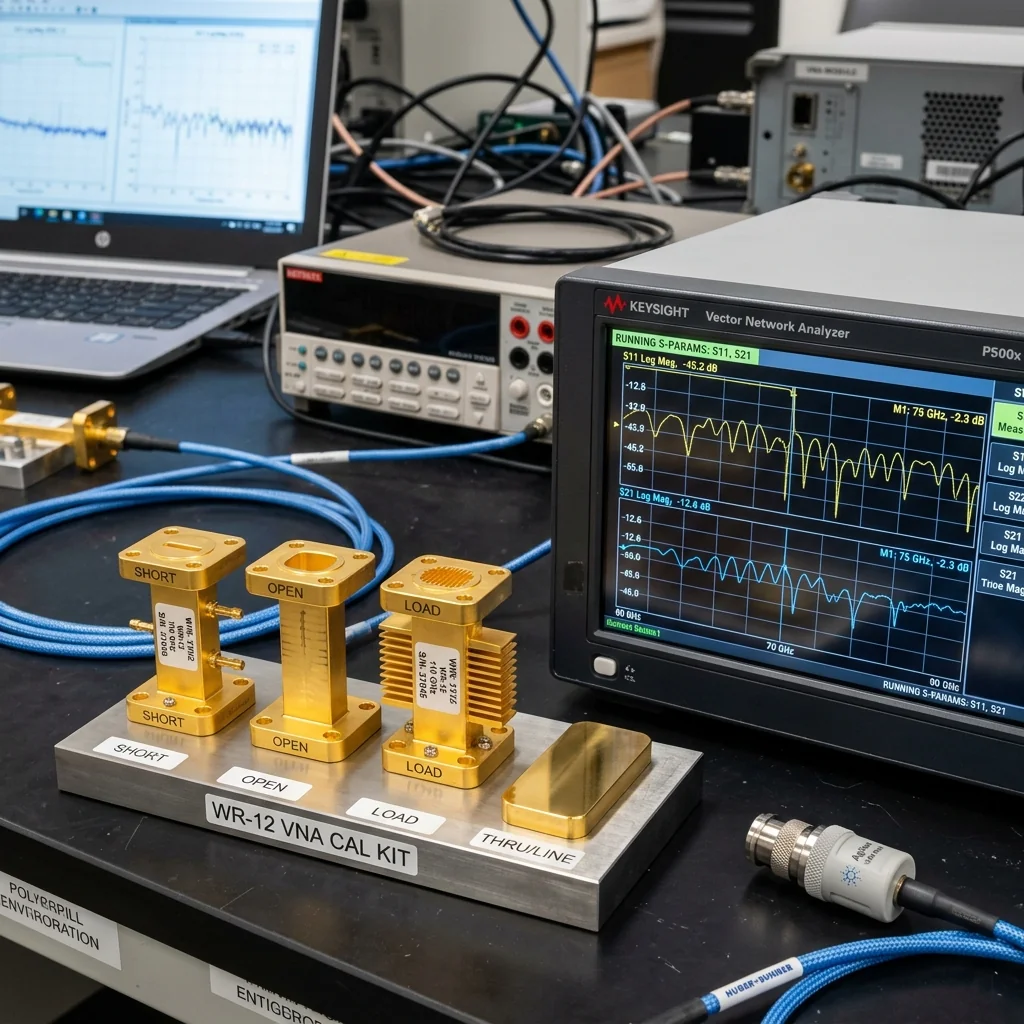
The Calibration Problem Nobody Talks About
During my years as an Application Engineer at Rohde & Schwarz, I spent most of my time helping customers who were convinced their device under test (DUT) was broken. Nine times out of ten, the DUT was perfectly fine. The problem was their calibration. More specifically, the problem was their calibration standards.
At frequencies below 18 GHz, calibration is relatively forgiving. A standard SOLT (Short-Open-Load-Thru) calibration kit from any reputable manufacturer will give you S-parameter measurements that are accurate to within a few hundredths of a dB. But the moment you push into Ka-band (26.5 to 40 GHz) and above, the physics of calibration changes entirely. The standards themselves become the limiting factor in your measurement accuracy, and most engineers do not realize how severely their data is being corrupted.
What Calibration Actually Does
A Vector Network Analyzer measures the complex ratio of reflected and transmitted waves at the ports of a device. But the VNA itself, and the cables and adapters connecting it to the DUT, introduce systematic errors: directivity leakage, source mismatch, port-to-port isolation, and frequency response roll-off. These are not random errors; they are repeatable and can be mathematically removed.
Calibration is the process of measuring a set of known reference standards (whose electrical behavior is precisely characterized) and using that data to build a 12-term error correction model. The VNA then applies this model in real time to remove the systematic errors from every subsequent measurement.
Engineering Insight: The accuracy of your calibration can never exceed the accuracy of your calibration standards. If your "known load" has a return loss of 40 dB but your VNA error model assumes it is 50 dB, every S11 measurement you make will carry that 10 dB uncertainty.
SOLT vs. TRL: Choosing the Right Method
The two primary calibration methods for waveguide measurements are SOLT and TRL. At Rohde & Schwarz, I would always start the conversation with one question: what is your frequency range?
| Parameter | SOLT Calibration | TRL Calibration |
|---|---|---|
| Standards Required | Short, Open, Load, Thru | Thru, Reflect (any), Line (precise length) |
| Load Quality Dependency | Critical. Accuracy limited by load match. | None. No broadband load required. |
| Best For | Coaxial measurements below 40 GHz | Waveguide measurements above 18 GHz |
| Bandwidth | Broadband (multi-decade) | Limited to ~8:1 frequency ratio per line |
| Accuracy at Ka-band | Moderate (load VSWR degrades) | Superior (no load dependency) |
| Complexity | Low (plug and measure) | Higher (precise line lengths required) |
Why SOLT Fails at mmWave
SOLT calibration depends on all four standards being precisely characterized. The Short and Open standards are relatively straightforward to manufacture with high precision, even at millimeter wave frequencies. The Thru is simply an empty, straight section of waveguide. But the Load is the weak link.
A waveguide matched load must absorb 100% of the incoming RF energy across the entire calibration bandwidth. At Ka-band and above, manufacturing a broadband absorber that maintains a return loss better than 40 dB across 26.5 to 40 GHz is extremely difficult. The absorbing wedge must be machined to sub-mil tolerances, and the material's absorption characteristics must remain stable across temperature. Any imperfection in the load directly corrupts the VNA's error model.
The TRL Advantage
TRL (Thru-Reflect-Line) calibration was specifically developed to solve this problem. The genius of TRL is that it eliminates the broadband matched load entirely. Instead, it uses a precision-length airline (a straight waveguide section of known physical length) as the primary reference. The "Reflect" standard can be anything with high reflectivity (a short plate works perfectly), and its exact reflection coefficient does not even need to be known.
Because the calibration accuracy depends on the physical length of a machined waveguide section rather than the broadband absorption quality of a lossy material, TRL provides significantly better measurement accuracy at millimeter wave frequencies. At RF Essentials, when customers are working above 30 GHz, we almost always recommend TRL-compatible waveguide standards.
The Flange Problem
Every time you connect a waveguide calibration standard to a VNA test port, the waveguide flanges must mate with absolute mechanical precision. At WR-28 (Ka-band), the internal aperture is only 7.112 mm x 3.556 mm. If the flanges are misaligned by even 25 micrometers (about one-thousandth of an inch), the discontinuity at the junction creates a parasitic reflection that corrupts your calibration.
This is why flange selection matters enormously. UG-599 flanges (the standard MIL-spec flange for WR-28) use alignment pins to ensure repeatable mating. But these pins wear over time, and the alignment degrades with every connect-disconnect cycle. For the highest-accuracy measurements, we recommend precision dowel-pinned flanges with alignment tolerances below 10 micrometers.
Lab Tip: After calibration, always run a verification step. Connect a known device (a precision 10 dB attenuator or airline) and measure its S-parameters. Compare the result against the manufacturer's certified data. If the deviation exceeds 0.1 dB in S21 or 2 dB in S11, your calibration has a flange alignment or standard quality issue. Recalibrate.
Temperature Stability
Waveguide calibration standards are machined from metals (typically brass or aluminum, gold-plated for corrosion resistance). Metal expands and contracts with temperature. At Ka-band, a 5°C temperature drift in the lab can cause the physical length of a TRL airline standard to shift by enough to introduce measurable phase error.
During my time at Rohde & Schwarz, the application labs maintained room temperature at 23°C ±1°C. For production test environments where this level of control is not feasible, we recommend performing calibration immediately before the measurement session, and completing the entire measurement within 30 minutes to minimize thermal drift.
Conclusion
Your VNA is only as accurate as the standards you use to calibrate it. At millimeter wave frequencies, the matched load becomes the bottleneck in SOLT calibration accuracy, flange alignment errors can corrupt your reference plane, and thermal drift introduces phase uncertainty that propagates through every measurement. Engineers who understand these failure modes and select the appropriate calibration method (TRL for waveguide, SOLT for coaxial) will produce measurements they can actually trust.
At RF Essentials, we manufacture the precision waveguide terminations, airlines, and shorts that form the foundation of accurate calibration kits. Every standard is machined to tight tolerances and individually verified on calibrated test equipment before shipment. If your measurements are not adding up, the answer is almost certainly in your calibration chain.
RF Essentials manufactures precision waveguide calibration standards, terminations, and straight sections for VNA measurement systems. All products are made in the USA.
Frequently Asked Questions
Why does calibration accuracy matter more than the DUT at millimeter wave?
The accuracy of a calibration can never exceed the accuracy of the calibration standards. If a known load actually has 40 dB of return loss but the VNA error model assumes 50 dB, every S11 measurement carries that 10 dB of uncertainty. In practice, most engineers who are convinced their device under test is broken actually have a calibration standards problem, not a hardware problem, especially once they push above Ka-band where the standards become the limiting factor.
Why does SOLT calibration fail above Ka-band?
SOLT depends on all four standards being precisely characterized, and the matched load is the weak link. A waveguide load must absorb 100 percent of the incident energy across the full band, but manufacturing a broadband absorber that holds better than 40 dB return loss from 26.5 to 40 GHz is extremely difficult. The absorbing wedge needs sub-mil tolerances and temperature-stable absorption, and any imperfection in the load directly corrupts the VNA's error model.
Why does flange alignment corrupt waveguide calibration?
Every time a standard connects to a test port, the waveguide flanges must mate with micrometer precision. At WR-28 the aperture is only 7.112 by 3.556 mm, so a misalignment of even 25 micrometers creates a discontinuity that reflects energy and corrupts the calibration. UG-599 alignment pins wear with every connect cycle, so high-accuracy work uses precision dowel-pinned flanges below 10 micrometers, and a verification measurement against a known device flags any remaining problem.