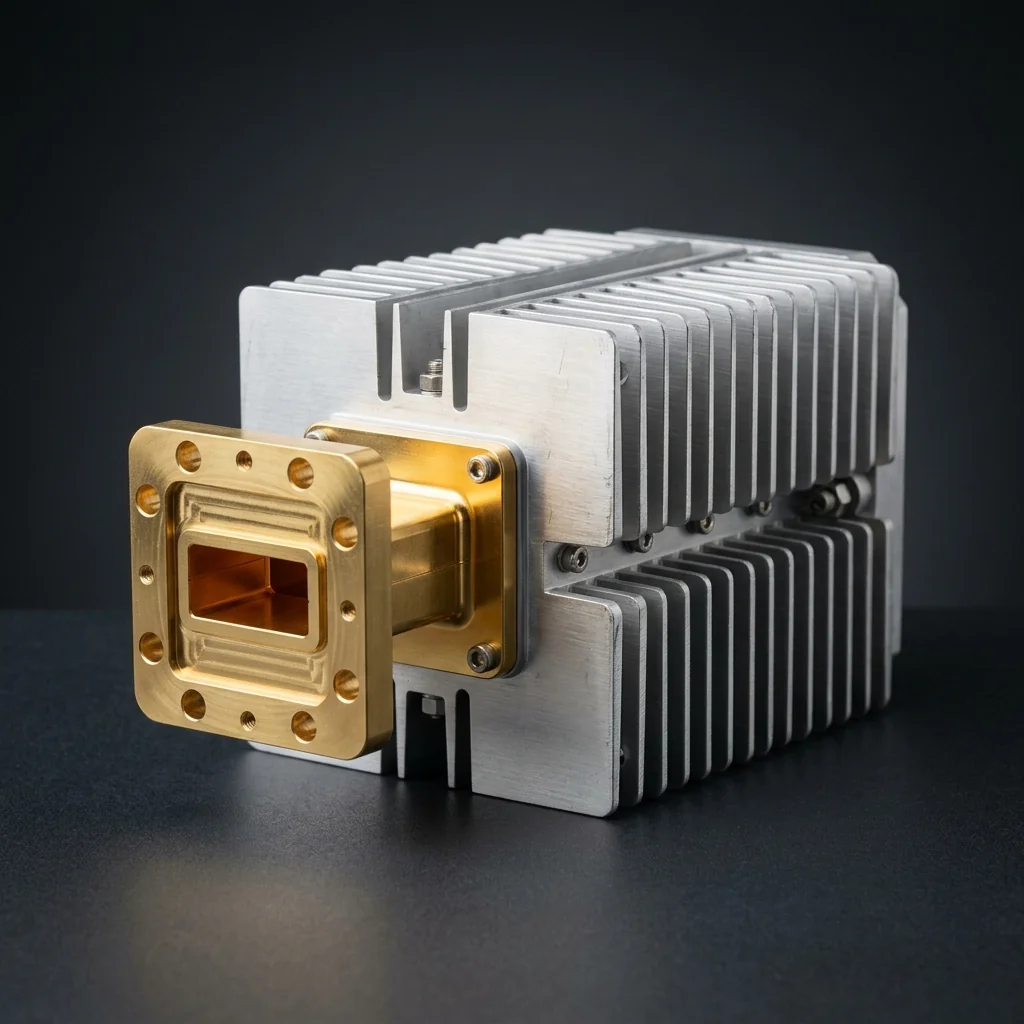
WR-22 High Power Termination
The WR-22 High Power Termination is a precision-engineered waveguide component that absorbs massive amounts of RF energy, safely dissipating it as heat to prevent signal reflection. It is specifically designed for the 33 - 50 GHz frequency range, serving as a critical building block in Q-Band infrastructure.
High-power terminations feature a wedge-shaped ceramic or silicon-carbide absorbing element bonded to a large external heatsink with cooling fins to maximize thermal convection. WR-22 operates in the Q-Band (33-50 GHz), sitting right above the Ka-band. Its 0.224" x 0.112" aperture requires precise CNC machining, as surface roughness begins to significantly impact insertion loss at these frequencies.
Key Features
High Power Capacity
Rated for sustained high-power RF absorption with integrated thermal management for reliable operation.
Heat Dissipation
Cooling fin heatsink design provides maximum thermal dissipation for continuous high-power operation.
Rugged Construction
Heavy-duty OFHC copper body engineered for demanding transmitter test and system burn-in environments.
Full-Band Coverage
Maintains excellent VSWR and return loss across the complete operating bandwidth even at elevated power levels.
Q-Band Use Cases
Radio Astronomy
Molecular cloud mapping
Q-Band Satcom
Next-gen broadband links
Military Data
High-capacity secure comms
Test Equipment
Vector network analysis
More High Power Terminations
Frequently Asked Questions
What happens if a high power termination overheats?+
If the absorbing wedge exceeds its thermal limit, it can crack or outgas. More importantly, as it heats up, its electrical resistance changes, ruining the impedance match and causing massive RF reflections (high VSWR) back into your amplifier.
What are the main applications for WR-22 Q-Band components?+
WR-22 is heavily utilized in advanced satellite communications (V-band/Q-band uplinks) to escape the congested Ka-band. It is also a critical band for radio astronomy, specifically for mapping complex molecules in deep space.
How does surface roughness affect WR-22?+
At 50 GHz, the skin depth of copper is incredibly thin (less than 0.3 micrometers). If the interior machining marks of the WR-22 component are larger than the skin depth, the RF current is forced to travel up and down the microscopic ridges, exponentially increasing resistive heating and insertion loss.