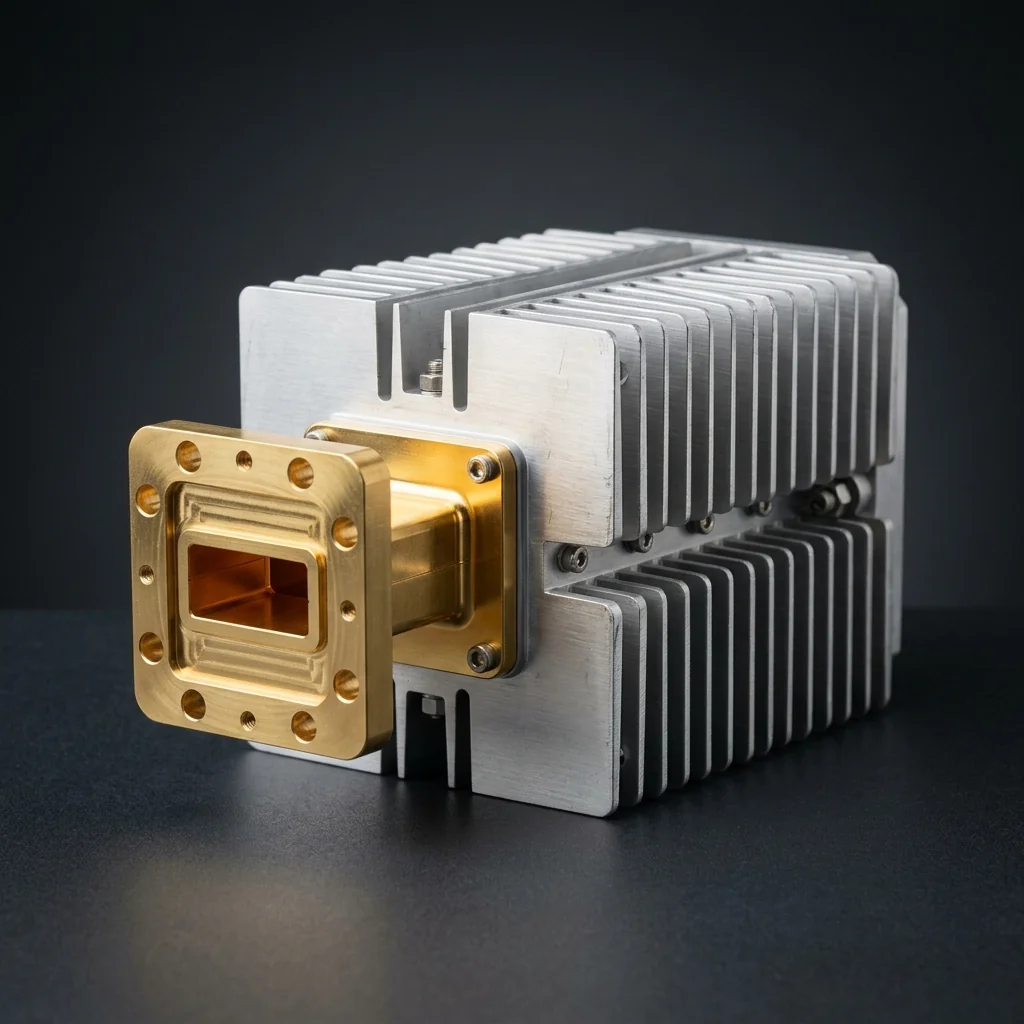
WR-12 High Power Termination
The WR-12 High Power Termination is a precision-engineered waveguide component that absorbs massive amounts of RF energy, safely dissipating it as heat to prevent signal reflection. It is specifically designed for the 60 - 90 GHz frequency range, serving as a critical building block in E-Band infrastructure.
High-power terminations feature a wedge-shaped ceramic or silicon-carbide absorbing element bonded to a large external heatsink with cooling fins to maximize thermal convection. Operating in the 60-90 GHz E-Band, WR-12 is the backbone of modern 71-86 GHz high-capacity telecom links. The tiny 0.122" x 0.061" aperture requires anti-cocking flanges to prevent catastrophic misalignment.
Key Features
High Power Capacity
Rated for sustained high-power RF absorption with integrated thermal management for reliable operation.
Heat Dissipation
Cooling fin heatsink design provides maximum thermal dissipation for continuous high-power operation.
Rugged Construction
Heavy-duty OFHC copper body engineered for demanding transmitter test and system burn-in environments.
Full-Band Coverage
Maintains excellent VSWR and return loss across the complete operating bandwidth even at elevated power levels.
E-Band Use Cases
E-Band Backhaul
71-86 GHz point-to-point
Telecom Backbone
Fiber-optic extension
Collision Avoidance
Advanced vehicular radar
High-Res Imaging
Security scanning systems
More High Power Terminations
Frequently Asked Questions
What happens if a high power termination overheats?+
If the absorbing wedge exceeds its thermal limit, it can crack or outgas. More importantly, as it heats up, its electrical resistance changes, ruining the impedance match and causing massive RF reflections (high VSWR) back into your amplifier.
Why is WR-12 critical for telecom backhaul?+
The FCC opened the 71-76 GHz and 81-86 GHz bands for ultra-high-capacity point-to-point microwave links. WR-12 components are the physical standard for routing these E-Band signals from the transceiver to the parabolic dish, enabling 10+ Gbps data rates where fiber is too expensive to lay.
What is an anti-cocking flange on WR-12?+
At E-Band frequencies, if a flange is bolted together unevenly (cocked), the microscopic gap will leak massive amounts of RF energy and ruin the VSWR. Anti-cocking flanges have an outer rim that guarantees the mating surfaces remain perfectly parallel during tightening.