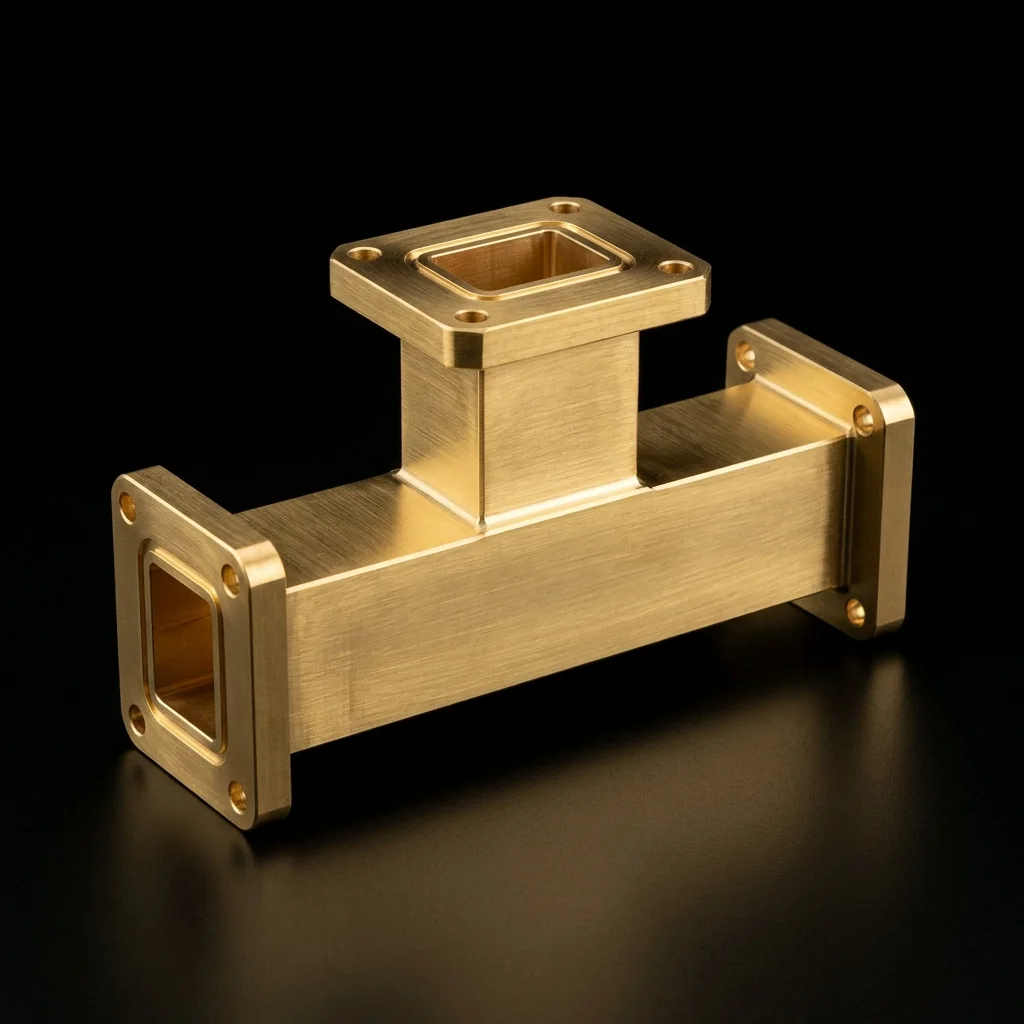
WR-05 Waveguide Tee
The WR-05 Waveguide Tee is a precision-engineered waveguide component that splits a single millimeter-wave signal into two paths, or combines two signals together. It is specifically designed for the 140 - 220 GHz frequency range, serving as a critical building block in G-Band infrastructure.
Available in E-plane (series) or H-plane (shunt) configurations, the Tee creates a precision 3-port junction. Due to the physics of the junction, a perfect match at all three ports requires an internal matching post. WR-05 (G-Band, 140-220 GHz) components cross into the Terahertz gap. With an aperture of just 0.051" x 0.0255", these components are primarily used in high-end scientific radiometry and cryogenic test environments.
Key Features
Dual Configuration
Available in E-plane (series) and H-plane (shunt) configurations to meet different signal phase and power division requirements.
Precision Port Alignment
CNC-machined port interfaces with tight tolerances ensure accurate waveguide alignment and repeatable flange mating on all three ports.
Low Junction Loss
Optimized tee geometry minimizes mismatch loss at the three-port intersection, maintaining signal integrity across the full operating bandwidth.
Gold-Plated Construction
OFHC copper body with gold plating provides excellent conductivity, corrosion resistance, and consistent long-term electrical performance.
G-Band Use Cases
Atmospheric Science
Radiometric Earth observation
THz Imaging
High-res security scanning
Cryogenic Test
Low-heat-load signal routing
Deep Space
Interstellar molecule detection
More Waveguide Tees
Frequently Asked Questions
What is a Magic Tee?+
A Magic Tee is a specialized 4-port component that combines an E-plane Tee and an H-plane Tee into a single unit. It acts as a 180-degree hybrid coupler, perfectly isolating the E and H ports from each other.
How does WR-05 perform in cryogenic systems?+
Waveguide carries far less heat down a cold chain than coaxial cable of equivalent bandwidth. WR-05 can route G-band signals into a cryostat while limiting the thermal load reaching the cold stage, which is why thin-wall waveguide runs are common in low-temperature test setups.
Can you use standard flanges on WR-05?+
No. WR-05 exclusively uses precision dowel-pinned flanges (like the UG-387/U-Mod) because human hands cannot reliably align a 1.2mm wide hole visually. The precision steel pins force the microscopic apertures to align perfectly.