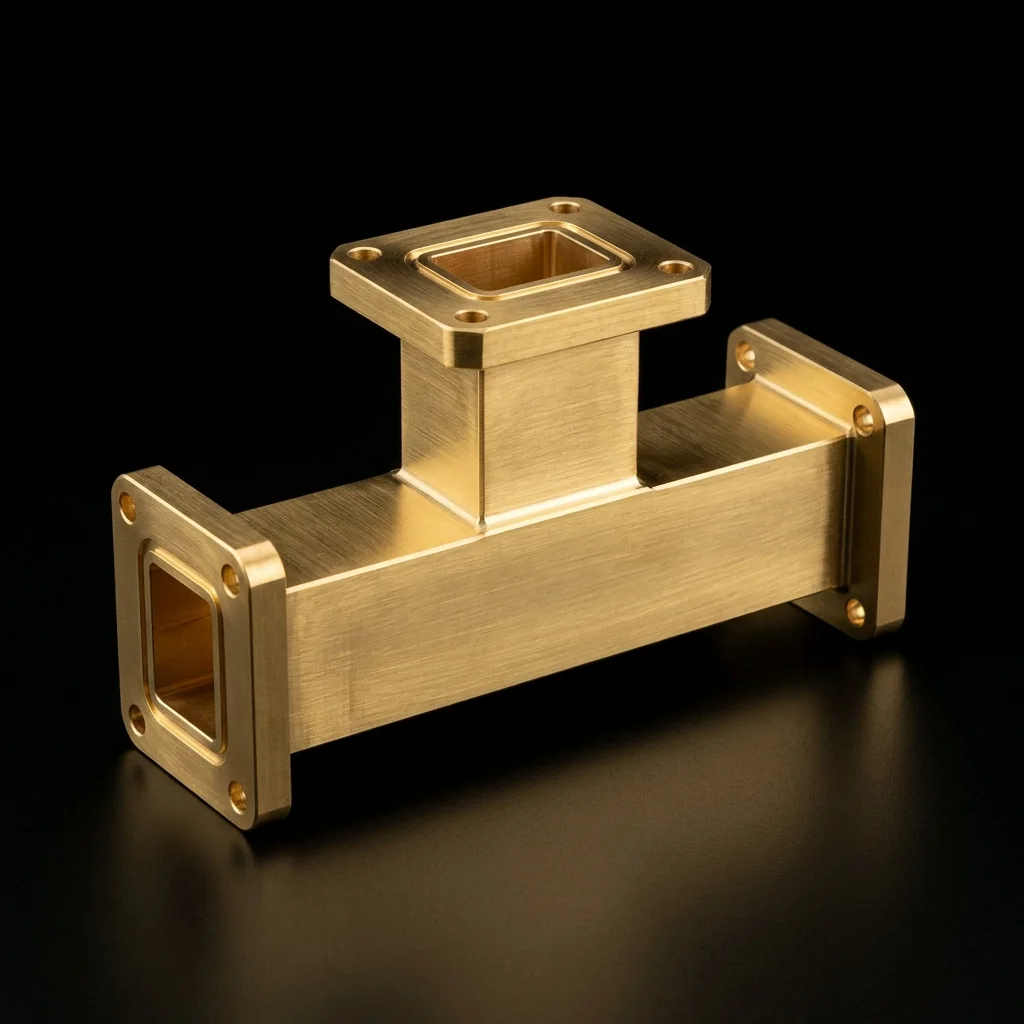
WR-22 Waveguide Tee
The WR-22 Waveguide Tee is a precision-engineered waveguide component that splits a single millimeter-wave signal into two paths, or combines two signals together. It is specifically designed for the 33 - 50 GHz frequency range, serving as a critical building block in Q-Band infrastructure.
Available in E-plane (series) or H-plane (shunt) configurations, the Tee creates a precision 3-port junction. Due to the physics of the junction, a perfect match at all three ports requires an internal matching post. WR-22 operates in the Q-Band (33-50 GHz), sitting right above the Ka-band. Its 0.224" x 0.112" aperture requires precise CNC machining, as surface roughness begins to significantly impact insertion loss at these frequencies.
Key Features
Dual Configuration
Available in E-plane (series) and H-plane (shunt) configurations to meet different signal phase and power division requirements.
Precision Port Alignment
CNC-machined port interfaces with tight tolerances ensure accurate waveguide alignment and repeatable flange mating on all three ports.
Low Junction Loss
Optimized tee geometry minimizes mismatch loss at the three-port intersection, maintaining signal integrity across the full operating bandwidth.
Gold-Plated Construction
OFHC copper body with gold plating provides excellent conductivity, corrosion resistance, and consistent long-term electrical performance.
Q-Band Use Cases
Radio Astronomy
Molecular cloud mapping
Q-Band Satcom
Next-gen broadband links
Military Data
High-capacity secure comms
Test Equipment
Vector network analysis
More Waveguide Tees
Frequently Asked Questions
What is a Magic Tee?+
A Magic Tee is a specialized 4-port component that combines an E-plane Tee and an H-plane Tee into a single unit. It acts as a 180-degree hybrid coupler, perfectly isolating the E and H ports from each other.
What are the main applications for WR-22 Q-Band components?+
WR-22 is heavily utilized in advanced satellite communications (V-band/Q-band uplinks) to escape the congested Ka-band. It is also a critical band for radio astronomy, specifically for mapping complex molecules in deep space.
How does surface roughness affect WR-22?+
At 50 GHz, the skin depth of copper is incredibly thin (less than 0.3 micrometers). If the interior machining marks of the WR-22 component are larger than the skin depth, the RF current is forced to travel up and down the microscopic ridges, exponentially increasing resistive heating and insertion loss.