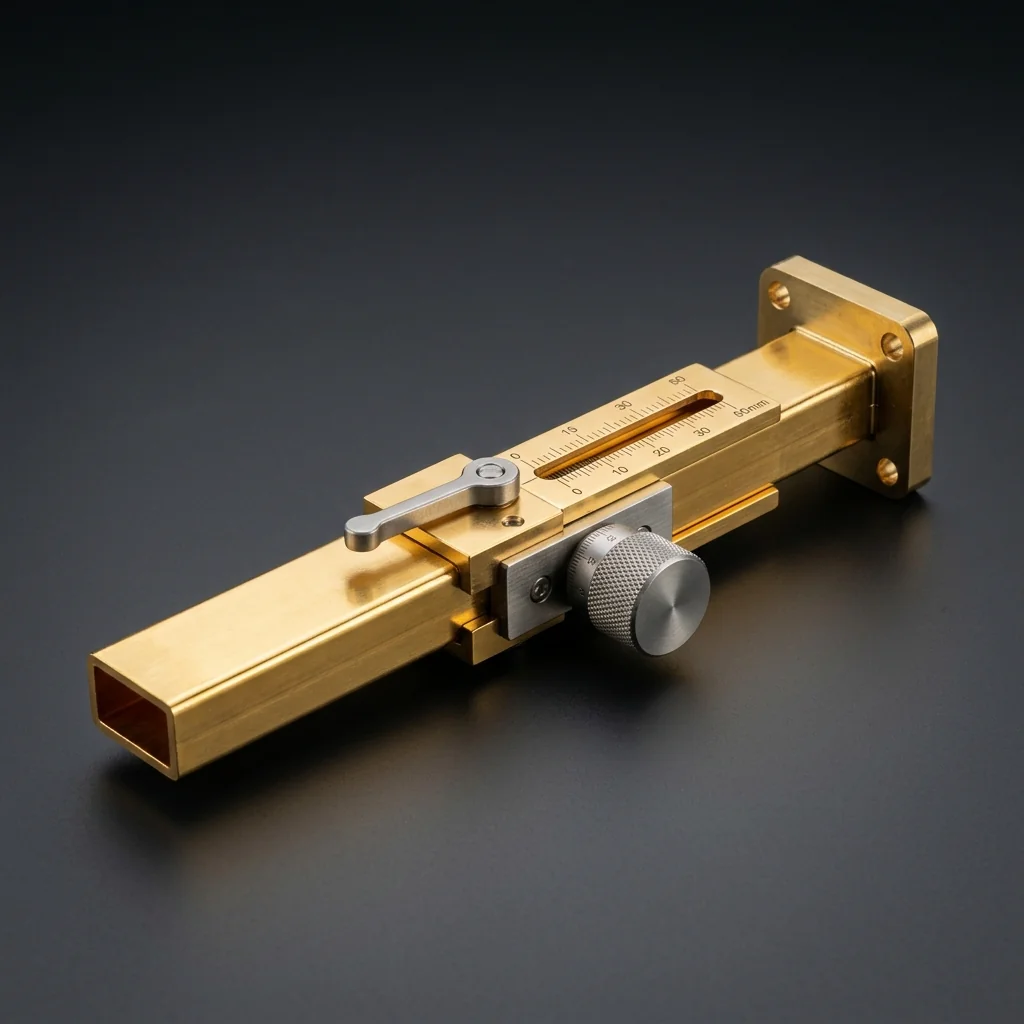
WR-05 Sliding Matched Termination
The WR-05 Sliding Matched Termination is a precision-engineered waveguide component that features an adjustable absorbing element for isolating and measuring residual reflections in test setups. It is specifically designed for the 140 - 220 GHz frequency range, serving as a critical building block in G-Band infrastructure.
The absorbing wedge is attached to a micrometer. By physically sliding the wedge back and forth, the phase of the termination reflection changes, allowing engineers to mathematically cancel out system errors. WR-05 (G-Band, 140-220 GHz) components cross into the Terahertz gap. With an aperture of just 0.051" x 0.0255", these components are primarily used in high-end scientific radiometry and cryogenic test environments.
Key Features
Adjustable Match
Sliding mechanism allows precise positioning of the absorptive element for optimized impedance matching at the target frequency.
Calibration Grade
Designed to calibration kit standards for use as a matched load reference in TRL and other calibration procedures.
Low Residual VSWR
When properly adjusted, achieves very low return loss for accurate reference plane establishment and measurement confidence.
Precision Mechanism
Smooth, low-friction sliding action with precision-machined internal bore for repeatable, accurate adjustments.
G-Band Use Cases
Atmospheric Science
Radiometric Earth observation
THz Imaging
High-res security scanning
Cryogenic Test
Low-heat-load signal routing
Deep Space
Interstellar molecule detection
More Sliding Matched Terminations
Frequently Asked Questions
Why does the termination need to slide?+
No termination is perfect. By sliding the load over at least one-half wavelength, you can observe the phase ripple of the imperfection on a VNA. You can then mathematically separate the reflection of the load from the reflection of the actual device under test.
How does WR-05 perform in cryogenic systems?+
Waveguide carries far less heat down a cold chain than coaxial cable of equivalent bandwidth. WR-05 can route G-band signals into a cryostat while limiting the thermal load reaching the cold stage, which is why thin-wall waveguide runs are common in low-temperature test setups.
Can you use standard flanges on WR-05?+
No. WR-05 exclusively uses precision dowel-pinned flanges (like the UG-387/U-Mod) because human hands cannot reliably align a 1.2mm wide hole visually. The precision steel pins force the microscopic apertures to align perfectly.