What Phase Noise Actually Is
An ideal oscillator generates a pure sinusoidal signal at exactly one frequency. In the frequency domain, it would appear as a perfect, infinitely narrow spectral line. In reality, no oscillator is perfect. Random fluctuations in the oscillator's active device, resonator, and power supply cause the instantaneous frequency and phase to jitter around the nominal value. This jitter spreads the spectral energy away from the carrier into "noise skirts" that fall off with increasing offset frequency. This spectral spreading is phase noise.
Phase noise is measured in dBc/Hz: decibels relative to the carrier power, measured in a 1 Hz bandwidth at a specified offset frequency. A measurement of -100 dBc/Hz at 10 kHz offset means that the noise power in a 1 Hz band located 10 kHz away from the carrier is 100 dB below the carrier power. Lower numbers (more negative) are better.
Why Phase Noise Matters
Radar Systems
In a pulsed Doppler radar, the local oscillator (LO) phase noise directly determines the minimum detectable target velocity. The radar measures Doppler shift by comparing the phase of the return signal to the phase of the transmitted signal. If the LO phase noise at the Doppler offset frequency is higher than the return signal level, the target is invisible. For a ground-based weather radar operating at X-band, an LO phase noise of -90 dBc/Hz at 1 kHz offset might be adequate. For a military airborne radar tracking slow-moving ground vehicles, phase noise of -120 dBc/Hz or better at 1 kHz is required.
Digital Communications
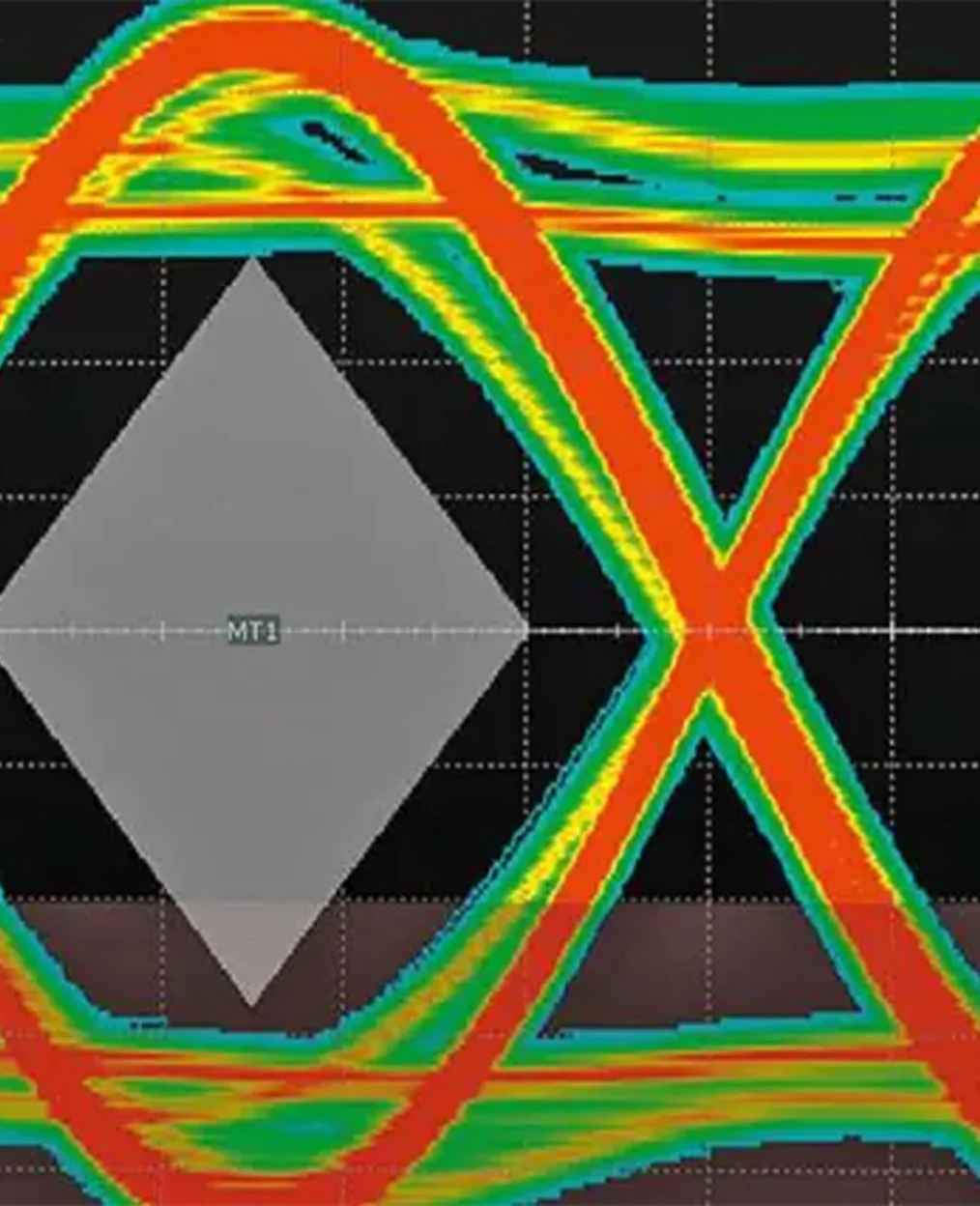
In high-order modulation schemes (64-QAM, 256-QAM), the constellation points are closely spaced. Phase noise on the LO causes the received constellation points to rotate randomly around their ideal positions. If the phase rotation exceeds the decision boundary between adjacent points, bit errors occur. 5G NR systems operating at 39 GHz with 256-QAM require extremely low phase noise LOs to maintain acceptable Error Vector Magnitude (EVM).
Leeson's Equation (simplified):
L(fm) = 10 log[ (2FkT/Ps) · (1 + (f0/2QLfm)²) · (1 + fc/fm) ]
Where F = device noise figure, QL = loaded Q of the resonator, fm = offset frequency, fc = flicker corner. The resonator Q is the most powerful lever: doubling Q improves close-in phase noise by 6 dB.
Sources of Phase Noise
| Noise Source | Frequency Dependence | Dominant Region | Mitigation |
|---|---|---|---|
| Flicker (1/f) Noise | 1/f³ slope | Close-in (< 10 kHz offset) | Low-noise active devices, high-Q resonator |
| Thermal (White) Noise | Flat (1/f² inside loop BW) | Far-out (> 100 kHz offset) | Higher signal power, lower noise figure |
| Power Supply Noise | Discrete spurs | Multiples of line frequency | Regulation, filtering, shielding |
| Vibration (Microphonics) | Discrete spurs at vibration freq | Mechanical resonances | Vibration isolation, rigid mounting |
Measurement Methodology
During my time at Rohde & Schwarz, I performed hundreds of phase noise measurements. The standard method uses a phase noise analyzer (such as the R&S FSWP) that employs a cross-correlation technique. Two independent measurement channels simultaneously sample the oscillator under test. Because each channel has its own independent noise, cross-correlating the two measurements cancels the analyzer's internal noise, revealing only the DUT's phase noise. This technique provides measurement sensitivity well below -170 dBc/Hz at far-out offsets.
For waveguide oscillators at Ka-band and above, the measurement setup requires careful attention to the RF signal path. The waveguide-to-coaxial transitions, cable losses, and connector quality all affect the noise floor of the measurement. We recommend using precision waveguide components (including our low-power terminations on unused ports) to minimize reflections that can corrupt the phase noise measurement.
Conclusion
Phase noise is the fundamental metric that separates a precision signal source from a noisy one. It determines radar sensitivity, communications capacity, and test measurement accuracy. Understanding Leeson's equation, identifying the dominant noise sources, and using proper measurement techniques are essential skills for any engineer working with microwave and millimeter wave systems.
RF Essentials manufactures precision waveguide components for phase noise measurement systems, including low-reflection terminations and straight sections.
Frequently Asked Questions
What is phase noise and how is it specified?
Random fluctuations in an oscillator's active device, resonator, and power supply make its instantaneous frequency and phase jitter, spreading spectral energy into noise skirts that fall off with offset. That spreading is phase noise. It is specified in dBc per hertz, decibels relative to the carrier measured in a 1 Hz bandwidth at a given offset, so minus 100 dBc per hertz at 10 kHz means the noise in a 1 Hz band 10 kHz from the carrier is 100 dB below it. More negative is better.
Why does phase noise matter in radar and digital communications?
In a pulsed Doppler radar, the local oscillator phase noise at the Doppler offset sets the minimum detectable velocity; if it exceeds the return level, a slow-moving target is invisible, which is why airborne radars demand minus 120 dBc per hertz or better at 1 kHz. In 64-QAM and 256-QAM links, phase noise rotates the closely spaced constellation points past their decision boundaries, raising error vector magnitude and causing bit errors.
What is the biggest lever for reducing close-in phase noise?
The loaded Q of the resonator. Leeson's equation shows close-in phase noise scaling inversely with the square of Q, so doubling Q improves it by 6 dB, which is why high-Q dielectric and sapphire resonators dominate low-noise sources. Flicker, or 1 over f, noise dominates closest to the carrier and is reduced with low-noise devices, while thermal noise dominates far out and is reduced with higher signal power and lower noise figure.