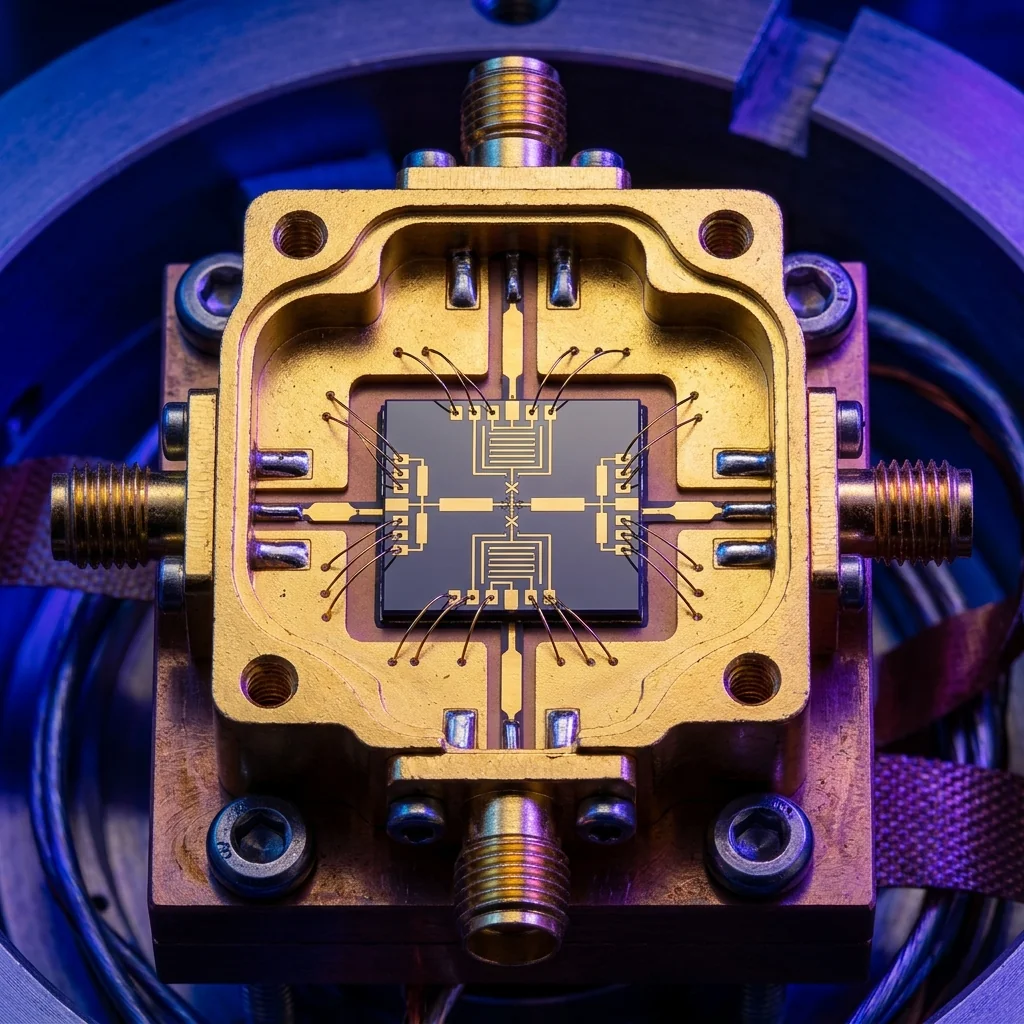
The Josephson Parametric Amplifier (JPA) is the enabling technology for high-fidelity qubit readout in superconducting quantum computers. It achieves what no semiconductor amplifier can: amplification with noise at the quantum limit, adding only half a photon of noise to the signal. This performance is not merely a specification advantage over HEMT amplifiers (which add thousands of photons of noise at 5 GHz). It is an absolute requirement. Without quantum-limited amplification, the readout signal from a qubit would be buried in amplifier noise, and single-shot state discrimination would fail.
The Parametric Amplification Principle
Parametric amplification works by modulating a parameter of a resonant circuit at twice the signal frequency. In a JPA, the nonlinear parameter is the inductance of a Josephson junction. A Josephson junction is a weak link between two superconductors (typically a thin aluminum oxide barrier between niobium electrodes) that exhibits a current-dependent inductance: L_J = Φ₀ / (2π × I_c × cos(φ)), where Φ₀ is the flux quantum, I_c is the junction critical current, and φ is the junction phase.
By applying a strong "pump" tone at or near the resonant frequency of the JPA circuit, the pump current modulates the junction inductance, which modulates the resonant frequency, which transfers energy from the pump to the signal. The result is coherent amplification with noise limited by quantum vacuum fluctuations rather than by the thermal noise of a resistive element.
Degenerate vs. Non-Degenerate Operation
| Parameter | Degenerate (pump = 2 × signal) | Non-Degenerate (pump ≠ 2 × signal) |
|---|---|---|
| Pump frequency | 2f_signal | f_signal + f_idler |
| Output | Amplified signal only | Amplified signal + idler |
| Phase sensitivity | Yes (squeezing) | No (phase-preserving) |
| Added noise | 0 photons (phase-sensitive) | 0.5 photons (quantum limit) |
| Practical use | Squeezed state generation | Standard qubit readout |
Most qubit readout systems use non-degenerate JPAs in phase-preserving mode, which adds exactly 0.5 photons of noise. This is the quantum limit for phase-preserving amplification, a fundamental constraint imposed by the Heisenberg uncertainty principle. No amplifier of any technology can beat this limit while preserving both quadratures of the signal.
JPA Circuit Architectures
Single-Junction Reflection Amplifier
The simplest JPA consists of a single Josephson junction embedded in a resonant circuit (typically a quarter-wave coplanar waveguide resonator). The signal enters through a coupling capacitor, reflects off the junction, and exits through the same port with gain. A microwave circulator routes the input signal to the JPA and the amplified output to the next stage. The circulator must provide 20 dB or better isolation to prevent the amplified signal from feeding back to the input.
SQUID-Based JPA
A SQUID (Superconducting Quantum Interference Device) loop replaces the single junction with two junctions in a loop. An external magnetic flux through the loop provides a second control knob for tuning the JPA's resonant frequency. This allows the JPA to be tuned across a range of 1 to 2 GHz by adjusting the DC flux bias, enabling a single JPA design to serve multiple qubit readout frequencies. The precision microwave components in the JPA's input and output lines must be non-magnetic to avoid disturbing the sensitive flux bias.
Gain-Bandwidth Product: A JPA's gain-bandwidth product is fundamentally limited by the coupling rate between the resonator and the external transmission line. A typical JPA achieves 20 dB of gain over a 10 to 30 MHz bandwidth, giving a gain-bandwidth product of 100 to 300 MHz. This is sufficient for single-qubit readout (which requires approximately 5 to 10 MHz of bandwidth) but inadequate for multiplexed readout of many qubits through a single line. This bandwidth limitation is the primary motivation for Traveling Wave Parametric Amplifiers (TWPAs).
Traveling Wave Parametric Amplifiers
TWPAs overcome the JPA's bandwidth limitation by distributing the parametric interaction along a long transmission line (thousands of Josephson junctions in series) rather than concentrating it in a single resonant circuit. The signal and pump co-propagate along the line, with energy transferring continuously from pump to signal. Because there is no resonant enhancement, the bandwidth is set by the phase-matching condition rather than by a resonator Q-factor.
Current TWPAs achieve 20 dB of gain across 4 to 8 GHz of bandwidth, enabling simultaneous amplification of dozens to hundreds of multiplexed qubit readout signals. The noise performance approaches the quantum limit across the full bandwidth, though the added noise is typically 1 to 3 photons rather than the 0.5 photons achieved by the best JPAs.
| Specification | JPA | TWPA (JJ-based) | TWPA (KI-based) | HEMT (4K) |
|---|---|---|---|---|
| Gain | 20-25 dB | 15-20 dB | 15-20 dB | 35-40 dB |
| Bandwidth | 10-30 MHz | 4-8 GHz | 2-6 GHz | 4-12 GHz |
| Added noise (photons) | 0.5 | 1-3 | 2-5 | 10-30 |
| Operating temp | 10-30 mK | 10-30 mK | 10-30 mK | 4 K |
| Input saturation | -120 dBm | -100 dBm | -95 dBm | -50 dBm |
| Pump power | -40 to -30 dBm | -20 to -10 dBm | -10 to 0 dBm | N/A |
Integration into the Readout Chain
A JPA operates at the mixing chamber stage of a dilution refrigerator (10 to 30 mK). The integration requirements are stringent:
- Magnetic shielding: the SQUID loop is sensitive to stray magnetic fields. A combination of mu-metal and superconducting aluminum shielding surrounds the JPA package to attenuate external fields by 60 to 80 dB.
- Cryogenic circulator: a ferrite circulator operating at millikelvin temperatures routes the signal to and from the JPA. The circulator must maintain 20 dB isolation and 0.5 dB insertion loss at operating temperature.
- Pump line filtering: the pump tone must reach the JPA without injecting thermal noise from higher temperature stages. Attenuators and bandpass filters on the pump line reduce noise while passing the pump.
- DC flux bias line: for SQUID-based JPAs, a superconducting wire delivers DC current to set the operating point. This line must be heavily filtered to prevent RF noise from modulating the JPA's gain.
The precision terminations and attenuators used in the JPA's pump and signal lines must be fabricated from non-magnetic materials and must maintain their specified performance at millikelvin temperatures.
Frequently Asked Questions
Why do superconducting qubits need a Josephson parametric amplifier?
The readout signal leaving a qubit is only a few photons, and a 4 K HEMT amplifier adds thousands of photons of noise at 5 GHz, which would bury it. A JPA amplifies at the quantum limit, adding only half a photon, so the measurement can distinguish the ground and excited states in a single shot. Without it, single-shot state discrimination simply fails, so it is an absolute requirement rather than a refinement.
How does parametric amplification work in a JPA?
The nonlinear element is a Josephson junction whose inductance depends on the current through it. A strong pump tone applied near the circuit's resonance modulates that inductance, which modulates the resonant frequency and transfers energy from the pump into the signal. Because the amplification is limited by quantum vacuum fluctuations rather than the thermal noise of a resistor, a JPA can reach the quantum noise limit that semiconductor amplifiers cannot.
Why are traveling wave parametric amplifiers replacing JPAs for multiplexed readout?
A JPA's gain-bandwidth product limits it to roughly 10 to 30 MHz, which is enough for a single qubit but not for many. A TWPA distributes the parametric interaction along thousands of Josephson junctions in series, giving about 20 dB of gain across the full 4 to 8 GHz band. That is wide enough to amplify dozens to hundreds of multiplexed readout tones at once, at the modest cost of 1 to 3 photons of added noise instead of 0.5.