The RF Plumbing Problem in Quantum Computing
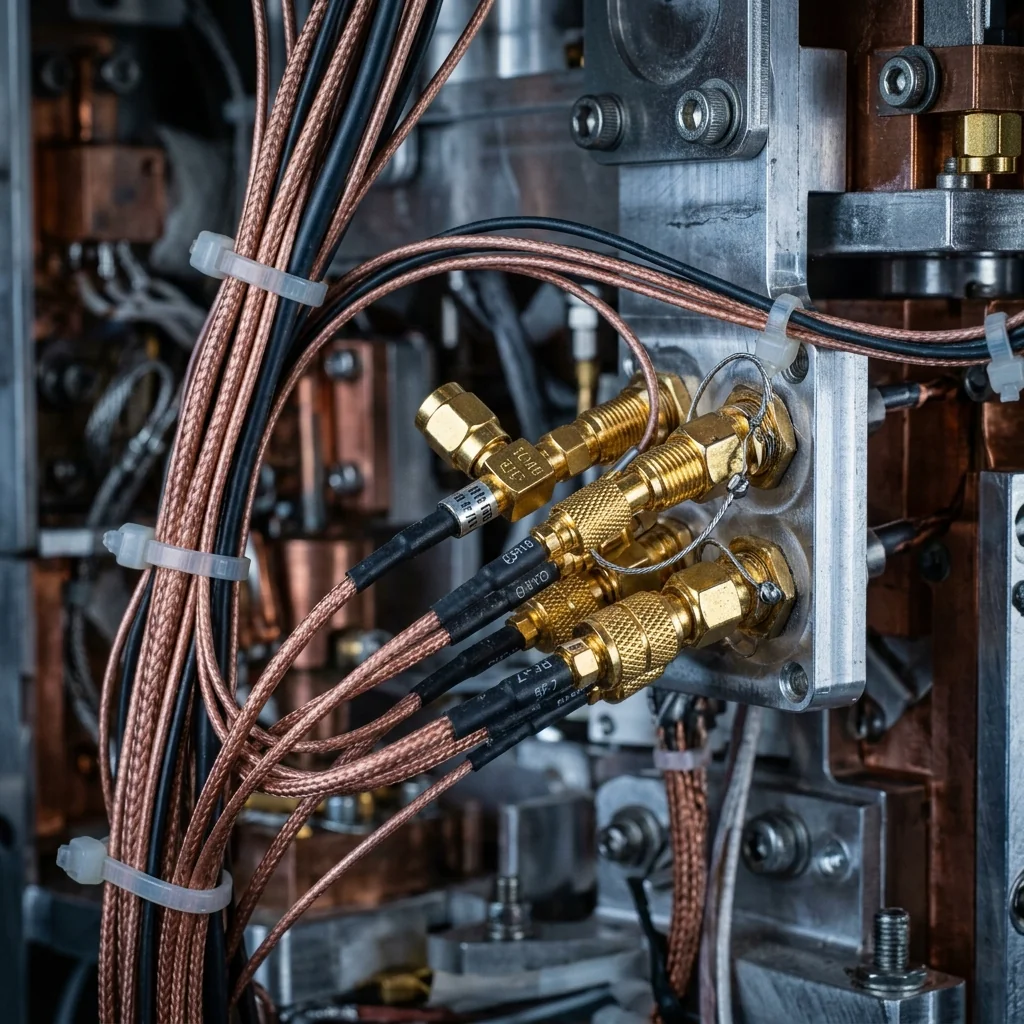
When I speak with system architects building superconducting quantum computers, the conversation rarely starts with qubits or coherence times. It almost always starts with plumbing. Specifically, the massive volume of RF cabling, attenuators, isolators, and terminations required to connect room-temperature control electronics to quantum processors sitting at the bottom of a dilution refrigerator at 10 millikelvin (mK).
In standard RF engineering, our primary enemy is insertion loss. We obsess over using high-conductivity materials like OFHC copper and silver plating to ensure maximum power transfer. But the quantum computing frontier completely inverts these priorities. In a dilution refrigerator, thermal conductivity is a vastly greater threat than electrical insertion loss.
If we ran a standard copper coaxial cable from the 300 Kelvin (room temperature) flange down to the 10 mK mixing chamber, the copper would act as a massive thermal short. It would dump room-temperature heat directly onto the quantum processor, completely overwhelming the cooling power of the refrigerator and destroying the fragile quantum states.
Thermal Noise and Johnson-Nyquist Constraints
The core mechanism used to control and read out superconducting qubits (such as transmons) relies on microwave pulses, typically in the 4 GHz to 8 GHz range. These signals are incredibly weak. A single microwave photon at 5 GHz carries an energy of roughly 3 × 10-24 Joules.
At these microscopic energy levels, the ambient thermal energy of the environment becomes a destructive source of noise. Every component in the signal chain generates thermal noise, governed by the Johnson-Nyquist theorem.
P = kB × T × Δf
Where kB = Boltzmann's constant (1.38 × 10⁻²³ J/K), T = Absolute temperature in Kelvin, Δf = Bandwidth in Hertz
To prevent thermal noise from obliterating the single-photon microwave signals required for quantum operations, the physical temperature of the environment, and all RF components within it, must be reduced to near absolute zero.
Attenuating Thermal Noise down the Cold Column
Because the control electronics sit at 300K, the microwave control pulses must travel down through multiple temperature stages (50K, 4K, 100mK, 10mK) to reach the processor. Along the way, we must progressively strip out the room-temperature thermal noise that travels down the cable.
We do this using cryogenic microwave attenuators. A 20 dB attenuator placed at the 4K stage knocks the incoming microwave signal down by a factor of 100, but crucially, it also drops the incoming 300K thermal noise down by a factor of 100. Because the attenuator itself is physically anchored to the 4K copper plate, the new noise it re-injects into the line is only the thermal noise of a 4K body, vastly lower than what came in.
This is why you see massive blocks of attenuators mounted at every stage of a dilution refrigerator. By cascading attenuators (e.g., 20 dB at 4K, 20 dB at 100mK, and 20 dB at 10mK), we progressively chill the electromagnetic field, arriving at the qubit with a pristine, cold microwave pulse.
Material Science: The Superconducting Transition
To prevent heat from traveling down the outer shield and center conductor of the coaxial lines, we must abandon copper for materials that are terrible thermal conductors. However, poor thermal conductors are usually poor electrical conductors, meaning high insertion loss.
From 300K down to 4K, we typically use alloys like Cupro-Nickel (CuNi) or Beryllium Copper (BeCu). These offer a tolerable compromise: bad enough at conducting heat to save the fridge, but good enough at conducting electricity to let the microwave signal survive.
Below 4K, the physics changes entirely. The temperatures are cold enough to exploit superconductivity. For the final runs from the 4K stage down to the 10mK processor, we use Niobium-Titanium (NbTi) semi-rigid coaxial cables.
| Cable Material | Temp Stage | Thermal Conductivity | Loss at 5 GHz | Primary Advantage |
|---|---|---|---|---|
| Copper (OFHC) | Not used across stages | Extremely High (~400 W/m·K) | Very Low | Excellent RF performance, but causes thermal failure. |
| Cupro-Nickel (CuNi) | 300K to 4K | Very Low (~30 W/m·K) | High (requires amplification) | Excellent thermal isolation to protect the 4K stage. |
| Beryllium Copper (BeCu) | 300K to 4K | Moderate (~100 W/m·K) | Moderate | Good balance of thermal blocking and RF transmission. |
| Niobium-Titanium (NbTi) | 4K to 10mK | Virtually Zero (at T < Tc) | Zero (Superconducting) | Total thermal isolation with zero insertion loss. |
When NbTi drops below its critical temperature (Tc ~9.2K), it becomes a superconductor. Its electrical resistance drops to exactly zero, meaning the microwave signal travels with zero insertion loss. Miraculously, when a metal becomes a superconductor, it also stops conducting heat via electrons. NbTi effectively becomes a thermal insulator while functioning as a perfect electrical conductor. This material property is what makes scaling quantum processors physically possible.
Thermalizing Components and Terminations
It's not just the cables. Every passive component, terminations, directional couplers, and circulators, must be meticulously "thermalized." If a matched load (termination) is floating in a vacuum, any RF energy it absorbs will cause it to heat up. In a 10mK environment, even a microwatt of dissipated power is a catastrophic heat load.
At RF Essentials, when we evaluate components for cryogenic deployment, the mechanical packaging is heavily scrutinized. The body of a termination must maintain an absolute, flawless mechanical contact with the refrigerator's cold plate. This means machining housings perfectly flat, using gold plating to prevent oxide layers that could act as thermal barriers, and deploying specialized thermal interface materials (TIMs) or oxygen-free copper braiding to ensure any dissipated heat is instantly wicked away into the massive cooling capacity of the dilution fridge.
The Scaling Bottleneck
The current architecture of routing individual semi-rigid coaxial cables from room temperature down to each qubit is not sustainable. A 1,000-qubit processor requires thousands of coaxial lines, attenuators, and isolators. The sheer physical volume of the metal, and the passive heat load it introduces, will soon exceed the physical dimensions and cooling power of even the largest commercially available dilution refrigerators.
The industry is aggressively pivoting toward integrated microwave photonics, cryogenic CMOS multiplexing, and superconducting flexible printed circuits to condense these massive RF assemblies. But for the foreseeable future, the integrity of quantum operations remains completely dependent on the precision engineering of discrete cryogenic microwave components. Mastering the delicate balance between thermal isolation and microwave propagation is the true frontier of quantum hardware engineering.
RF Essentials manufactures precision-matched low power terminations and waveguide assemblies for critical measurement and instrumentation systems. All products are made in the USA.
Frequently Asked Questions
Why is thermal conductivity, not insertion loss, the main enemy in cryogenic RF?
Running a standard copper coaxial cable from the 300 K flange down to the 10 mK mixing chamber would act as a thermal short, dumping room-temperature heat directly onto the quantum processor and overwhelming the refrigerator's cooling power. So cryogenic lines deliberately use poor thermal conductors, which inverts the usual RF priority of maximum conductivity. Protecting the cold stages matters more than the last decibel of signal.
How do cryogenic attenuators clean up thermal noise down the cold column?
A 20 dB attenuator drops both the incoming signal and the 300 K thermal noise riding on it by a factor of 100, and because it is anchored to a cold plate it re-injects only the much smaller thermal noise of its own stage. Cascading attenuators, for example 20 dB at 4 K, 20 dB at 100 mK, and 20 dB at 10 mK, progressively chills the electromagnetic field so a pristine, cold microwave pulse reaches the qubit.
Why is niobium-titanium coaxial cable used for the coldest stage?
Below its critical temperature of about 9.2 K, niobium-titanium becomes superconducting, so its electrical resistance drops to exactly zero and the microwave signal travels with zero insertion loss. At the same time, becoming a superconductor stops it conducting heat through electrons, so it also acts as a thermal insulator. That rare combination of perfect electrical conductor and thermal insulator is what makes the 4 K to 10 mK runs possible.