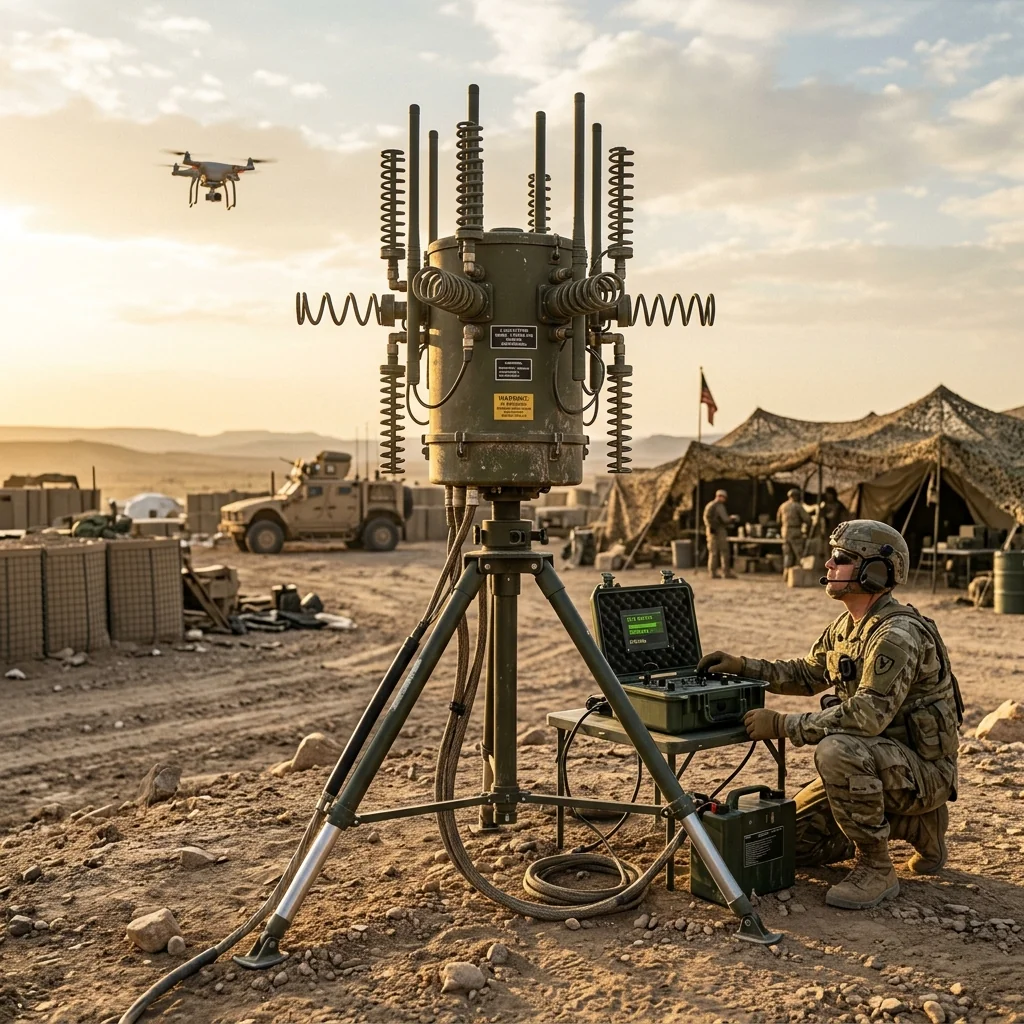
The proliferation of small unmanned aerial systems (sUAS) has created a category of RF engineering problems that did not exist a decade ago. Commercial quadcopters operating on 2.4 GHz and 5.8 GHz ISM bands, often with GNSS-guided autonomous waypoint capabilities, now pose credible security threats to military installations, critical infrastructure, and public events. The defense industry's response has been a rapid evolution in counter-UAS (C-UAS) technology, with RF jamming systems at the center of the technical solution set.
Recent product announcements from defense manufacturers demonstrate the direction the market is heading: compact, rapidly deployable omnidirectional RF jammers capable of disrupting drone control links, video feeds, and satellite navigation signals across a full 360-degree coverage envelope. For RF engineers, these systems represent a fascinating convergence of antenna design, power amplifier engineering, spectral management, and ruggedized packaging.
The RF Problem: Disrupting the Drone Link
Every commercially available drone depends on at least two RF links to function: a command-and-control (C2) link between the operator's controller and the drone, and a GNSS receiver that provides position, navigation, and timing (PNT) data. Many drones also transmit a real-time video downlink, typically on a separate frequency or channel within the same band.
| Link Type | Common Frequencies | Protocol Examples | Jamming Effect |
|---|---|---|---|
| C2 Uplink | 2.4 GHz, 5.8 GHz | DJI OcuSync, Wi-Fi, proprietary | Loss of operator control; triggers failsafe |
| Video Downlink | 2.4 GHz, 5.8 GHz | Analog FPV, digital HD | Loss of situational awareness for operator |
| GNSS | 1.575 GHz (L1), 1.227 GHz (L2) | GPS, GLONASS, BeiDou, Galileo | Loss of position hold; drift or forced landing |
| Remote ID | 2.4 GHz (BLE), 5.8 GHz (Wi-Fi) | ASTM F3411, ASD-STAN | Loss of identification broadcast |
An effective C-UAS jammer must overpower these links within its coverage volume. The fundamental equation is straightforward: the jammer must deliver enough power density at the drone's receiver to exceed the desired signal from the legitimate transmitter (the operator's controller or the GNSS constellation) by a sufficient margin. This is expressed as the jamming-to-signal ratio (J/S).
J/S = Pj + Gj - Lj - (Ps + Gs - Ls)
Where Pj is jammer transmit power, Gj is jammer antenna gain toward the target, Lj is path loss from jammer to drone, and (Ps + Gs - Ls) is the desired signal power at the drone receiver. A J/S ratio of 0 dB indicates the jamming signal equals the desired signal; practical disruption typically requires J/S > 6 dB.
Omnidirectional Antenna Architecture
The defining feature of 360° jammer systems is their omnidirectional radiation pattern in the azimuth plane. This is achieved through antenna arrays that distribute radiating elements around the full circumference of the housing, typically in a cylindrical or polygonal arrangement.
Design Trade-offs
An omnidirectional pattern inherently distributes radiated power across 360°, which reduces the effective radiated power (ERP) in any single direction compared to a directional jammer of the same transmit power. A directional jammer with a 60° beamwidth concentrates its energy into roughly one-sixth of the azimuth plane. An omnidirectional system must compensate for this by either increasing total transmit power or accepting a reduced effective range.
This trade-off is deliberate. Omnidirectional coverage eliminates the need for threat bearing information, mechanical steering, or operator intervention to point the jammer. For rapidly deployable systems protecting a fixed perimeter, this "set and forget" capability is operationally preferable to higher gain in a single direction.
Multi-Band Element Design
Modern C-UAS jammers must cover multiple frequency bands simultaneously. A system jamming 2.4 GHz, 5.2 GHz, 5.8 GHz, and 1.575 GHz (GNSS L1) requires either wideband antenna elements capable of spanning a 3.7:1 bandwidth ratio, or dedicated narrowband elements for each target band. Most practical designs use the latter approach, arranging separate radiating elements for each band around the cylindrical structure.
Each element set must achieve acceptable impedance matching (VSWR < 2:1) across its operating band, maintain pattern uniformity in the azimuth plane, and present adequate gain in the elevation plane to cover the typical engagement geometry: drones approaching at altitudes of 10 to 400 meters at ranges of 500 meters to several kilometers.
Spot Jamming vs. Barrage Jamming
The distinction between these two approaches has significant implications for system design and collateral interference.
Barrage Jamming
A barrage jammer transmits noise or interference across a wide, continuous bandwidth. This approach requires high total power but guarantees coverage of the target signal regardless of its exact frequency, hopping pattern, or channel selection. The drawback is substantial: barrage jamming causes significant collateral interference with legitimate wireless systems, including Wi-Fi networks, Bluetooth devices, and any other equipment operating in the jammed band.
Spot Jamming
Spot jamming concentrates energy on specific frequency channels or narrow bands known to be used by the target drone. This approach requires threat intelligence: the jammer must know which frequencies the drone is using, which can be provided by a co-located RF sensor or detection system. The advantage is significantly reduced collateral interference and more efficient use of transmit power. The same total power budget produces a higher J/S ratio on the target frequency because none of it is wasted on unoccupied spectrum.
Engineering Insight: A 200 W total system power budget distributed as barrage noise across 100 MHz of bandwidth at 2.4 GHz produces a power spectral density of 2 W/MHz. The same 200 W concentrated on a single 20 MHz Wi-Fi channel produces 10 W/MHz, a 7 dB improvement in J/S ratio at the target receiver. This difference can extend effective jamming range by 40-60% for the same total power consumption.
Power Architecture and Thermal Management
C-UAS jammers face a unique thermal challenge: they must generate substantial RF power from compact, sealed enclosures rated for outdoor deployment in extreme temperatures.
Power Amplifier Selection
GaN (gallium nitride) power amplifier technology has become the default choice for modern jammer designs. GaN PA modules offer several advantages that align directly with C-UAS requirements:
- High power density: GaN HEMTs deliver significantly higher output power per unit die area compared to GaAs or LDMOS, enabling compact module designs
- Wideband operation: GaN amplifiers can be designed to cover octave or multi-octave bandwidths, allowing a single PA chain to serve the full 2.4 - 5.8 GHz range
- High junction temperature tolerance: GaN devices operate reliably at junction temperatures exceeding 200°C, providing margin in passively cooled enclosures
- Ruggedness: GaN's breakdown voltage and resistance to load mismatch make it tolerant of the VSWR reflections that occur when the antenna pattern is disturbed by nearby structures
Thermal Dissipation
A system consuming 200 W total and achieving 25% PA efficiency dissipates approximately 150 W as heat. In an IP67-sealed enclosure with no fan or forced air, this heat must be conducted to the external surface and radiated or convected to the ambient environment. At an ambient temperature of +50°C, maintaining junction temperatures below safe limits requires careful thermal stack-up design: thermally conductive interface materials between the PA die and the baseplate, high-conductivity aluminum housing, and maximized external surface area through finning or structural ribbing.
System Integration: From Standalone Jammer to Layered Defense
Modern C-UAS systems are rarely deployed in isolation. An RF jammer is one effector in a broader kill chain that includes detection, identification, tracking, and mitigation. The RF architecture of the complete system typically involves multiple subsystems communicating and coordinating through a command-and-control network.
Detection and Cueing
Before a jammer can be activated, the threat must be detected. Common detection modalities include RF sensing (passive monitoring for drone uplink/downlink emissions), radar (active detection using dedicated C-UAS radar operating at X-band or Ku-band), electro-optical/infrared (EO/IR) cameras, and acoustic sensors. Many systems use multiple detection modalities and fuse the data to improve detection probability and reduce false alarms.
Networked Operation
Multiple jammer units can be networked to create a coordinated jamming field. Each unit operates at lower individual power, reducing the regulatory and electromagnetic compatibility (EMC) burden, while the combined effect provides coverage over a larger area than any single unit. This distributed architecture also provides redundancy: if one unit fails, the remaining units continue to provide coverage with reduced but non-zero capability.
API and Software Integration
The trend toward software-controlled jamming reflects the broader shift in defense electronics toward open architecture and programmable systems. API-based control allows the jammer to be activated, configured, and coordinated by external command systems without manual intervention. This enables automated engagement sequences: detect a drone via RF sensor, classify the threat, select the appropriate jamming bands, activate the jammer, and confirm the effect, all within seconds and without operator input.
Regulatory and Spectrum Considerations
RF jamming is heavily regulated in most jurisdictions. In the United States, the Communications Act of 1934 (as amended) prohibits the operation, marketing, or sale of jamming equipment except by authorized federal agencies. Similar restrictions exist across most of NATO and the European Union. This means that C-UAS jammer deployment is currently limited to military, law enforcement, and government security applications in most countries.
From an engineering perspective, this regulatory framework drives two design requirements: the ability to precisely control which frequencies are jammed (spot jamming capability), and comprehensive logging of all emissions for post-operation accountability. Both requirements add complexity to the signal generation and control subsystems.
The Road Ahead
The C-UAS RF jamming market is evolving rapidly, driven by the escalating drone threat in both military and civil security contexts. Several technical trends are shaping the next generation of systems:
- Adaptive jamming: Systems that automatically detect the drone's operating frequency and modulation type, then generate a matched jamming waveform for maximum effectiveness
- Cognitive electronic warfare: AI-driven jamming that learns from engagement outcomes and adjusts its strategy in real time
- Protocol-aware jamming: Rather than brute-force noise, these systems exploit known vulnerabilities in specific drone C2 protocols to achieve disruption at lower power levels
- GNSS spoofing as complement: Instead of merely denying GNSS, transmitting false GNSS signals to redirect the drone to a controlled location
For the RF component supply chain, the growth of the C-UAS market translates directly to increased demand for wideband GaN power amplifiers, multi-band omnidirectional antenna assemblies, precision RF connectors rated for field deployment, and compact circulators and isolators that protect PA outputs in high-VSWR antenna environments. These are systems where component reliability is non-negotiable: a jammer that fails to activate during an actual drone incursion is a single point of failure in the security architecture.
RF Essentials manufactures precision waveguide components, terminations, isolators, and RF assemblies for defense and electronic warfare applications. All products are made in the USA.
Frequently Asked Questions
Which RF links does a counter-drone jammer target?
Every commercial drone depends on at least a command-and-control link on 2.4 and 5.8 GHz and a GNSS receiver on 1.575 GHz L1 and 1.227 GHz L2, and many add a video downlink and a Remote ID broadcast. Jamming the command link causes loss of operator control and triggers the drone's failsafe, while jamming GNSS removes position hold and forces the drone to drift or make a forced landing.
What is the trade-off of an omnidirectional counter-drone jammer?
Spreading radiated power across the full 360 degrees of azimuth lowers the effective radiated power in any single direction compared with a directional jammer, so an omni system must either raise total transmit power or accept reduced range. The payoff is that it needs no threat bearing, no mechanical steering, and no operator intervention, which makes it a set-and-forget perimeter defense. Practical disruption typically requires a jamming-to-signal ratio above 6 dB.
What is the difference between barrage and spot jamming?
Barrage jamming spreads noise across a wide continuous band, guaranteeing coverage regardless of the drone's exact frequency or hopping pattern, but it wastes power and causes heavy collateral interference to Wi-Fi and Bluetooth. Spot jamming concentrates energy on the specific channels the drone uses, which requires threat intelligence but delivers a much higher jamming-to-signal ratio. Putting 200 W on one 20 MHz channel yields 10 W per MHz versus 2 W per MHz spread across 100 MHz, a 7 dB advantage.