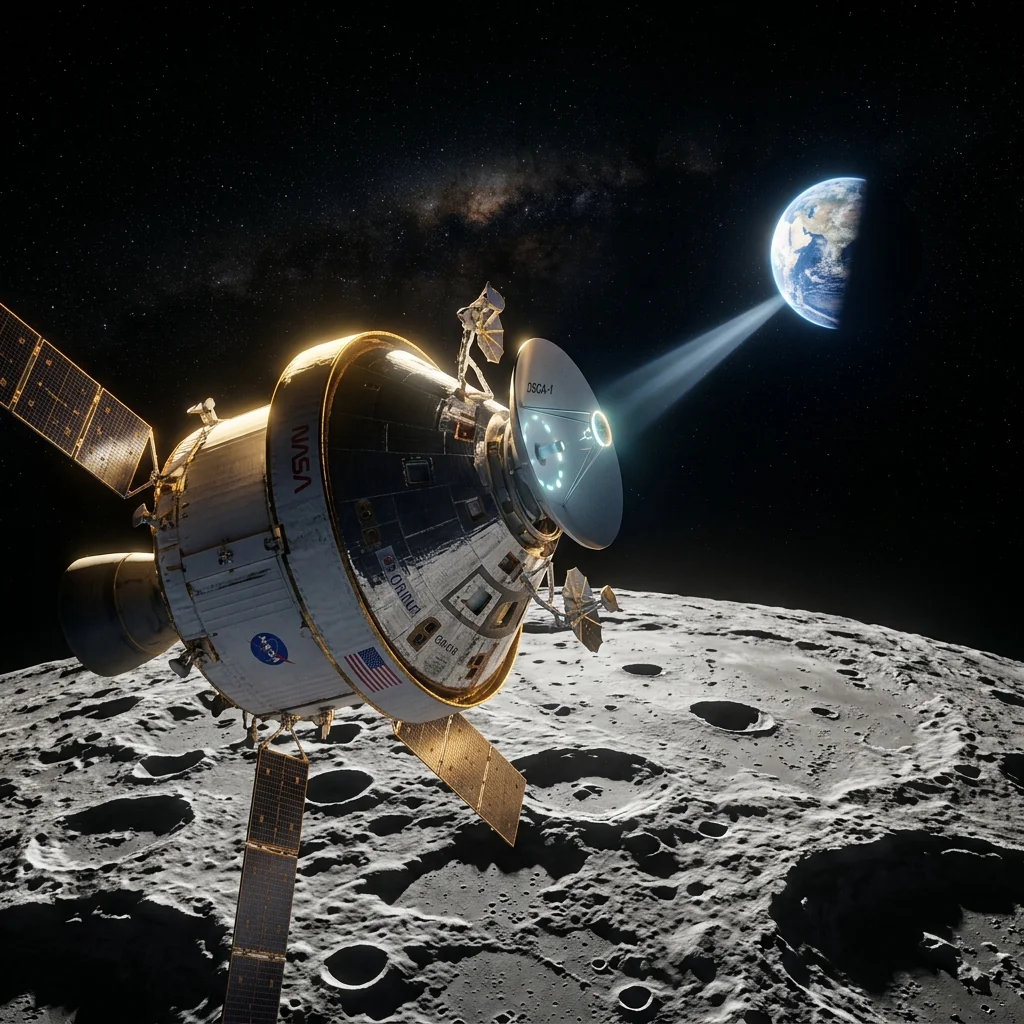
When four astronauts aboard NASA's Orion spacecraft completed their trans-lunar injection burn and began their trajectory toward the Moon, they crossed a communications threshold that most RF engineers spend their entire careers studying from a distance. At lunar range, approximately 384,400 km from Earth, maintaining a reliable RF link is not a matter of adding gain or boosting power. It is a systems-level problem that touches every discipline in the field: antenna design, waveguide fabrication, signal processing, thermal management, and link budget analysis.
The Artemis II mission, the first crewed flight beyond low Earth orbit since Apollo 17 in 1972, is a proving ground for the next generation of deep space communications architecture. For the RF engineering community, it represents something more specific: a live, high-stakes validation of S-band and Ka-band systems operating under conditions that cannot be fully replicated in a terrestrial lab.
The Communications Architecture of Orion
Orion's communications system is built around two primary RF links, each serving a distinct function in the mission architecture.
| Parameter | S-Band Link | Ka-Band Link |
|---|---|---|
| Frequency | 2.2 GHz (downlink) / 2.0 GHz (uplink) | 25.5 - 27.0 GHz |
| Primary Function | Voice, telemetry, command | High-rate science data, HD video |
| Data Rate | Up to ~2 Mbps | Up to ~600 Mbps (via relay) |
| Antenna Type | Phased array | High-gain steerable dish |
| Ground Network | DSN 34m/70m dishes | DSN + Near Space Network |
| Link Margin Challenge | Moderate (proven heritage) | Tight (atmospheric absorption, pointing) |
The S-band system handles the safety-critical traffic: voice communications between the crew and Mission Control, real-time telemetry from vehicle subsystems, and command uplinks for navigation and system management. This is the link that must never fail. Its design heritage traces back through decades of NASA missions, but the implementation on Orion incorporates a modern electronically steered phased array antenna, a significant departure from the mechanically pointed dishes of the Apollo era.
The Ka-band link is where the mission pushes into new territory. Operating in the 25.5 to 27 GHz range, this high-rate data link supports the transmission of HD video, high-resolution imagery, and large science data payloads back to Earth. At these frequencies, the engineering challenges multiply: atmospheric absorption increases, beam pointing requirements tighten, and the thermal behavior of the waveguide and feed components becomes a front-line design concern.
Free-Space Path Loss at Lunar Distance
The fundamental challenge of deep space communications is free-space path loss (FSPL). At lunar distance, the numbers are unforgiving.
FSPL = 20·log₁₀(d) + 20·log₁₀(f) + 20·log₁₀(4π/c)
At S-band (2.2 GHz) and 384,400 km: ~211 dB
At Ka-band (26 GHz) and 384,400 km: ~233 dB
A 233 dB path loss at Ka-band means the signal arriving at Earth's ground station is astronomically weak. To close this link, every decibel matters. The transmit power amplifier, the antenna gain on both ends, the noise temperature of the ground station receiver, the losses in every waveguide run, connector, and transition on the spacecraft, they all factor into whether the link closes with adequate margin or does not close at all.
This is where component-level engineering directly impacts mission success. A waveguide section with 0.2 dB of excess insertion loss at 26 GHz is not an academic concern; it is a direct reduction in effective radiated power that propagates through the entire link budget. At lunar distance, that 0.2 dB could be the difference between receiving clean HD video or receiving noise.
Waveguide and Component Challenges at Ka-Band
At Ka-band frequencies, the physical dimensions of waveguide components shrink considerably. WR-34 rectangular waveguide, commonly used in the 22 to 33 GHz range, has internal dimensions of just 8.636 mm x 4.318 mm. At these scales, manufacturing tolerances that would be negligible at lower frequencies become performance-critical.
Surface Finish and Conductor Loss
At 26 GHz, the skin depth in copper is approximately 0.4 μm. Surface roughness on the order of the skin depth directly increases conductor loss. For a spacecraft operating on a fixed power budget with no opportunity for field repair, every fraction of a dB in the waveguide run must be accounted for at the design stage. Gold plating, precision CNC machining, and rigorous surface finish specifications (typically Ra 0.4 μm or better) are standard requirements for flight hardware.
Thermal Cycling
In the vacuum of space, thermal gradients are severe. The sun-facing side of the Orion service module can reach +150°C while the shadow side drops below -150°C. Waveguide flanges, transitions, and connectors must maintain their mechanical tolerances across this full range. Differential expansion between dissimilar metals at flange interfaces is a well-known failure mode that must be addressed through material selection and joint design.
Vibration and Launch Loads
Before any RF component operates in space, it must survive the launch environment. The Space Launch System (SLS) generates acoustic and vibration loads that stress every mechanical joint in the RF chain. Waveguide assemblies must be designed for both static and dynamic loading, with qualification testing that includes random vibration, sine sweep, and shock profiles that exceed the expected flight environment by defined margins.
The Deep Space Network: The Other Half of the Link
Orion's transmitter is only half the equation. On the ground, NASA's Deep Space Network (DSN) provides the receive capability. The DSN operates three ground station complexes spaced approximately 120° apart in longitude, at Goldstone (California), Madrid (Spain), and Canberra (Australia), ensuring continuous coverage as the Earth rotates.
The 34-meter beam waveguide antennas at these sites are equipped with cryogenically cooled low-noise amplifiers (LNAs) that achieve system noise temperatures below 20 K at Ka-band. At these noise levels, the Johnson-Nyquist noise floor of the receiver is pushed so low that the dominant noise contributions shift to atmospheric effects: water vapor absorption, tropospheric scintillation, and rain fade.
Engineering Insight: A DSN 34-meter Ka-band receive system achieves a G/T (gain-to-noise-temperature ratio) on the order of 55 dB/K. Every component in the receive chain, from the feed horn to the waveguide to the LNA input, is optimized to preserve this figure. A 0.1 dB increase in feed loss at 26 GHz can degrade the system noise temperature by several Kelvin, directly impacting the achievable data rate.
What Artemis II Means for the RF Industry
Beyond the mission itself, Artemis II signals a broader shift in how the aerospace industry approaches RF component procurement and manufacturing.
Compressed Development Timelines
The cadence of space missions is accelerating. NASA's Artemis program, commercial lunar payload services (CLPS), commercial crew, and the proliferation of LEO satellite constellations are all driving demand for flight-qualified RF hardware on timelines that would have been unrealistic a decade ago. Engineering teams need components that can be prototyped, tested, and qualified for flight without multi-month procurement delays.
Domestic Manufacturing Requirements
For defense and NASA programs, ITAR and domestic sourcing requirements are not optional. The RF supply chain must be able to deliver precision-machined waveguide assemblies, terminations, and transitions from U.S.-based facilities with full traceability and documentation. This is not a preference; it is a programmatic requirement that directly influences vendor selection.
Precision at Scale
The transition from prototype to production is where many RF programs encounter friction. A one-off waveguide assembly machined to spec in a development shop is useful for testing, but the program ultimately needs tens or hundreds of units with identical performance. Manufacturers that can maintain tight tolerances across production runs, not just on individual pieces, provide a measurable advantage to program schedules.
Looking Forward
Artemis II is not an endpoint. It is a systems-level demonstration that sets the baseline for Artemis III (crewed lunar landing), the Lunar Gateway station, and eventually crewed missions to Mars. Each step outward increases the FSPL, tightens the link budgets, and raises the stakes on every RF component in the signal chain.
For RF engineers and the companies that support them, the message is clear: deep space communications is not a niche application. It is the forcing function that drives the state of the art in low-loss waveguide fabrication, high-efficiency power amplifiers, cryogenic LNA design, and precision antenna systems. The components that make these links work at 384,400 km will define the floor for what is achievable at 225 million km.
The RF chain does not get a second chance at lunar distance. Every waveguide section, every connector, every termination must perform exactly as designed, the first time, in an environment that permits no rework. That is the standard the industry is building toward. Artemis II proves it is achievable.
RF Essentials manufactures precision waveguide components, terminations, and assemblies for aerospace, defense, and satellite communications. All products are made in the USA.
Frequently Asked Questions
What RF links does NASA's Orion spacecraft use?
Orion carries two. An S-band link near 2.0 GHz uplink and 2.2 GHz downlink handles the safety-critical voice, telemetry, and command traffic at up to about 2 Mbps through an electronically steered phased array, and it must never fail. A Ka-band link from 25.5 to 27 GHz carries high-rate science data and HD video at up to roughly 600 Mbps via a high-gain steerable dish, where the engineering challenges multiply.
How severe is free-space path loss at lunar distance?
At the lunar range of about 384,400 km, free-space path loss is roughly 211 dB at S-band and 233 dB at Ka-band. A 233 dB loss makes the signal arriving at Earth astronomically weak, so every decibel in the budget matters. A waveguide section with just 0.2 dB of excess loss at 26 GHz is a direct reduction in effective radiated power that, at lunar distance, can be the difference between receiving clean HD video and receiving noise.
What environmental stresses must Orion's Ka-band waveguide survive?
Three big ones. Surface finish must reach Ra 0.4 micrometers or better, because at 26 GHz the copper skin depth is about 0.4 micrometers and roughness raises conductor loss. The hardware must hold tolerance through thermal cycling from above 150 C on the sun side to below minus 150 C in shadow without differential-expansion flange failures. And it must survive the SLS launch acoustic, random-vibration, sine-sweep, and shock loads, qualified beyond the expected flight environment.