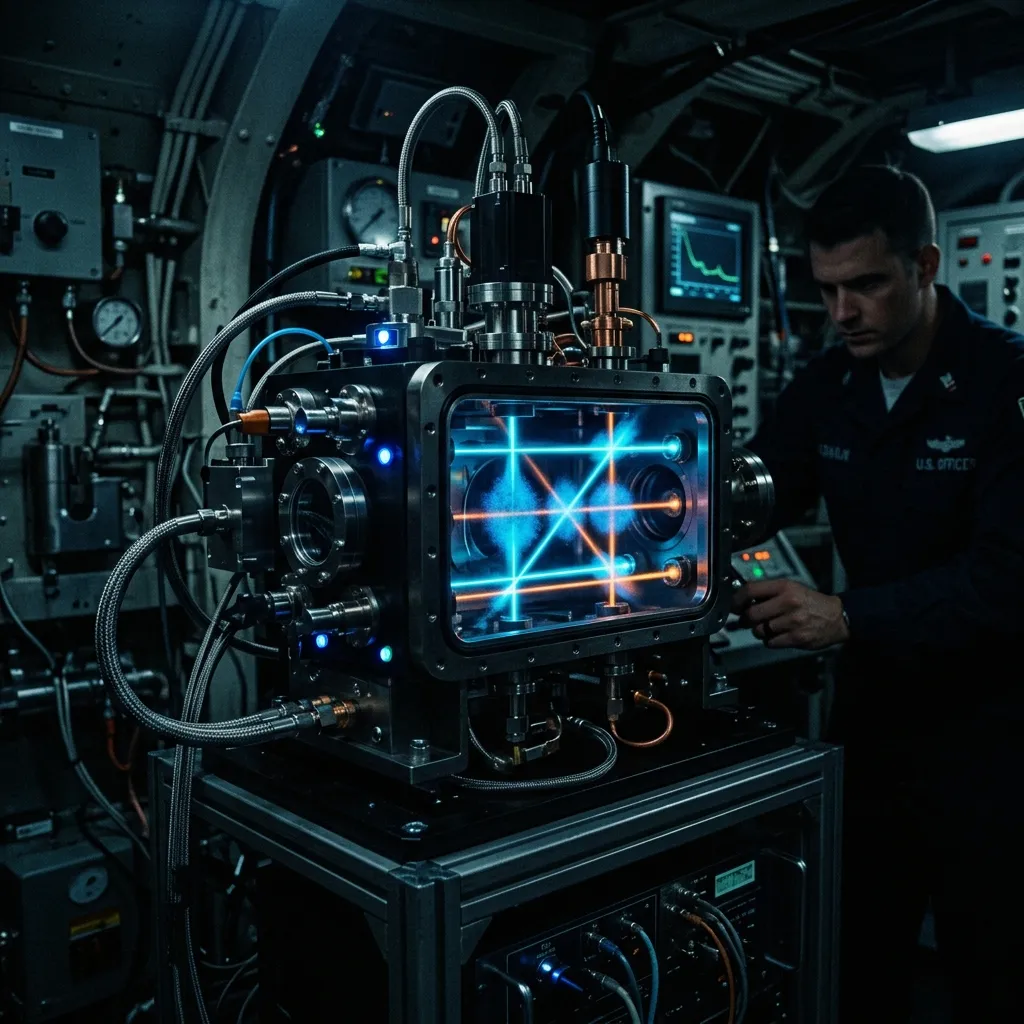
The modern world is built on a high-altitude house of cards. Every trillion-dollar financial transaction, every logistics network, and every military maneuver relies on a constellation of satellites orbiting 12,000 miles away, whispering a signal so weak it arrives at Earth with less power than the light of a 100-watt bulb viewed from 15 miles away. In an era of near-peer conflict, GPS is not just "vulnerable." It is a massive targeting beacon for enemy Electronic Warfare (EW) units.
When the jammers turn the sky into electronic soup, the side that wins is the side that does not need to look up. We are entering the age of Quantum Positioning Systems (QPS): a future where navigation is derived from the fundamental constants of the universe, not a fragile RF link from space.
1. The Physics: Turning Atoms into Matter Waves
In a standard high-end Inertial Navigation System (INS), accelerometers and gyroscopes measure movement from a known starting point. Even the most expensive classical systems drift. A tiny mathematical error in the morning becomes a 500-meter position error by the afternoon. This is because mechanical parts have friction, temperature sensitivities, and microscopic physical defects that accumulate over time.
Quantum sensors fix this by using Cold Atom Interferometry.
The process begins with lasers. Engineers use precisely tuned laser beams to "kick" the kinetic energy out of atoms (typically Rubidium-87 or Cesium-133) until they are nearly stationary, cooled to within microkelvins of absolute zero. At this temperature, the atoms stop behaving like discrete particles and start behaving like waves. This is the matter-wave duality predicted by de Broglie, and it allows an atom to serve as the ultimate inertial measurement device.
The Technical Toolbox
- Matter-Wave Interference: Laser pulses split an atom "cloud" into two quantum paths. If the platform moves (accelerates, rotates), the phase of these matter waves shifts. When the two paths are recombined, they create an interference fringe pattern. The measurement is not reading a spring displacement or a spinning wheel; it is reading the interference of the atom's own wave function against the inertial frame of the universe.
- Superposition: During the measurement window, the atom exists in two locations simultaneously. This allows it to sample the local gravitational and inertial environment along two different paths at once, providing a sensitivity that classical silicon MEMS sensors cannot approach. Current cold-atom accelerometers have demonstrated sensitivities on the order of 10-9 g/√Hz, several orders of magnitude better than the best tactical-grade MEMS devices.
- The Universal Constant: Unlike a mechanical sensor that changes with age or a quartz crystal that drifts with temperature, an atom of Rubidium-87 is identical everywhere in the universe. Its transition frequencies are fundamental constants that never need recalibrating. The measurement standard is literally baked into the laws of physics.
Key Specification: The current state of the art in cold-atom gravimeters achieves absolute gravity measurements with precision better than 1 μGal (10-8 m/s²). For context, classical spring gravimeters drift by several μGal per day and require frequent recalibration against a known reference. A cold-atom sensor holds its accuracy indefinitely because it references the atom itself.
2. Combat Applications: No Signal, No Problem
This is not laboratory theory. This is about maintaining the lethality and survivability of billion-dollar assets when the GPS constellation goes dark.
The Silent Service: Submarines at 800 Feet
Saltwater is a near-perfect shield for RF above a few kilohertz. GPS is completely useless underwater. Currently, a submarine must raise a mast above the surface to acquire a GPS fix, which is effectively announcing its position to every maritime patrol aircraft and satellite in the area.
A submarine equipped with a quantum gravimeter can map the tiny variations in Earth's local gravity field caused by underwater ridges, trenches, seamounts, and geological density variations. By matching this real-time "gravity fingerprint" against an onboard bathymetric/gravimetric database, the submarine can maintain centimeter-level position awareness while remaining submerged for months, totally silent and invisible to overhead surveillance.
Aircraft in the Electronic Bubble
In a high-intensity conflict scenario, dedicated EW assets will saturate the airspace with GPS jamming. A stealth fighter's navigation receiver will be neutralized the moment it crosses the contested boundary.
The quantum solution here involves two parallel technologies. First, a cold-atom inertial measurement unit (IMU) provides drift-free dead reckoning without any external RF reference. Second, Rydberg atom receivers (covered in depth in our companion article) can detect extremely weak navigation signals buried 100x deeper in the noise than a standard military GPS receiver. The combination provides navigation continuity in environments where legacy systems fail completely.
Precision Guided Munitions
GPS-guided munitions (JDAM, SDB, Excalibur) are highly susceptible to spoofing and jamming. A quantum IMU on a guided weapon provides an independent inertial truth that cannot be jammed, spoofed, or denied. Even if the GPS receiver is saturated, the weapon maintains its inertial solution from the quantum sensor, ensuring terminal accuracy at the target.
3. The Engineering Frontier: Phase Noise and SWaP-C
The transition from the laboratory to the cockpit is not purely a physics problem. It is an RF engineering war fought on two specific fronts.
Phase Noise is the Assassin
To probe and manipulate cold atoms, the system requires microwave synthesizers and laser sources with phase noise specifications that appear almost unreasonable. The local oscillator (LO) that drives the atom interrogation sequence must maintain coherence over the entire measurement cycle. If the LO jitters even a fraction of a picosecond, the matter-wave interference pattern blurs and the navigation solution degrades.
| Parameter | Requirement | Why It Matters |
|---|---|---|
| LO Phase Noise | < -120 dBc/Hz @ 1 Hz offset | Determines atom interrogation fidelity |
| Clock Stability | Allan deviation < 10-13 @ 1s | Drives timing accuracy of Raman pulses |
| Laser Linewidth | < 1 MHz (probe), < 100 kHz (coupling) | Sets atomic transition resolution |
| Microwave Power Stability | < 0.01 dB variation over measurement | Prevents systematic phase shifts |
Engineering the world's cleanest clocks and lowest-noise microwave sources is the prerequisite technology for quantum navigation. Without clean RF, the quantum state collapses into noise.
SWaP-C: Size, Weight, Power, and Cost
Currently, a laboratory-grade cold-atom interferometer fills a standard equipment rack, consumes kilowatts of power, and requires a vibration-isolated optical bench. The engineering mission for this decade is shrinking the lasers, vacuum chambers, magnetic shielding, and microwave plumbing into a Photonic Integrated Circuit (PIC) that can fit inside a drone, a cruise missile, or a dismounted soldier's rucksack.
The target form factors tell the story of the engineering challenge:
- Strategic platforms (submarines, ships): Rack-mounted, ~50 kg, 200 W. Achievable now.
- Tactical platforms (fighters, helicopters): Shoebox-sized, ~5 kg, 20 W. In development.
- Expendable platforms (missiles, UAS): Fist-sized, <1 kg, <5 W. Requires PIC integration, 5-10 year horizon.
4. The Industrial Quantum Complex
Several organizations are currently moving quantum navigation hardware from the cleanroom to operational environments:
| Organization | Focus Area | Technical Approach |
|---|---|---|
| Infleqtion | Quantum-on-a-Chip | Vacuum packaging and miniaturized cold-atom systems. Shrinking the heart of a quantum lab into a ruggedized, shoebox-sized unit. |
| AOSense | Strategic-Grade INS | High-precision sensors for assets that cannot tolerate drift. Focus on long-endurance submarine and deep-strike navigation. |
| Vector Atomic | Ruggedized Quantum Clocks | Qualification testing for vibration, shock, and thermal extremes. Building quantum clocks that survive jet engines and depth charges. |
| Sandia National Labs | MEMS-Scale Quantum Devices | Vanguard of miniaturization research. Working toward handheld quantum inertial sensors for dismounted infantry. |
| ColdQuanta (now Infleqtion) | Cold Atom Platforms | Commercial cold-atom source technology for both computing and sensing applications. |
5. The RF Engineering Connection
For RF engineers, quantum navigation is not an abstract physics curiosity. It is a rapidly growing market that depends directly on microwave and mmWave component performance. Every quantum sensor system requires:
- Ultra-low-phase-noise synthesizers operating at the atom's hyperfine transition frequency (6.834 GHz for Rb-87, 9.192 GHz for Cs-133)
- Precision waveguide and coaxial distribution networks to deliver microwave signals to the atom interrogation zone with minimal loss and reflection
- Magnetic shielding using mu-metal and active field cancellation to isolate the atom cloud from external RF interference
- Cryogenic-compatible RF components for systems that operate cold-atom sources near millikelvin temperatures
- EMI/EMC hardening to prevent the sensor's own electronics from contaminating the quantum measurement
The waveguides, terminations, filters, and amplifiers that comprise these systems require the same precision manufacturing standards as any other defense-grade RF hardware, with the additional constraint that phase noise and spectral purity specifications are among the most demanding in the industry.
6. Summary: Internal Truth vs. External Lies
The future of positioning, navigation, and timing (PNT) is not about launching more satellites. It is about making satellites irrelevant for critical operations. The paradigm is shifting from External Truth, relying on a signal transmitted by someone else, to Internal Truth, calculating position from the fundamental laws of physics inside the platform itself.
For the engineering student or the RF professional, this is one of the most consequential intersections of quantum physics and RF engineering in our era. The work is not about designing filters for a smartphone. It is about designing the microwave interfaces that allow us to talk to atoms, read their quantum states, and extract navigation data that no jammer can deny.
The satellites will remain a convenience. The atom is the reality.
RF Essentials manufactures precision waveguide components and cryogenic-compatible RF assemblies for defense, aerospace, and navigation applications. All products are made in the USA.
Frequently Asked Questions
How do cold-atom quantum sensors navigate without GPS?
Laser-cooled rubidium or cesium atoms held within microkelvins of absolute zero behave as matter waves rather than particles. Laser pulses split an atom cloud into two quantum paths, and any acceleration or rotation of the platform shifts the relative phase between them. Recombining the paths produces an interference fringe pattern that reads inertial motion directly against the frame of the universe, with no external RF signal required.
Why do quantum inertial sensors not drift like classical ones?
A classical inertial navigation system accumulates error from friction, temperature sensitivity, and microscopic defects, so a small morning error can grow to hundreds of meters by afternoon. A rubidium-87 atom is identical everywhere in the universe and its transition frequencies are fixed constants, so a cold-atom gravimeter holds accuracy better than 1 microGal indefinitely without ever recalibrating against an external reference.
Where do GPS-denied quantum sensors matter most?
Submarines, which cannot receive GPS underwater and otherwise must raise a mast and reveal their position, can navigate by matching real-time gravity-field fingerprints to an onboard bathymetric database while staying submerged for months. Aircraft in jammed airspace pair a cold-atom inertial unit for drift-free dead reckoning with Rydberg receivers, and quantum inertial units give guided munitions an inertial truth that cannot be jammed or spoofed.