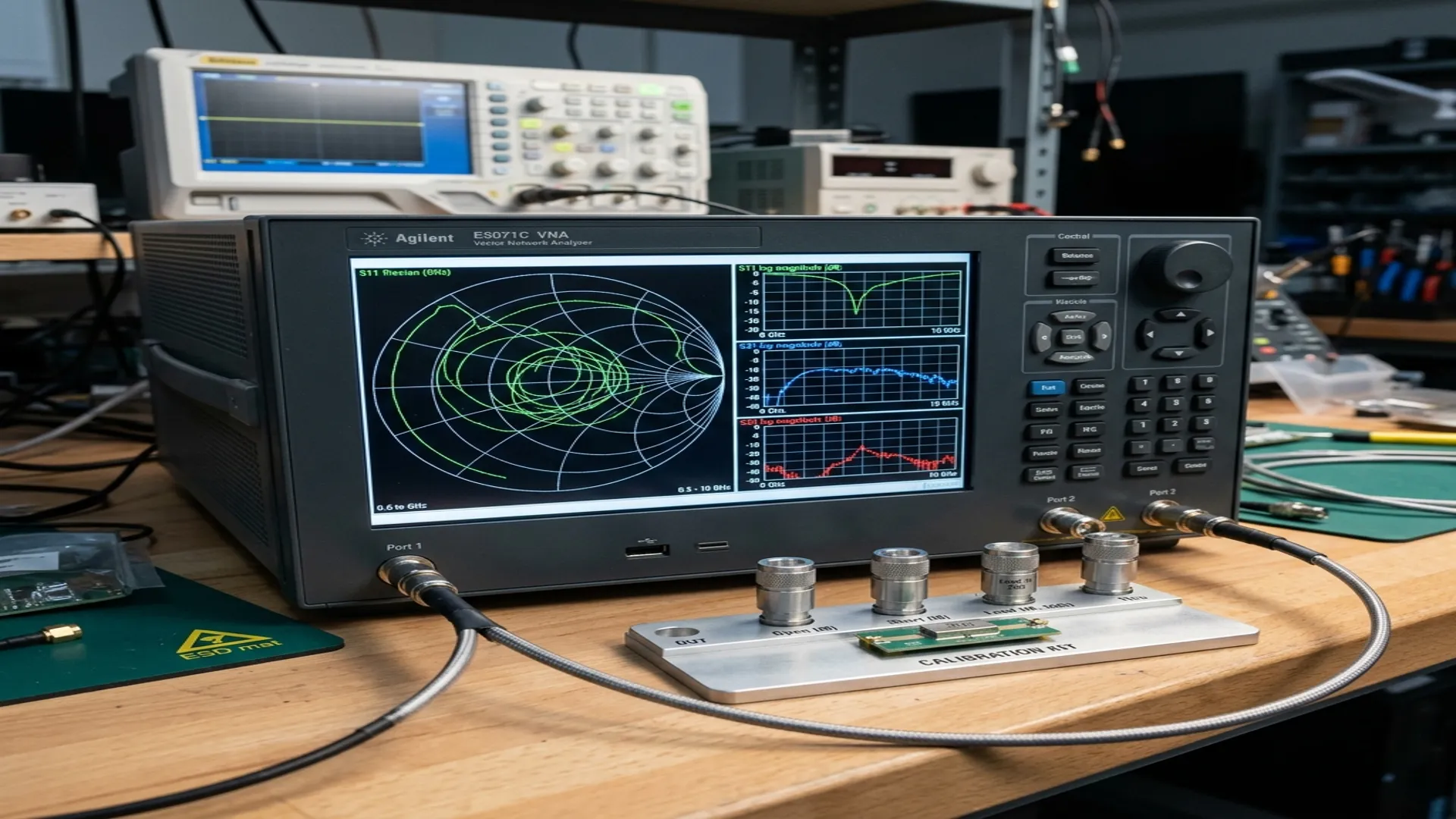
S-parameters (scattering parameters) are the language of RF engineering. Every component datasheet, every simulation model, every VNA measurement, and every impedance matching design is expressed in S-parameters. If you cannot read them fluently, you cannot design, test, or troubleshoot RF systems. This guide covers what S-parameters actually tell you, how to interpret them on both a magnitude plot and a Smith chart, and the measurement mistakes that produce bad data.
1. What S-Parameters Measure
S-parameters describe how an RF component handles traveling waves. At each port, there is an incident wave (going in) and a reflected wave (coming out). S-parameters are the ratios of these waves.
| Parameter | Definition | What It Tells You | Common Name |
|---|---|---|---|
| S11 | Reflected/Incident at Port 1 | How much energy is reflected back from Port 1 | Input return loss, input match |
| S21 | Transmitted (Port 2)/Incident (Port 1) | How much energy passes from Port 1 to Port 2 | Insertion loss (passive), gain (active) |
| S12 | Transmitted (Port 1)/Incident (Port 2) | How much energy passes from Port 2 to Port 1 | Reverse isolation, reverse gain |
| S22 | Reflected/Incident at Port 2 | How much energy is reflected back from Port 2 | Output return loss, output match |
All four parameters are complex numbers (magnitude and phase) measured as a function of frequency. They are typically expressed in decibels for magnitude and degrees for phase.
2. Reading S-Parameters: The Magnitude Plot
S11 and S22 (Return Loss)
For passive components, S11 and S22 should be as negative as possible (in dB). A well-matched component has S11 = -20 dB or better, meaning that only 1% of the incident power is reflected. The conversion between S11 in dB and VSWR is:
| S11 (dB) | VSWR | % Power Reflected | Interpretation |
|---|---|---|---|
| -6 dB | 3.01:1 | 25.0% | Poor match |
| -10 dB | 1.92:1 | 10.0% | Marginal |
| -15 dB | 1.43:1 | 3.2% | Acceptable for most systems |
| -20 dB | 1.22:1 | 1.0% | Good match |
| -25 dB | 1.12:1 | 0.3% | Very good match |
| -30 dB | 1.07:1 | 0.1% | Excellent match |
S21 (Insertion Loss or Gain)
For passive components (cables, connectors, waveguide, filters), S21 is negative, representing insertion loss. A WR-90 waveguide straight section might have S21 = -0.02 dB at mid-band, loss of only 0.5%. For active components (amplifiers), S21 is positive, representing gain. An LNA with S21 = +25 dB amplifies the signal by a factor of 316.
Reciprocity Check: For passive, linear components, S21 should equal S12 (the device is reciprocal). If your VNA measurement shows S21 and S12 differing by more than 0.1 dB, something is wrong: a loose connector, a calibration error, or the device is not actually passive (it has a ferrite element, like a circulator or isolator).
3. Reading S-Parameters: The Smith Chart
The Smith chart plots S11 (or S22) as a complex reflection coefficient on a normalized impedance grid. The center of the chart is Z = Z₀ (perfect match, S11 = 0). The outer edge is |S11| = 1 (total reflection).
- Center of chart: Perfect 50Ω match. The closer to center, the better the impedance match.
- Right side of real axis: Impedance is higher than 50Ω (resistive, Z > Z₀).
- Left side of real axis: Impedance is lower than 50Ω (resistive, Z < Z₀).
- Upper half: Impedance has a positive reactive component (inductive).
- Lower half: Impedance has a negative reactive component (capacitive).
- Tracing frequency: As frequency increases, the S11 trace moves clockwise on the Smith chart. A tight spiral toward center means the device match improves with frequency.
4. Multi-Port S-Parameters
Components with more than two ports (power dividers, couplers, switches) have larger S-parameter matrices. A 3-port device has nine S-parameters (S11, S12, S13, S21, S22, S23, S31, S32, S33). The interpretation is the same: Sij is the transmission from port j to port i. For a 3-dB Wilkinson power divider, you expect S21 = S31 = -3 dB (equal split), S11 < -20 dB (good input match), and S23 = S32 < -20 dB (good isolation between output ports).
5. Common Measurement Pitfalls
- Uncalibrated VNA: A VNA without calibration produces meaningless data. The raw measurement includes the VNA's own systematic errors, cable losses, and connector mismatches. Always calibrate before measuring.
- Wrong reference impedance: S-parameters are defined with respect to a reference impedance (usually 50Ω). If your system impedance is 75Ω (cable TV) or 300Ω (waveguide), you must set the correct reference or mathematically transform the data.
- Connector repeatability: Every time you disconnect and reconnect a connector, the measurement changes slightly. Use torque wrenches on precision connectors (SMA: 5 in-lbs, N-type: 12 in-lbs, 2.92mm: 8 in-lbs) for repeatable measurements.
- Cable movement: Flexing the test cables after calibration changes their phase response. Use phase-stable cables, secure them, and do not touch them during the measurement.
- Port extension errors: If the DUT is not connected directly at the calibration reference plane, you need port extension to de-embed the additional cable or adapter length. Incorrect port extension adds ripple to the S11 trace.
Use our free VSWR Calculator to convert between S11, return loss, VSWR, and reflection coefficient instantly.
Frequently Asked Questions
What do S-parameters actually measure?
S-parameters describe how a component handles traveling waves at its ports, as ratios of reflected and transmitted waves to the incident wave. S11 and S22 are the input and output return loss, or impedance match. S21 is insertion loss for a passive component or gain for an active one. S12 is the reverse isolation. All four are complex numbers, magnitude and phase, measured as a function of frequency, and they are the common language of every RF datasheet and simulation.
How do I interpret S11 in dB versus VSWR?
For a passive component, S11 should be as negative as possible. Minus 10 dB means 10 percent of the power is reflected, a marginal 1.92 to 1 match. Minus 20 dB reflects 1 percent, a good 1.22 to 1 match. Minus 30 dB reflects only 0.1 percent, an excellent 1.07 to 1 match. S11 converts directly to VSWR, and the more negative the value, the better the impedance match at that frequency.
What is the reciprocity check on a passive device?
For a passive, linear component, S21 should equal S12 because the device is reciprocal, energy passes equally in both directions. If a VNA measurement shows S21 and S12 differing by more than about 0.1 dB, something is wrong: a loose connector, a calibration error, or the device is not actually passive. Intentionally non-reciprocal parts like ferrite circulators and isolators are the deliberate exception, where S21 and S12 differ by design.