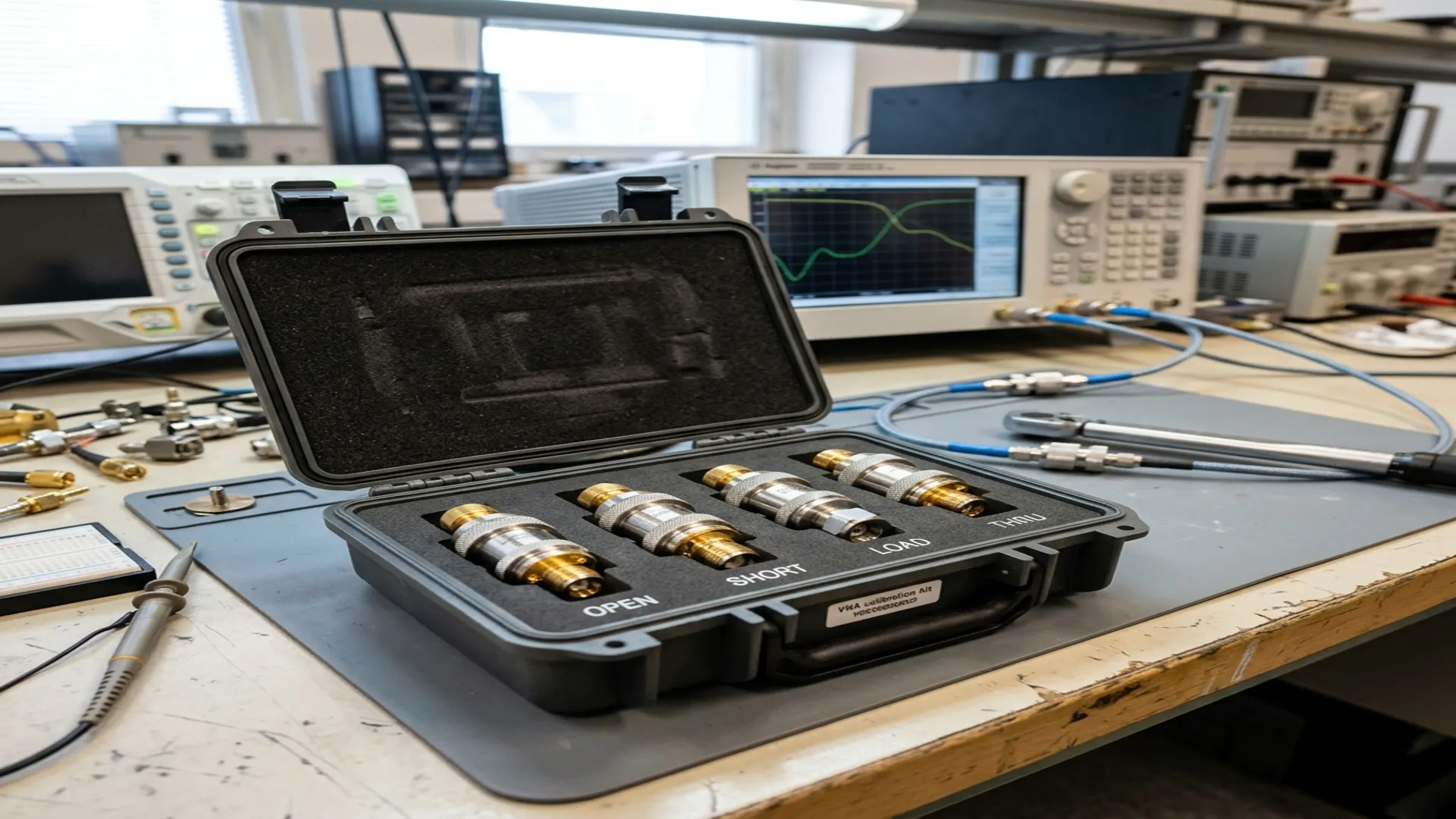
A vector network analyzer is only as accurate as its calibration. An uncalibrated VNA includes systematic errors from its own internal hardware, the test cables, the adapters, and the connectors. These errors can easily exceed 1 dB in magnitude and 10 degrees in phase, making the raw measurement useless for any serious engineering work. Calibration mathematically removes these systematic errors, moving the measurement reference plane to the exact point where the device under test connects.
This guide covers the calibration methods you will encounter in practice, when to use each one, and the common mistakes that invalidate your cal.
1. SOLT (Short-Open-Load-Thru)
SOLT is the most common VNA calibration method. You connect four known standards to the VNA ports in sequence: a short circuit, an open circuit, a matched load (50Ω), and a thru connection (direct cable-to-cable). The VNA measures each standard and solves for its systematic error terms.
When to Use SOLT
- Coaxial measurements from DC to 50 GHz (depending on connector quality)
- General-purpose lab measurements where calibration kits are available
- When measurement speed matters (SOLT is fast to perform)
Limitations
- Accuracy depends entirely on how well the calibration standards match their defined models. The load standard is the most critical: a load with -40 dB return loss limits your measurement accuracy to approximately -40 dB.
- At frequencies above 50 GHz, coaxial SOLT standards become difficult to manufacture with sufficient accuracy.
- Not available for waveguide. A waveguide "open" is not a defined standard (it radiates).
The Load Is Everything: In SOLT calibration, the matched load standard determines the floor of your return loss measurement accuracy. If your load has a true return loss of -35 dB, you cannot accurately measure DUT return loss below about -32 dB. For high-accuracy work, verify your load standard against a known reference or use a different calibration method (TRL).
2. TRL (Thru-Reflect-Line)
TRL calibration uses three standards: a thru connection, a reflect standard (short or open, does not need to be precisely characterized), and a transmission line of known impedance and approximately quarter-wavelength electrical length. TRL does not require a precision load standard, which makes it fundamentally more accurate than SOLT at frequencies where precision loads are difficult to manufacture.
When to Use TRL
- Waveguide measurements: TRL is the standard calibration method for waveguide. The line standard is a precision waveguide straight section, and the reflect is a waveguide short (a flat metal plate).
- On-wafer measurements: Probing semiconductor devices on a wafer where coaxial standards cannot be connected.
- High-accuracy measurements: When you need the best possible measurement accuracy and are willing to spend time on calibration.
Limitations
- The line standard has a usable frequency range limited to approximately 8:1 bandwidth. For broadband measurements, you need multiple line standards of different lengths.
- TRL calibration requires the thru and line to have exactly the same cross-section and characteristic impedance. Any dimensional mismatch between the thru and line introduces calibration error.
| Method | Standards Needed | Best For | Accuracy | Speed |
|---|---|---|---|---|
| SOLT | Short, Open, Load, Thru | Coaxial, DC to 50 GHz | Good (limited by load) | Fast |
| TRL | Thru, Reflect, Line | Waveguide, on-wafer, high-accuracy | Excellent | Moderate |
| LRL | Line, Reflect, Line | Non-insertable DUTs | Excellent | Moderate |
| ECal | Electronic cal module | Production, repeated cal | Good | Very fast |
| Unknown Thru | Short, Open, Load + any thru | Mixed connectors | Good | Fast |
3. Electronic Calibration (ECal)
An ECal module is a solid-state device that internally switches between multiple impedance states on command from the VNA. You connect it once to each port, press a button, and the VNA steps through all the impedance states automatically. The calibration takes 30 to 60 seconds with no manual standard changes.
ECal is ideal for production environments where calibration is performed frequently by operators who may not be RF specialists. The accuracy is comparable to SOLT with a high-quality calibration kit. The disadvantage is cost ($5,000 to $20,000 per module) and the fact that each ECal module covers a specific frequency range and connector type.
4. Waveguide Calibration
Waveguide calibration deserves special attention because the rules are different from coaxial:
- No "open" standard: A waveguide open end radiates. Use TRL (not SOLT) for waveguide.
- Short standard: A flat metal plate (shorting plate) bolted to the waveguide flange. Simple, accurate, and broadband.
- Line standards: Precision waveguide straight sections of known length. For WR-90 (X-band), a typical TRL line is 12.7 mm long (quarter wavelength at 10 GHz).
- Offset shorts: Multiple shorts with different offset lengths can be used instead of line standards for broadband waveguide calibration.
5. Calibration Verification
After calibrating, verify the cal before measuring your DUT:
- Measure the load standard: After calibration, re-measure the load. The S11 should be at the noise floor of the measurement. If it is not, the calibration failed.
- Measure a known device: Measure a component with known S-parameters (a previous golden unit, or a simple airline). Compare to the known values.
- Check the thru: Measure a thru connection. S21 should be 0 dB (within the noise floor) and S11 should be below -40 dB across the full band.
RF Essentials manufactures precision waveguide shorts, matched loads, and straight sections suitable for TRL calibration across all standard waveguide bands from WR-284 through WR-10.
Frequently Asked Questions
Why must a VNA be calibrated before measuring?
An uncalibrated vector network analyzer includes systematic errors from its own internal hardware, the test cables, the adapters, and the connectors. These can easily exceed 1 dB in magnitude and 10 degrees in phase, which makes the raw measurement useless for serious engineering. Calibration mathematically removes those systematic errors and moves the measurement reference plane to the exact point where the device under test connects.
What is the difference between SOLT and TRL calibration?
SOLT connects short, open, load, and thru standards in sequence. It is fast and general-purpose for coaxial work to about 50 GHz, but its accuracy is limited by how well the matched load standard is known. TRL uses a thru, a reflect that does not need precise characterization, and a precision line of known impedance. By avoiding the load standard entirely, TRL is fundamentally more accurate and is the standard method for waveguide and on-wafer measurements.
Why can't SOLT be used for waveguide calibration?
A waveguide open end radiates rather than presenting a defined open-circuit standard, so the open in SOLT does not exist for waveguide. Waveguide calibration uses TRL instead: a flat metal shorting plate bolted to the flange provides the reflect, a precision waveguide straight section provides the line, about 12.7 mm for X-band WR-90, and offset shorts of different lengths can substitute for line standards to extend broadband coverage.