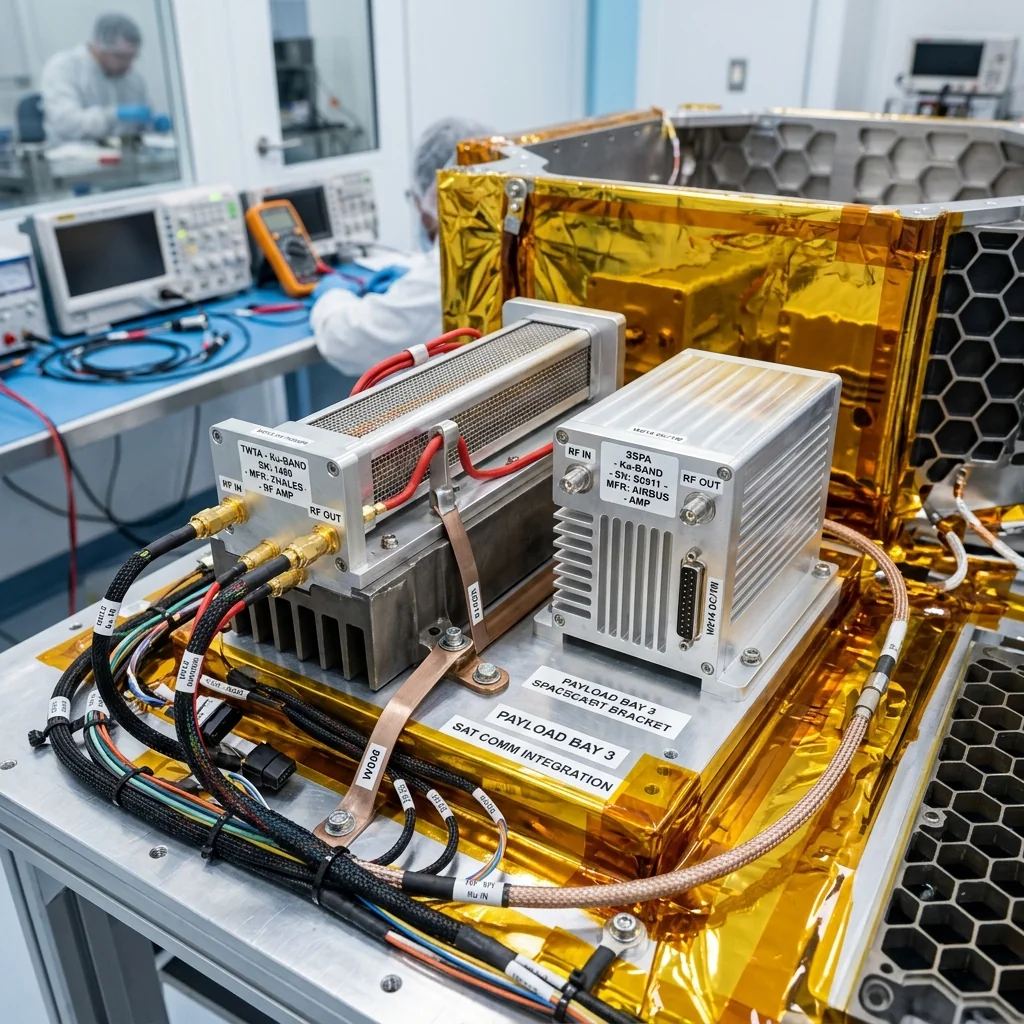
Every satellite transponder chain terminates in a high-power amplifier (HPA) that determines the downlink EIRP, the DC power draw, and a significant portion of the payload mass. For more than four decades, the Traveling Wave Tube Amplifier (TWTA) has dominated this role, converting DC power into RF output with efficiencies that solid-state devices struggled to match. That dynamic has changed. Gallium Nitride MMIC technology now produces SSPAs that rival tube-based HPAs in efficiency across certain bands while offering advantages in linearity, volume, and graceful degradation. The choice between TWTA and SSPA is no longer obvious, and the wrong decision can add millions to mission cost or shave critical margin from a link budget.
At RF Essentials, our engineering team supports payload integrators with waveguide assemblies, precision termination loads, and feed network components for both TWTA and SSPA architectures. This article walks through the engineering trade study that drives the selection decision.
1. How Each Technology Works
A TWTA generates RF power by passing an electron beam through a slow-wave structure (the helix or coupled-cavity circuit) while a modulated RF signal propagates along that structure. The electron beam transfers kinetic energy to the RF wave through velocity modulation and bunching, producing broadband gain with saturated efficiencies of 55% to 70% depending on the collector design. Modern multi-stage depressed collectors (MDCs) recover spent electron energy, pushing overall DC-to-RF conversion efficiency above 65% at Ku-band and Ka-band.
An SSPA uses transistor-based power amplifier stages, historically built on GaAs but increasingly on GaN-on-SiC MMIC processes. Multiple transistor cells are combined through waveguide power combining networks to achieve the required output power. GaN devices offer power densities of 5 to 10 W/mm of gate periphery at Ku-band, enabling compact modules that produce 100 to 200 watts of saturated output from a single package.
2. Head-to-Head Comparison
| Parameter | TWTA (MDC) | SSPA (GaN) | Advantage |
|---|---|---|---|
| DC-to-RF Efficiency (Saturated) | 60-70% | 35-55% | TWTA |
| Linearity (C/IM3 at OBO) | -15 to -20 dBc | -25 to -30 dBc | SSPA |
| Mass per Watt (kg/W) | 0.03-0.05 | 0.02-0.04 | SSPA |
| Bandwidth (% of center freq) | 10-20% | 20-40% | SSPA |
| Failure Mode | Catastrophic (single tube) | Graceful (individual FETs) | SSPA |
| Typical Power Range | 20 W to 500+ W | 5 W to 200 W | TWTA (high power) |
| Radiation Tolerance | Inherent (vacuum device) | Requires hardening | TWTA |
| On-Orbit Lifetime | 15-20 years demonstrated | 15 years projected | TWTA (heritage) |
3. The Efficiency Question
Efficiency is the dominant parameter for GEO payloads because DC power translates directly to solar array size, battery capacity, and thermal dissipation. A 200 W TWTA at 65% efficiency draws 308 W DC and dissipates 108 W as heat. The same 200 W output from a GaN SSPA at 45% efficiency draws 444 W DC and dissipates 244 W. That 136 W difference, multiplied across 48 transponders on a typical HTS payload, adds 6.5 kW to the bus power requirement and requires substantially more thermal radiator area.
Payload Power Budget Impact: For a 48-transponder GEO HTS satellite, the efficiency gap between 65% TWTA and 45% SSPA translates to approximately 6.5 kW of additional bus power and 400 kg of additional thermal management mass. At current launch costs of $15,000 to $20,000 per kg to GEO, that mass penalty alone represents $6M to $8M in launch cost.
However, efficiency comparisons at saturation are misleading for modern multicarrier payloads. Most HTS transponders operate with output backoff (OBO) of 3 to 6 dB to meet intermodulation requirements. At 5 dB OBO, TWTA efficiency drops to 35-40% due to the nonlinear transfer characteristic of the tube, while GaN SSPAs maintain 25-30% efficiency because their Class AB bias point is closer to the backed-off operating regime. The efficiency gap narrows significantly under realistic operating conditions.
4. Linearity and Multicarrier Operation
Satellite transponders increasingly carry multiple FDMA or OFDM carriers simultaneously, making amplifier linearity critical. Third-order intermodulation products (IM3) from adjacent carriers create interference that degrades the carrier-to-interference ratio across the transponder bandwidth.
SSPAs exhibit superior linearity at backed-off power levels because transistor gain compression follows a smooth, gradual characteristic. TWTAs display a sharper saturation knee with AM-to-PM conversion that generates asymmetric intermodulation products. A linearizer (LTWTA) can improve tube linearity by 5 to 10 dB, but adds complexity, mass, and another potential failure point. GaN SSPAs routinely achieve C/IM3 of -25 dBc at 3 dB OBO without external linearization.
5. Where TWTAs Still Win
Above 200 watts of RF output, TWTAs remain unchallenged. High-power broadcast satellites at C-band and Ku-band require 250 to 500 watts per transponder, and no production SSPA achieves this power level with competitive efficiency. The physics of GaN heat dissipation at these power densities creates thermal management problems that offset the amplifier's intrinsic advantages.
TWTAs also hold a decisive advantage in radiation environments. Vacuum electron devices are inherently immune to total ionizing dose (TID) and single-event effects (SEE) that can degrade or destroy semiconductor junctions. GaN devices require careful radiation hardening and testing to qualify for GEO orbits with their 15-year exposure to trapped particle radiation. For military and science missions traversing high-radiation environments, TWTAs remain the conservative, proven choice.
6. The GaN Inflection Point
The industry is currently at an inflection point. GaN SSPA production yields have improved by 40% since 2023, and several European and American space primes have qualified GaN SSPA modules for LEO and MEO constellations. Telesat Lightspeed, Amazon Kuiper, and next-generation OneWeb payloads all specify GaN SSPAs for their user-link transponders, driven by the mass savings and graceful degradation advantages that are critical for constellations of hundreds or thousands of spacecraft.
For GEO HTS payloads above 200 watts per channel, the TWTA with multi-stage depressed collector remains the baseline. For LEO and MEO constellations operating at 20 to 100 watts per channel, GaN SSPAs are now the default selection. The transition zone, 100 to 200 watts at Ku-band and Ka-band, is where the trade study becomes genuinely competitive and mission-specific.
7. Waveguide Integration Considerations
Both amplifier types connect to the antenna feed network through waveguide output ports. TWTAs typically use WR-75 (Ku-band) or WR-28 (Ka-band) flanged outputs with precision waveguide transitions to the output multiplexer (OMUX). SSPAs may use either waveguide or coaxial outputs depending on power level, but high-power GaN modules increasingly use waveguide outputs to minimize connector losses at the amplifier-to-OMUX interface.
RF Essentials manufactures the precision waveguide components that connect HPAs to output networks: straight waveguide sections, bends, adapters, and calibration loads used during payload-level integration and test. Our components meet the surface finish and dimensional tolerance requirements for space-qualified waveguide assemblies.
RF Essentials provides precision waveguide assemblies, feed components, and test loads for satellite payload integration. From WR-28 Ka-band to WR-75 Ku-band, our components meet space-qualification surface finish and dimensional requirements.
Frequently Asked Questions
How do TWTAs and SSPAs differ in a satellite payload?
A traveling wave tube amplifier passes an electron beam through a slow-wave structure, transferring kinetic energy to the RF wave to produce broadband gain, and with a multi-stage depressed collector it reaches 60 to 70 percent efficiency. A solid-state power amplifier combines GaN-on-SiC transistor cells through power-combining networks to make 100 to 200 watts per package at 35 to 55 percent efficiency, with better linearity, wider bandwidth, and graceful degradation.
Why does amplifier efficiency dominate the GEO payload trade study?
DC power sets the solar array size, battery capacity, and radiator area, so efficiency is the dominant parameter. Across 48 transponders, the gap between a 65 percent TWTA and a 45 percent SSPA adds roughly 6.5 kW of bus power and about 400 kg of thermal management mass, which at 15,000 to 20,000 dollars per kg to GEO is 6 to 8 million dollars in launch cost. Under realistic output backoff, though, the TWTA efficiency falls faster and the gap narrows.
Where do TWTAs still beat SSPAs?
Above 200 watts of RF output. Broadcast satellites need 250 to 500 watts per transponder, and no production SSPA reaches that with competitive efficiency because GaN heat density creates thermal problems at those power levels. TWTAs also win in radiation: as vacuum electron devices they are inherently immune to total ionizing dose and single-event effects, while GaN must be carefully hardened and tested for a 15-year GEO exposure.