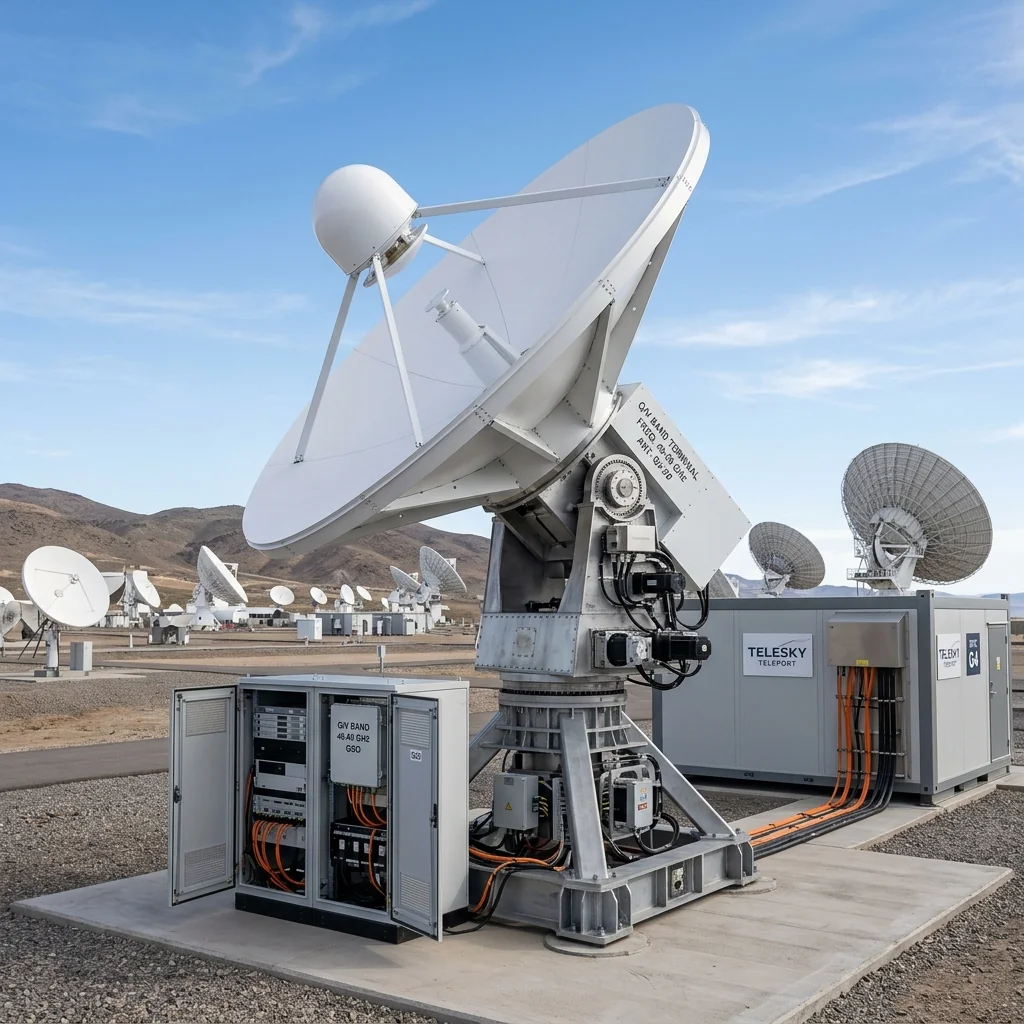
If you follow spectrum allocation news, satellite constellation announcements, or defense communications procurement, one frequency range keeps surfacing in every conversation: Q/V band. The 37.5 to 54 GHz window has become the focal point for the next generation of satellite communications architecture, attracting billions in investment from operators, semiconductor manufacturers, and ground station developers.
This is not speculative. Eutelsat, Viasat, SES, and Amazon's Project Kuiper have all committed to Q/V-band feeder link architectures for their current and next-generation high-throughput satellite (HTS) systems. The European Space Agency's ARTES program is actively funding Q/V-band technology development. Regulatory bodies including Ofcom and the ITU have opened new spectrum allocations specifically for Q/V-band gateway earth stations.
For RF engineers and the component supply chain that supports them, this frequency migration represents a fundamental shift in what gets designed, manufactured, and deployed. Here is what is driving it, what the technical challenges look like, and why the RF component market is responding.
What Are Q-Band and V-Band?
The terminology can be confusing because multiple band designation systems overlap in this frequency range. For satellite communications, the relevant allocations are:
| Band | Frequency Range | Primary SatCom Use | Wavelength |
|---|---|---|---|
| Q-Band (Downlink) | 37.5 - 42.5 GHz | Gateway feeder link downlink | ~8.0 - 7.1 mm |
| V-Band (Uplink) | 47.5 - 54.0 GHz | Gateway feeder link uplink | ~6.3 - 5.6 mm |
| Ka-Band (Reference) | 26.5 - 40.0 GHz | User links, some feeder links | ~11.3 - 7.5 mm |
| Ku-Band (Reference) | 12 - 18 GHz | User links, broadcast | ~25 - 16.7 mm |
The combined Q/V-band allocation provides approximately 10 GHz of contiguous spectrum for satellite feeder links. To put that in perspective, the entire Ka-band allocation for satellite services provides roughly 3.5 GHz. Q/V band nearly triples the available feeder link bandwidth, and that single fact is driving the entire investment thesis.
Why the Migration from Ka-Band Is Happening Now
The satellite communications industry has been operating on a predictable frequency migration path for decades: C-band to Ku-band to Ka-band, each step moving higher in frequency to access more bandwidth. The transition to Q/V-band follows the same logic, but this time the pressure is more acute.
Ka-Band Congestion
Ka-band spectrum for satellite feeder links is effectively fully subscribed. The proliferation of Ka-band HTS systems over the past decade, combined with LEO mega-constellations that also use Ka-band for gateway links, has saturated the available spectrum. Operators launching new systems cannot secure enough Ka-band feeder link spectrum to match the capacity of their user beams.
The Capacity Math
A modern HTS satellite using spot beam technology might generate 500 user beams, each carrying 500 Mbps of throughput. That is 250 Gbps of aggregate capacity on the user side. All of that data must funnel through the feeder link to reach the gateway. With Ka-band feeder link bandwidth limited to a few GHz, the feeder link becomes the bottleneck, requiring either extensive frequency reuse (which introduces self-interference) or migration to a wider band.
The Bottleneck Equation: A satellite with 250 Gbps user capacity using 16-APSK modulation at 3 bits/Hz spectral efficiency requires ~83 GHz of feeder link bandwidth (before frequency reuse). Ka-band provides ~3.5 GHz. Q/V-band provides ~10 GHz. Even with aggressive frequency reuse, Q/V-band is the only path to matching next-generation user capacity without requiring dozens of gateway sites.
The LEO Multiplier
LEO constellations intensify the problem. A LEO satellite is visible from any given gateway for only a few minutes per pass. To maintain continuous connectivity, the gateway must hand off between satellites as they rise and set. This means the gateway needs enough bandwidth to serve whichever satellite is currently overhead while also maintaining links to adjacent satellites for seamless handover. The bandwidth appetite of LEO gateway operations is significantly higher per-gateway than GEO, making Q/V-band not just attractive but necessary.
The Technical Challenges at 40-50 GHz
If Q/V-band offers three times the bandwidth, why has the industry not moved there sooner? The physics of radio propagation at millimeter-wave frequencies creates engineering challenges that required years of technology maturation to address.
Rain Fade: The Dominant Impairment
At 50 GHz, rain attenuation is severe. A moderate rainfall rate of 25 mm/hr can produce signal attenuation exceeding 15 dB on a satellite-to-ground path at 30° elevation. For comparison, the same rain rate at Ka-band (30 GHz) produces approximately 6-8 dB of attenuation. At Ku-band (14 GHz), the same rain produces less than 2 dB.
| Frequency | Clear Sky Attenuation | Rain (10 mm/hr) | Rain (25 mm/hr) | Rain (50 mm/hr) |
|---|---|---|---|---|
| 14 GHz (Ku) | ~0.5 dB | ~1.2 dB | ~2.0 dB | ~3.5 dB |
| 30 GHz (Ka) | ~1.0 dB | ~4.0 dB | ~7.5 dB | ~13.0 dB |
| 40 GHz (Q) | ~1.5 dB | ~7.0 dB | ~12.0 dB | ~20.0 dB |
| 50 GHz (V) | ~2.5 dB | ~9.0 dB | ~16.0 dB | ~26.0 dB |
A 15 dB rain fade event is not a marginal impairment; it is a link-killing event. No amount of link margin budgeted at design time can economically absorb fades of this magnitude. The solution is architectural rather than brute-force.
Gateway Diversity: The Architectural Solution
Gateway site diversity is the primary fade mitigation strategy for Q/V-band feeder links. The concept is straightforward: deploy two or more gateway earth stations separated by enough distance (typically 20-50 km) that a localized rain cell affecting one site does not simultaneously affect the other. The satellite dynamically routes feeder link traffic to whichever gateway has the best channel conditions.
This approach works because heavy rain events are spatially localized. A thunderstorm cell producing 50 mm/hr rainfall rarely exceeds 5-10 km in horizontal extent. Two gateways separated by 30 km will almost never experience simultaneous deep fades, achieving combined link availability above 99.9% even in tropical climates where individual-site availability at Q/V-band might only reach 97-98%.
The trade-off is cost: every gateway site requires a full complement of antenna systems, LNAs, upconverters, power amplifiers, and fiber backhaul connectivity. Gateway diversity roughly doubles the ground segment infrastructure cost, but the bandwidth gain from Q/V-band more than compensates in total cost-per-bit.
Adaptive Coding and Modulation (ACM)
ACM is the dynamic response to varying channel conditions. When the sky is clear, the system operates with high-order modulation (32-APSK, 64-APSK) achieving spectral efficiencies above 4 bits/Hz. As rain begins to attenuate the signal, the system automatically steps down to more robust modulation schemes (QPSK, 8-PSK) that require less SNR to decode correctly, trading throughput for link reliability.
The challenge for hardware designers is that ACM requires the entire RF chain to operate linearly across a wide dynamic range. The power amplifier must maintain acceptable EVM with 64-APSK during clear sky, while the LNA and downconverter must handle the full range of signal levels from clear sky (strong) to deep fade (near noise floor) without nonlinear distortion corrupting the adaptive demodulation process.
RF Component Technology Driving the Migration
Q/V-band satellite systems would not be economically viable without several concurrent advances in RF component technology.
GaN Power Amplifiers
GaN-on-SiC HEMT technology has been the key enabler for Q/V-band ground terminal transmitters. At 50 GHz, GaN devices achieve output power levels of 5-10 W per device with power-added efficiencies (PAE) in the 20-30% range. While these numbers are modest compared to GaN performance at lower frequencies, they are sufficient for gateway uplink applications where high-gain antennas (3-5 meter dishes) compensate for the per-device power limitation.
The critical advantage of GaN over competing technologies (InP, GaAs) at Q/V-band is its combination of power density and breakdown voltage. GaN's 3.4 eV bandgap supports drain voltages of 20-28 V at V-band frequencies, simplifying power supply design and improving overall system efficiency compared to the 3-5 V supply rails required by InP devices.
Low-Noise Amplifiers
Receive-side performance at Q-band (37.5-42.5 GHz) demands LNAs with noise figures below 2.5 dB and gains above 25 dB. InP (indium phosphide) HEMT technology currently dominates this application, achieving noise figures of 1.8-2.2 dB at 40 GHz. Cryogenic cooling, while common in radio astronomy and deep space applications like the Deep Space Network, is generally not used in commercial gateway terminals due to cost and maintenance constraints. Room-temperature InP LNA performance is sufficient for most commercial system link budgets.
Waveguide and Feed Systems
At Q-band frequencies, WR-22 rectangular waveguide (internal dimensions 5.69 mm x 2.845 mm) is the standard transmission medium. At V-band, WR-19 (4.775 mm x 2.388 mm) or WR-15 (3.759 mm x 1.880 mm) may be used depending on the exact frequency. At these dimensions, the manufacturing requirements for surface finish, dimensional tolerance, and flange flatness become critical performance drivers.
Component Insight: At 47.5 GHz, the skin depth in copper is approximately 0.30 μm. The internal surface finish of waveguide components must be significantly better than this value to avoid excess conductor loss. Typical specifications call for Ra ≤ 0.2 μm, achievable through precision CNC machining followed by chemical polishing or gold plating. A waveguide assembly with 0.3 dB of excess insertion loss at the gateway feed directly reduces the system G/T by the same amount, impacting receive sensitivity across the entire coverage area.
Frequency Converters
Q/V-band upconverters and downconverters must cover the full allocated bandwidth (5+ GHz instantaneous bandwidth at V-band) with flat gain, low phase noise, and high spurious-free dynamic range. The local oscillator (LO) chain for these converters typically uses a low-phase-noise crystal reference multiplied up to the 35-45 GHz range, with the multiplied phase noise degrading by 20·log₁₀(N) where N is the multiplication factor. This makes phase noise management at the reference oscillator level critically important.
Who Is Investing and Why
GEO HTS Operators
Viasat's ViaSat-3 constellation and Eutelsat's KONNECT VHTS both use Q/V-band feeder links to support aggregate throughputs exceeding 1 Tbps per satellite. These operators have committed to Q/V-band because it is the only way to feed enough bandwidth to their user beams without building an impractical number of Ka-band gateway sites.
LEO Constellation Builders
Amazon's Project Kuiper has filed for Q/V-band gateway links to support its 3,236-satellite constellation. Telesat's Lightspeed constellation also incorporates Q/V-band gateway architecture. For LEO operators, the combination of gateway diversity and Q/V-band bandwidth is essential to support the rapid satellite handover cadence required by low-orbit architectures.
Defense and Government
Military satellite communications programs are evaluating Q/V-band for protected communications. The narrower beamwidths achievable at 40-50 GHz provide inherent spatial filtering that improves resistance to jamming and interception. The U.S. Space Development Agency's Transport Layer architecture includes provisions for Q/V-band inter-satellite and ground segment links.
Ground Segment Equipment Manufacturers
Companies manufacturing gateway antennas, block upconverters (BUCs), and frequency conversion equipment are investing heavily in Q/V-band product lines. The ground segment represents a larger total addressable market than the space segment for Q/V-band RF hardware, because every satellite requires multiple gateway sites, and each site requires redundant RF chains.
The Supply Chain Impact
For RF component manufacturers, the Q/V-band migration creates demand across every product category:
- Waveguide assemblies: WR-22 and WR-19 waveguide runs, bends, twists, transitions, and flanges for gateway feed systems
- Terminations: Precision waveguide terminations for calibration, test, and unused port management in multi-port feed networks
- Isolators and circulators: Ferrite devices protecting PA outputs from reflected power in the antenna feed chain
- Connectors and transitions: Coax-to-waveguide adapters, waveguide-to-waveguide transitions between standard sizes
- Attenuators: Precision fixed and variable attenuators for signal level management in the receive chain
- Test equipment accessories: Calibration standards, directional couplers, and power sensors rated to 50+ GHz
The manufacturing tolerances at these frequencies are demanding. Components that pass performance specifications at Ka-band (26-40 GHz) may not meet requirements at V-band (47-54 GHz) without tighter dimensional control, improved surface finish, and more rigorous quality assurance processes. This creates a competitive advantage for manufacturers with established precision machining capabilities and in-house RF test infrastructure calibrated to 50+ GHz.
What Comes After Q/V Band?
The frequency migration trajectory does not stop at V-band. Research programs are already exploring W-band (75-110 GHz) and even higher frequencies for future satellite links. The European Space Agency has funded propagation measurement campaigns at W-band to characterize the channel. However, W-band commercial deployment is likely 10-15 years away; the semiconductor, waveguide manufacturing, and test infrastructure required for production systems at those frequencies is still in the early development stage.
For the current investment cycle, Q/V-band is the actionable frontier. The technology is mature enough to deploy, the spectrum is available, the demand is confirmed by committed satellite programs, and the economics work at scale. RF engineers and manufacturers who position themselves in this frequency range now will be serving a market that is growing for the next two decades.
RF Essentials manufactures precision waveguide components, terminations, and RF assemblies for satellite communications and ground station applications. All products are made in the USA.
Frequently Asked Questions
What are Q-band and V-band, and why do satellite operators want them?
For satellite feeder links, Q-band from 37.5 to 42.5 GHz carries the gateway downlink and V-band from 47.5 to 54 GHz carries the uplink, together providing about 10 GHz of contiguous spectrum. That is nearly triple the roughly 3.5 GHz available at Ka-band. The extra feeder-link bandwidth is the entire investment thesis, which is why Eutelsat, Viasat, SES, and Amazon's Project Kuiper have committed to Q/V-band architectures.
Why is the satellite industry migrating from Ka-band to Q/V-band now?
Ka-band feeder spectrum is effectively fully subscribed, while modern high-throughput satellites generate hundreds of gigabits per second of user capacity that must funnel through the feeder link. A 250 Gbps payload using 16-APSK at 3 bits per hertz needs roughly 83 GHz of feeder bandwidth before reuse. Ka-band offers only about 3.5 GHz, making the feeder the bottleneck, so Q/V-band's 10 GHz is the practical path to matching user capacity.
How is the severe rain fade at 40 to 50 GHz handled?
Gateway site diversity is the primary fix. At 50 GHz a moderate 25 mm per hour rain rate can produce more than 15 dB of attenuation, a link-killing fade that no static margin can economically absorb. Because heavy rain cells are spatially localized, operators deploy two or more gateways separated by 20 to 50 km, and the satellite dynamically routes feeder traffic to whichever site currently has the clear channel.