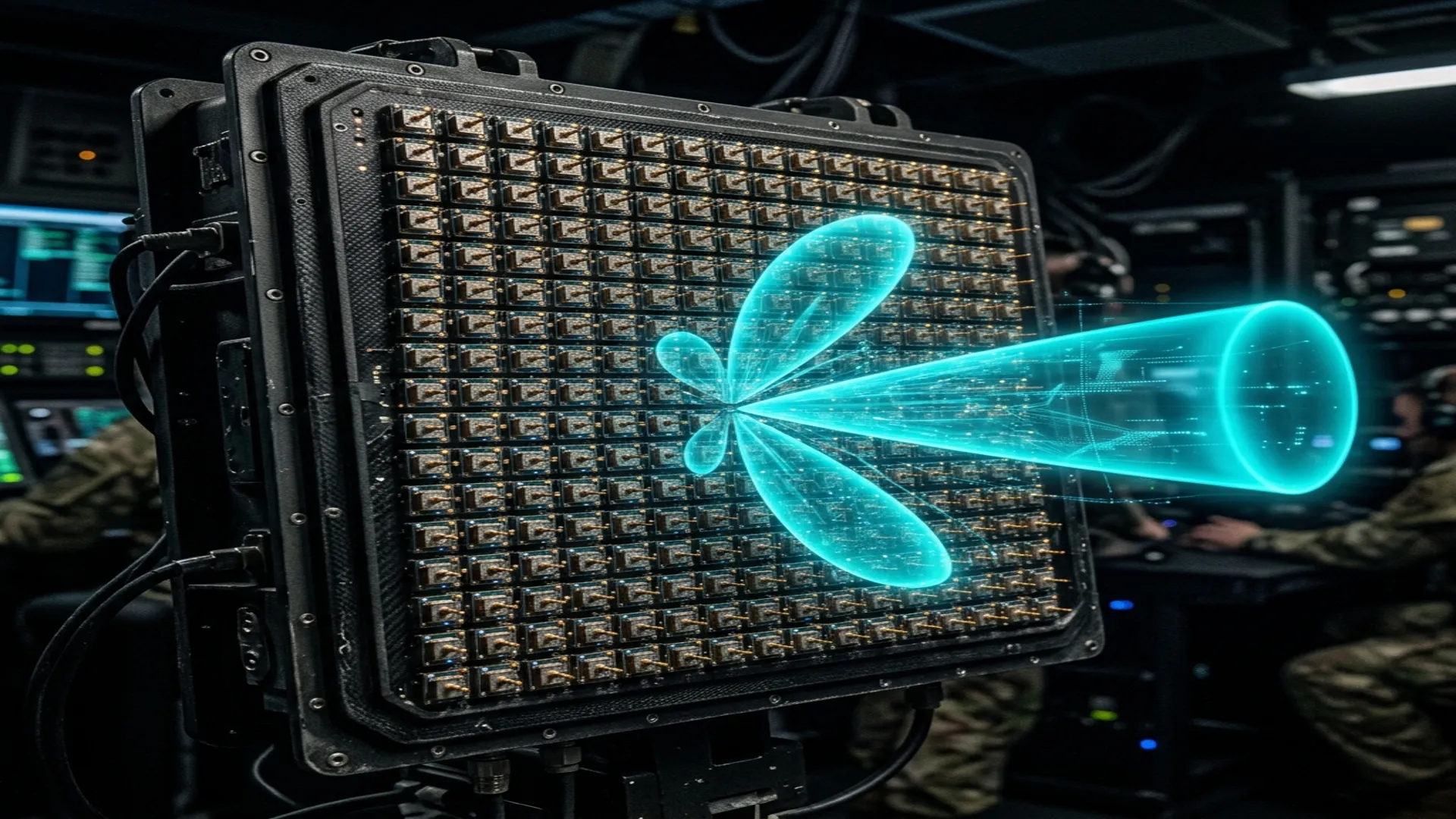
A phased array is a group of antenna elements whose individual signals are combined with controlled phase shifts to steer the radiated beam electronically, without physically moving the antenna. This is the technology behind modern AESA radars, 5G mmWave base stations, satellite communication terminals, and electronic warfare systems. It is, by a wide margin, the most important antenna technology of the 21st century.
This article covers the physics of beam steering, the math that governs array patterns, the engineering tradeoffs between analog and digital beamforming, and the RF feed network components that determine whether a phased array performs to its specifications or falls short.
1. The Fundamental Principle: Constructive Interference by Design
Every phased array operates on a single physical principle: when multiple coherent sources radiate simultaneously, their fields add constructively in some directions and destructively in others. By controlling the relative phase of each element, you control where the constructive interference occurs, which means you control the beam direction.
Consider a linear array of N identical elements spaced d apart. Each element radiates the same signal, but element k is given a progressive phase shift of k·Δφ. The resulting far-field pattern has a maximum (main beam) in the direction where the path length differences exactly compensate the applied phase shifts.
Δφ = Progressive phase shift between adjacent elements (radians)
d = Element spacing (m)
λ = Wavelength (m)
This is the foundation of all phased array engineering. Change Δφ and the beam moves. Change it fast (microseconds) and you have electronic beam scanning that is orders of magnitude faster than any mechanical positioner.
2. Array Factor and Element Pattern
The total radiation pattern of a phased array is the product of two components: the element pattern (the radiation pattern of a single antenna element in isolation) and the array factor (the pattern created by the spatial arrangement and phasing of the elements). This is the pattern multiplication principle.
AF = Array factor, determined by geometry, spacing, and element weights
The array factor for a uniform linear array of N elements with equal amplitude and progressive phase shift β is:
AF = sin(Nψ/2) / sin(ψ/2), where ψ = (2πd/λ)sinθ + β
This produces a main beam with a half-power beamwidth of approximately HPBW ≈ 0.886λ/(Nd·cosθ₀) radians, and sidelobes whose first level is -13.2 dB below the main beam for uniform amplitude weighting.
3. Grating Lobes: The Spacing Trap
If the element spacing d exceeds λ/2, the array factor develops additional maxima called grating lobes. These are full-power beams pointing in unintended directions, and they are catastrophic for radar (false targets), communications (interference), and EW (energy wasted in wrong directions).
Design Rule: For a phased array that must scan to ±60° from broadside without grating lobes, the maximum element spacing is d ≤ λ / (1 + sin60°) = 0.536λ. For full hemisphere scanning (±90°), the limit drops to d ≤ λ/2. These constraints directly determine the number of elements needed for a given aperture size and operating frequency.
At X-band (10 GHz, λ = 30 mm), d ≤ 15 mm for half-hemisphere scanning. A 1-meter square aperture requires (1000/15)² ≈ 4,444 elements. At Ka-band (35 GHz, λ = 8.6 mm), the same aperture needs over 54,000 elements. The element count, and the associated cost of TR modules, phase shifters, and feed network components, scales quadratically with frequency for a fixed aperture size.
4. Analog vs. Digital vs. Hybrid Beamforming
| Architecture | Phase Control | Beams | Pros | Cons |
|---|---|---|---|---|
| Analog | RF phase shifters per element | 1 per subarray | Lower power, simpler digital backend, proven heritage | Fixed amplitude taper, limited null steering, single beam per subarray |
| Digital | ADC per element, digital weights | Arbitrary (software) | Full control of amplitude and phase per element, simultaneous multi-beam, adaptive nulling | Extreme data rate, power, cost; ADC per element at mmWave is challenging |
| Hybrid | Analog subarrays + digital combining | Multiple (limited) | Practical balance of flexibility and cost, common in 5G NR | Subarray-level granularity limits nulling and sidelobe control |
Modern AESA radars (AN/APG-81, AN/APG-83, AN/SPY-6) use analog beamforming with a dedicated transmit/receive (TR) module behind each element. Each TR module contains a phase shifter, variable-gain amplifier, T/R switch, limiter, and LNA, all in a hermetically sealed package. The per-element cost of a TR module ranges from $100 to $500 depending on frequency, power level, and production volume.
5. The RF Feed Network: Where Components Matter
The feed network distributes the transmit signal to all elements and combines the received signals. Its performance directly determines the array's efficiency, sidelobe level, and scan accuracy. Every component in the feed network contributes loss, phase error, and amplitude imbalance that degrade the array pattern.
Power Dividers and Combiners
Wilkinson dividers, hybrid couplers, and waveguide power dividers distribute the transmit signal with controlled amplitude and phase to each element or subarray. A corporate feed network for N elements requires log2(N) stages of binary dividers. Each stage introduces 0.2 to 0.5 dB of insertion loss (depending on frequency and technology). For a 1,024-element array, 10 divider stages contribute 2 to 5 dB of total feed loss, which directly reduces the array's effective radiated power.
Phase Shifters
Phase shifters are the beam-steering mechanism. Digital phase shifters (switched-line or loaded-line types) provide discrete phase steps (typically 5 to 6 bits, giving 11.25° or 5.625° resolution). The phase quantization produces a predictable set of beam-pointing errors and elevated sidelobe levels. A 5-bit phase shifter produces peak sidelobes approximately 0.5 dB higher than the theoretical minimum for the given amplitude taper.
Waveguide Components in Feed Networks
At frequencies above Ku-band (12 GHz), waveguide-based feed networks are common because waveguide offers lower loss than microstrip or stripline at these frequencies. The feed network uses waveguide power dividers, waveguide-to-coax adapters, waveguide bends, and precision waveguide terminations on unused ports. The quality of these components determines the amplitude and phase tracking across the array aperture.
Feed Network Rule: Every 0.5 dB of feed network loss reduces the array's effective radiated power by 0.5 dB. In a radar system where detection range scales as the fourth root of ERP, a 2 dB increase in feed loss reduces detection range by approximately 16%. At Ka-band, where every decibel of loss is expensive to recover, the difference between a 0.3 dB waveguide divider and a 0.8 dB microstrip divider is operationally significant.
6. Scan Loss and Active Element Pattern
When a phased array steers its beam away from broadside, the effective aperture projected in the beam direction shrinks by cos(θ), causing a gain reduction of approximately cos(θ) (in voltage) or cos²(θ) (in power). This scan loss is approximately 1.5 dB at 45° and 3 dB at 60°.
The active element pattern (AEP) is the actual radiation pattern of a single element when all other elements are present and terminated. Mutual coupling between elements modifies the element pattern, and this modification is scan-angle dependent. At wide scan angles, the AEP can differ significantly from the isolated element pattern, causing additional scan loss beyond the cos(θ) projection effect. Accurate phased array design requires full-wave electromagnetic simulation of the active element pattern, not just the isolated element pattern.
7. Thermal Management: The Hidden Challenge
Each TR module in an AESA dissipates heat. A typical GaN-based TR module at X-band operates at 10 to 20% power-added efficiency, meaning 80 to 90% of the DC input power is converted to heat. For a 4,000-element array with each module dissipating 2 watts, the total thermal load is 8 kilowatts concentrated on the array face. Removing this heat without introducing thermal gradients that cause differential phase shifts across the aperture is a critical mechanical engineering challenge. Liquid cooling, heat pipes, and thermally conductive substrates are standard approaches.
| Parameter | Small Array (64 elements) | Medium Array (1,024 elements) | Large Array (4,096+ elements) |
|---|---|---|---|
| Beamwidth (X-band) | ~14° | ~3.5° | ~1.7° |
| Gain (broadside) | ~24 dBi | ~36 dBi | ~42 dBi |
| Thermal Load | ~130 W | ~2 kW | ~8+ kW |
| Feed Network Stages | 6 | 10 | 12 |
| Cooling | Conduction/air | Forced air/liquid | Liquid (mandatory) |
RF Essentials manufactures precision waveguide power dividers, terminations, adapters, and feed network components used in phased array systems for defense, radar, and satellite communications. All products are made in the USA.
Frequently Asked Questions
What causes grating lobes in a phased array, and how do I avoid them?
Grating lobes are full-power beams pointing in unintended directions that appear when element spacing exceeds half a wavelength. To scan to plus or minus 60 degrees without them, spacing must stay at or below 0.536 wavelengths; for full hemisphere scanning the limit drops to half a wavelength. These rules set the element count, which is why a 1 meter aperture needs about 4,400 elements at X-band but over 54,000 at Ka-band.
What is the difference between analog, digital, and hybrid beamforming?
Analog beamforming uses RF phase shifters with one beam per subarray, keeping power and cost low but limiting nulling and multi-beam operation. Digital beamforming places an ADC behind every element for full per-element control and simultaneous beams, at the cost of extreme data rate and power. Hybrid architectures combine analog subarrays with digital combining, which is the practical balance used in most 5G NR millimeter-wave systems.
How much loss does the feed network add in a large array?
A corporate feed splits the signal through log2(N) binary divider stages, and each stage adds roughly 0.2 to 0.5 dB. For a 1,024 element array that is 10 stages, or about 2 to 5 dB of total feed loss, which comes straight off the effective radiated power. This is why divider, coupler, and phase shifter quality matters so much: every fraction of a dB in the feed degrades the array's performance.