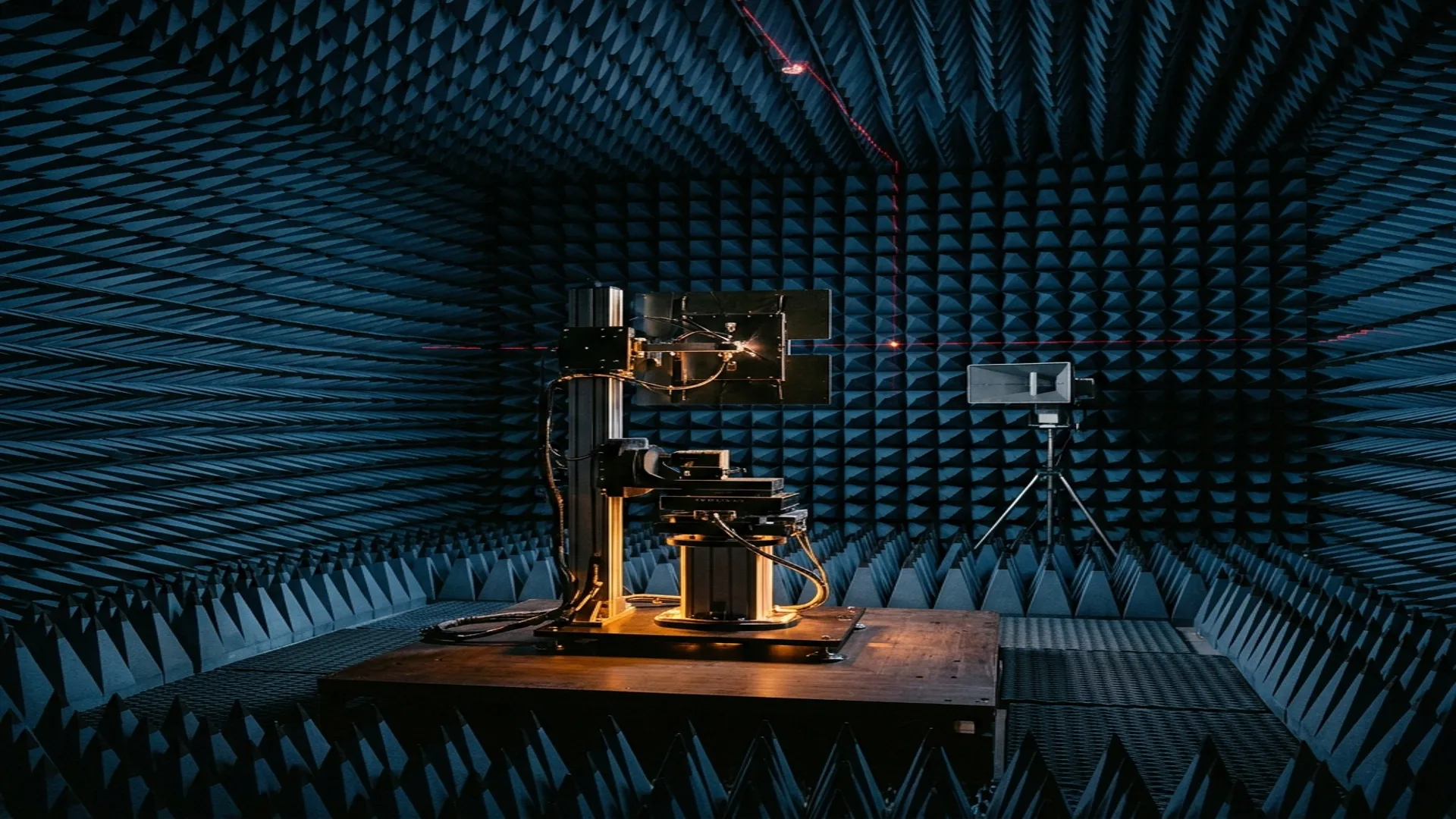
Antenna measurement is where theory meets reality. You can simulate a radiation pattern in HFSS or CST all day, but until you measure the physical antenna in a controlled environment, you do not know what you have built. The measurement method you choose determines the accuracy of the result, the cost of the test facility, the time required per antenna, and the types of errors that can corrupt your data.
This guide covers the two fundamental approaches (far-field and near-field), their variants, the math behind the near-field-to-far-field transformation, and the error sources that cause the most problems in practice.
1. The Far-Field Condition
An antenna's radiation pattern is defined in the far field, the region where the radiated fields have settled into a stable angular distribution that does not change shape with increasing distance. The boundary between the near field and the far field is set by the Fraunhofer distance:
λ = Operating wavelength (m)
Rff = Minimum far-field distance (m)
This formula deserves more respect than it usually gets. For a 1-meter dish at 10 GHz (λ = 3 cm), Rff = 67 meters. For a 3-meter dish at 30 GHz, Rff = 1,800 meters. For a phased array with a 2-meter aperture at 77 GHz (automotive radar frequency), Rff = 2,051 meters, over 2 kilometers. Building a free-space range that long, with adequate absorber treatment and multipath control, is economically prohibitive for many applications.
| Antenna | D (m) | Frequency | Rff |
|---|---|---|---|
| WR-90 horn | 0.15 | 10 GHz | 1.5 m |
| 1 m parabolic dish | 1.0 | 12 GHz | 80 m |
| 5G mmW panel (28 GHz) | 0.3 | 28 GHz | 17 m |
| AESA radar array | 1.5 | 10 GHz | 150 m |
| Automotive radar (77 GHz) | 0.1 | 77 GHz | 5.1 m |
| Satellite reflector | 3.0 | 20 GHz | 1,200 m |
2. Far-Field Measurement Methods
Outdoor Far-Field Range
The antenna under test (AUT) is mounted on a tower or positioner at one end of a line-of-sight path. A source antenna (typically a standard-gain horn) radiates from the other end at a distance greater than Rff. The AUT is rotated through azimuth and elevation while a receiver records the power at each angle.
Outdoor ranges are simple in concept but challenging in practice. Ground reflections create multipath that corrupts the measurement. Diffraction from range edges adds spurious signals. Weather changes the propagation characteristics during a measurement sweep. Outdoor ranges work best for large antennas at lower frequencies (below X-band) where the far-field distance is manageable and the site can be graded to control ground reflections.
Indoor Anechoic Chamber
The anechoic chamber is a shielded room lined with RF absorber material (carbon-loaded foam pyramids or ferrite tiles) that suppresses reflections from the walls, floor, and ceiling. The chamber simulates free-space conditions by reducing the reflected power level to 40 to 60 dB below the direct signal. This is the standard approach for frequencies from 1 GHz through 110 GHz.
The chamber must be large enough to satisfy the far-field condition. A chamber designed to test antennas up to 0.5 meters in aperture at 18 GHz needs a minimum length of 30 meters, which is a significant investment in real estate and absorber material.
Compact Antenna Test Range (CATR)
A CATR uses a precision parabolic reflector to convert a spherical wave from a feed horn into a plane wave in a "quiet zone" at a much shorter physical distance than the Fraunhofer distance. The AUT sits in the quiet zone and sees what appears to be a far-field illumination, even though it is only a few meters from the reflector.
CATR Advantage: A CATR can test antennas that would require a 200-meter outdoor range in a chamber only 15 to 20 meters long. The tradeoff is the cost and precision of the parabolic reflector. A CATR reflector must have a surface accuracy better than λ/50 to achieve quiet-zone amplitude ripple below ±0.5 dB and phase ripple below ±5°. At Ka-band (35 GHz), this means surface accuracy of 170 micrometers across a reflector that may be 3 to 5 meters in diameter.
3. Near-Field Measurement Methods
Near-field scanning measures the amplitude and phase of the antenna's radiated field on a surface close to the antenna (typically 2 to 10 wavelengths away). The measured near-field data is then mathematically transformed to produce the far-field pattern using Fourier-based algorithms. This approach eliminates the need for a physically large test range.
Planar Near-Field Scanning
A probe (typically an open-ended waveguide or a small horn) is scanned across a flat plane in front of the AUT. At each point, the amplitude and phase of the received signal are recorded. The scan plane must extend at least as far as the AUT aperture plus a margin to capture energy radiated at wide angles.
The near-field data on the planar surface is related to the far-field pattern by a two-dimensional Fourier transform. The scan spacing must satisfy the Nyquist criterion: Δx, Δy ≤ λ/2. At 10 GHz, this is 15 mm spacing. At 60 GHz, it is 2.5 mm. The number of measurement points scales quadratically with frequency for a fixed aperture, making high-frequency planar scans time-intensive.
Planar scanning is best suited for high-gain, directive antennas (dishes, phased arrays, horn antennas) where most of the radiated energy is concentrated in the forward hemisphere. It cannot accurately reconstruct the back-lobe region of the pattern.
Cylindrical Near-Field Scanning
The probe moves along a vertical track while the AUT rotates on a turntable, tracing out a cylindrical measurement surface. This captures the full 360° azimuth pattern while sampling in elevation. The transformation uses a combination of Fourier transform (in the azimuth direction) and Hankel transform (in the vertical direction).
Cylindrical scanning is well-suited for antennas with omnidirectional or broad azimuth patterns, such as base station antennas, vehicle-mounted systems, and sector antennas.
Spherical Near-Field Scanning
The probe traces out a sphere surrounding the AUT, capturing the complete radiation pattern including back lobes. The transformation uses spherical wave expansion, decomposing the near-field data into a sum of spherical harmonics (spherical mode coefficients) that fully characterize the antenna's radiation.
Spherical scanning is the most general and most accurate near-field technique. It is the only method that provides a complete 3D radiation pattern, including gain, directivity, efficiency, and polarization in all directions. It is the standard method for spacecraft antenna testing, where the back-lobe and side-lobe patterns are critical for interference analysis.
| Method | Coverage | Best For | Transform | Typical Accuracy |
|---|---|---|---|---|
| Planar NF | Forward hemisphere | High-gain, directive antennas | 2D FFT | ±0.3 dB gain, ±3° pointing |
| Cylindrical NF | Full azimuth, limited elevation | Base station, omnidirectional | FFT + Hankel | ±0.5 dB gain |
| Spherical NF | Full sphere (4π sr) | Spacecraft, complete characterization | Spherical wave expansion | ±0.2 dB gain, ±1° pointing |
| Far-field (CATR) | Sector scan | Quick gain/pattern verification | Direct measurement | ±0.5 dB gain |
| Far-field (outdoor) | Full rotation possible | Large antennas, lower frequencies | Direct measurement | ±1.0 dB gain |
4. Probe Correction: Why It Matters
The near-field probe is not a point sensor. It has its own radiation pattern, which modifies the measured near-field data. If you use an open-ended waveguide probe with a 10 dB beamwidth of 90° and scan a planar surface, the probe's pattern attenuates the measured field at wide angles. Without probe correction, the reconstructed far-field sidelobes will be systematically lower than their true values.
Probe correction requires a complete characterization of the probe's radiation pattern (amplitude and phase). The corrected near-field-to-far-field transformation deconvolves the probe pattern from the measured data. For planar scanning, probe correction adds negligible computational cost. For spherical scanning, it requires expanding the probe pattern in spherical harmonics, which adds complexity but is a solved problem implemented in all commercial near-field software packages.
5. Common Measurement Errors
- Cable flexure: As the AUT rotates, the RF cable connecting it to the receiver flexes. This changes the cable's insertion loss and phase, creating errors that appear as asymmetry and ripple in the measured pattern. Use rotary joints or fiber-optic links to eliminate this source.
- Probe positioning errors: Near-field scanning requires positional accuracy of better than λ/50 (0.6 mm at 10 GHz, 0.08 mm at 77 GHz). Structural deformation of the scanner under its own weight, thermal expansion of the rail system, and vibration all contribute to positioning errors.
- Room reflections: Even in an anechoic chamber, the absorber has finite reflectivity. At low frequencies (below 1 GHz), absorber performance degrades and room reflections can be the dominant error source. Time-gating (using a vector network analyzer in time-domain mode) can suppress room reflections by windowing the direct signal.
- Truncation: In planar near-field scanning, the scan area is finite. Energy radiated at wide angles misses the scan plane and is lost. This truncation produces a "ripple" artifact in the reconstructed far-field pattern, most visible in the sidelobe region. The scan plane should extend at least 2 to 3 beamwidths beyond the AUT aperture projection to minimize truncation effects.
- Multiple reflections between AUT and probe: If the AUT and probe are separated by less than 2λ, multiple bounces between them create standing waves that modulate the measured data. Increasing the probe distance reduces this effect but increases the required scan area.
6. Choosing the Right Method
Decision Framework: If the antenna fits in the quiet zone of your CATR, use the CATR (fastest, simplest). If the antenna is too large for your CATR or you need full-sphere data, use spherical near-field scanning (most complete). If you only need the forward hemisphere of a directive antenna and measurement time is critical, use planar near-field scanning (fastest NF method). If the antenna operates below 2 GHz and has a large aperture, consider an outdoor far-field range (lowest absorber cost).
The waveguide components used in every measurement setup, from the standard-gain reference horn to the waveguide-to-coax adapters on the probe, from the precision terminations on unused ports to the rotary joints in the cable path, all directly affect the accuracy of the measurement. A waveguide adapter with poor VSWR introduces standing waves between the AUT and the measurement system. A termination with inadequate return loss creates a reflection that adds coherently to the measured signal. The quality of the RF components in the measurement chain is not a secondary concern. It is a primary contributor to the measurement uncertainty budget.
RF Essentials provides precision waveguide components, standard-gain horns, terminations, and adapters used in antenna test ranges and near-field scanning systems worldwide. All products are made in the USA with full dimensional and RF test data.
Frequently Asked Questions
How do I calculate the far-field distance for an antenna?
The far-field, or Fraunhofer, distance is 2 times D squared divided by wavelength, where D is the largest antenna dimension. The numbers grow quickly: a 1 meter dish at 12 GHz needs about 80 meters, and a 3 meter satellite reflector at 20 GHz needs roughly 1,200 meters. Building a free-space range that long is often impractical, which drives engineers toward compact ranges or near-field scanning.
When should I use near-field scanning instead of a far-field range?
Near-field scanning measures amplitude and phase on a surface a few wavelengths from the antenna, then transforms that data into the far-field pattern. It is the practical choice when the Fraunhofer distance is too large for a chamber, and it works best for high-gain directive antennas like dishes, horns, and phased arrays. It cannot accurately reconstruct deep back-lobe regions, so it is less suited to broad or omnidirectional patterns.
What scan spacing does planar near-field measurement require?
The probe must sample at or below half a wavelength to satisfy the Nyquist criterion, so spacing is 15 mm at 10 GHz but only 2.5 mm at 60 GHz. Because the point count grows with the square of frequency for a fixed aperture, high-frequency planar scans become time-intensive, which is one reason millimeter-wave near-field testing runs slower than many engineers expect.