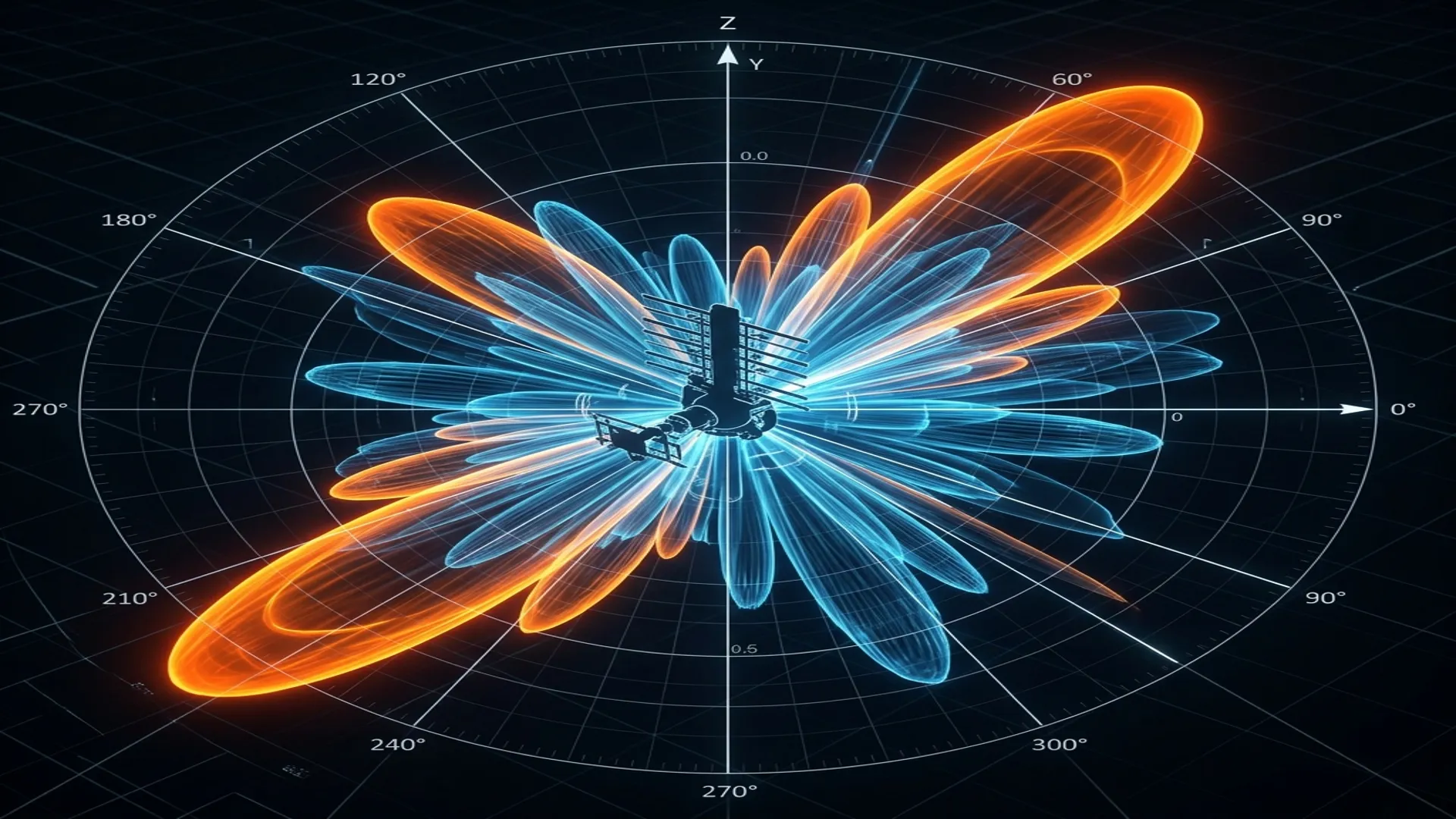
Antenna gain is the single most referenced specification in RF system design. It appears in every link budget, every radar range equation, and every compliance test report. It is also one of the most frequently misunderstood specifications, confused with directivity, conflated with effective aperture, and quoted without reference to the measurement conditions that produced the number.
This guide defines each of these quantities precisely, shows how they relate to each other mathematically, and provides the practical knowledge needed to use them correctly in real engineering work.
1. Directivity: The Pattern Shape Factor
Directivity is a measure of how concentrated an antenna's radiation is in a particular direction, relative to an isotropic radiator that spreads power equally in all directions. It is a geometric property of the radiation pattern only. It has nothing to do with losses, efficiency, or how much power you put into the antenna.
Uavg = Average radiation intensity over all directions
Prad = Total radiated power (W)
An isotropic antenna has D = 1 (0 dBi). A half-wave dipole has D = 1.64 (2.15 dBi). A typical pyramidal horn has D = 50 to 500 (17 to 27 dBi) depending on aperture size. A 1-meter parabolic dish at 10 GHz has D ≈ 11,000 (40.4 dBi).
The key insight: directivity tells you where the power goes, not how much power there is. A lossless antenna with 20 dBi of directivity concentrates its radiation into a beam that is 100 times more intense than an isotropic radiator fed with the same power. But if the antenna has 3 dB of internal loss, only half the input power reaches the radiation mechanism, and the observed gain is only 17 dBi.
2. Gain: Directivity Minus Losses
Gain is directivity multiplied by radiation efficiency. It accounts for all losses within the antenna structure: ohmic loss in conductors, dielectric loss in substrates, surface wave losses, and feed network losses. Gain is what you actually measure in an antenna test range.
D = Directivity (dimensionless or dBi)
In decibels: GdBi = DdBi + 10·log₁₀(ηrad)
dBi vs. dBd: Gain referenced to an isotropic radiator is in dBi. Gain referenced to a half-wave dipole is in dBd. The conversion is simple: dBi = dBd + 2.15. A specification of "6 dBd" is the same as "8.15 dBi." Always verify the reference. Mixing up dBi and dBd introduces a 2.15 dB error in your link budget, which is enough to make a marginal link fail.
Realized Gain vs. IEEE Gain
IEEE Std 145-2013 defines gain as the ratio of radiation intensity to the input power accepted by the antenna, divided by 4π. "Realized gain" (sometimes called "absolute gain") further accounts for impedance mismatch loss between the source and the antenna. If the antenna has a VSWR of 2.0:1, the mismatch loss is approximately 0.5 dB, and the realized gain is 0.5 dB lower than the IEEE gain.
In practice, most published gain specifications are IEEE gain (mismatch not included). To use them in a link budget, you must add a separate mismatch loss term for the actual VSWR at your operating frequency.
3. Effective Aperture: The Capture Area
Effective aperture (Ae) is the equivalent area of a perfect power collector that would intercept the same amount of power from an incident plane wave as the antenna does. It connects the antenna's gain to its physical behavior as a receiver.
G = Antenna gain (linear, not dB)
λ = Wavelength (m)
For an isotropic antenna (G = 1), the effective aperture is λ²/(4π). At 10 GHz, this is 0.72 cm². At 1 GHz, it is 716 cm². This frequency dependence is fundamental: a fixed-gain antenna captures more area at lower frequencies.
For aperture antennas (horns, dishes, phased arrays), the effective aperture relates to the physical aperture by the aperture efficiency ηap:
Ae = ηap · Aphys
| Antenna Type | Typical Gain (dBi) | Aperture Efficiency | Radiation Efficiency |
|---|---|---|---|
| Half-wave dipole | 2.15 | N/A (wire antenna) | > 95% |
| Patch antenna (microstrip) | 5 to 8 | N/A (resonant) | 70 to 90% |
| Pyramidal horn | 10 to 25 | ~51% | > 98% |
| Corrugated horn | 15 to 25 | 70 to 80% | > 98% |
| Parabolic dish | 25 to 50 | 55 to 75% | > 95% |
| Phased array (AESA) | 25 to 45 | 50 to 70% | 40 to 70% (includes TR module losses) |
| Yagi-Uda | 8 to 15 | N/A (parasitic) | 85 to 95% |
4. The Friis Transmission Equation: Putting It Together
The Friis equation ties together transmit power, antenna gains, wavelength, and distance into the fundamental link budget equation for free-space propagation:
Pt = Transmitted power (W)
Gt, Gr = Transmit and receive antenna gains (linear)
R = Distance between antennas (m)
λ = Wavelength (m)
In dB form: Pr(dBm) = Pt(dBm) + Gt(dBi) + Gr(dBi) - FSPL(dB)
Where FSPL = 20·log₁₀(4πR/λ)
Every term in this equation requires precise definitions. Pt is the power delivered to the transmit antenna (after all cable and connector losses). Gt and Gr must be IEEE gain at the specific operating frequency, not the peak gain across the band. And the (λ/4πR)² term is not actually a "loss" caused by the medium. It is the geometric spreading of the wavefront. Even in a perfectly lossless vacuum, the power density decreases as 1/R² simply because the energy is spread over an ever-larger sphere.
5. Gain Measurement Methods
Gain Comparison Method
The most common method. The antenna under test (AUT) is compared to a reference antenna with known gain (typically a standard-gain horn). Both antennas are measured in the same test setup at the same distance, and the gain difference is calculated from the received power levels. This method achieves ±0.3 to ±0.5 dB accuracy when performed carefully.
Two-Antenna Method (Friis Method)
Two identical antennas face each other at a known distance. The transmitted power, received power, frequency, and distance are measured. From the Friis equation, the gain of each antenna is calculated directly. No reference antenna is needed. Accuracy is typically ±0.5 to ±1.0 dB, limited by multipath and distance measurement precision.
Three-Antenna Method
Three antennas are measured in three pairwise combinations. This produces three equations with three unknowns (the gain of each antenna), which can be solved exactly. The three-antenna method is the primary method used by national metrology labs (NIST, PTB) for establishing gain standards. Accuracy can reach ±0.1 dB in a well-controlled environment.
Measurement Tip: The far-field distance for gain measurements is 2D²/λ, where D is the largest dimension of the antenna under test. For a 30 cm aperture at 10 GHz, the far-field distance is 6 meters. Measurements taken closer than this distance produce gain values that are systematically low due to phase curvature across the AUT aperture. If your test range is too short, use a compact range with a parabolic reflector to create a plane wave at shorter physical distances.
RF Essentials manufactures precision standard-gain horn antennas, waveguide components, and terminations used as calibration references in antenna test ranges worldwide. All products are made in the USA.
Frequently Asked Questions
What is the difference between antenna gain and directivity?
Directivity describes only the shape of the radiation pattern, how tightly an antenna concentrates power relative to an isotropic radiator. It ignores losses. Gain is directivity multiplied by radiation efficiency, so it includes ohmic, dielectric, and feed losses. An antenna with 20 dBi of directivity and 3 dB of internal loss delivers 17 dBi of gain, which is the number you measure on a test range.
How do I convert between dBi and dBd, and why does it matter?
dBi references gain to an isotropic radiator; dBd references it to a half-wave dipole. The conversion is dBi = dBd + 2.15. A horn quoted as 6 dBd is the same as 8.15 dBi. Mixing the two references injects a 2.15 dB error into a link budget, which is often enough to turn a passing margin into a dropped link, so always confirm the reference before using a published number.
Why does a fixed-gain antenna capture more power at lower frequencies?
Effective aperture scales with the square of wavelength: Ae = G times lambda squared divided by 4 pi. For an isotropic antenna the capture area is 0.72 square centimeters at 10 GHz but 716 square centimeters at 1 GHz. The same gain figure corresponds to a much larger collecting area as frequency drops, which is why lower-band links tend to close more easily for a given antenna gain.