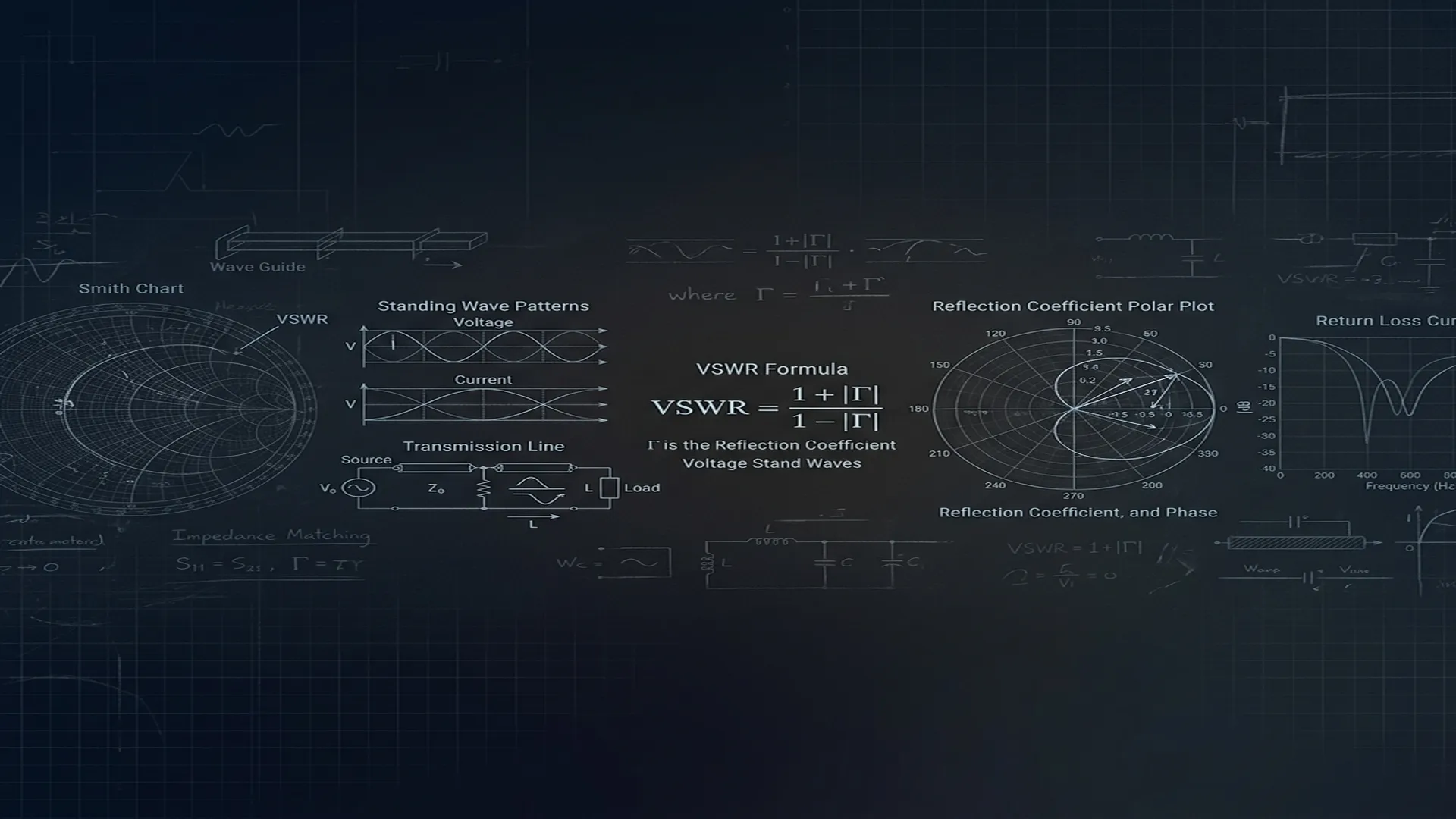
VSWR / Return Loss /
Mismatch Loss Calculator
Enter any one value and instantly get all equivalent impedance matching parameters. The most frequently used RF engineering calculator.
Convert VSWR, Return Loss & Reflection Coefficient
VSWR to Return Loss Conversion Table
Common VSWR values and their equivalent return loss, reflection coefficient, and mismatch loss. Use this table for quick lookups during design reviews or when reading component datasheets.
| VSWR | Return Loss (dB) | Γ | Mismatch Loss (dB) | % Power Reflected |
|---|---|---|---|---|
| 1.00 : 1 | ∞ | 0.000 | 0.000 | 0.0% |
| 1.05 : 1 | 32.26 | 0.024 | 0.003 | 0.06% |
| 1.10 : 1 | 26.44 | 0.048 | 0.010 | 0.23% |
| 1.15 : 1 | 23.13 | 0.070 | 0.021 | 0.49% |
| 1.20 : 1 | 20.83 | 0.091 | 0.036 | 0.83% |
| 1.30 : 1 | 17.69 | 0.130 | 0.074 | 1.69% |
| 1.40 : 1 | 15.56 | 0.167 | 0.122 | 2.78% |
| 1.50 : 1 | 13.98 | 0.200 | 0.177 | 4.00% |
| 1.75 : 1 | 11.29 | 0.273 | 0.334 | 7.44% |
| 2.00 : 1 | 9.54 | 0.333 | 0.512 | 11.11% |
| 2.50 : 1 | 7.36 | 0.429 | 0.881 | 18.37% |
| 3.00 : 1 | 6.02 | 0.500 | 1.249 | 25.00% |
| 5.00 : 1 | 3.52 | 0.667 | 2.553 | 44.44% |
| 10.00 : 1 | 1.74 | 0.818 | 4.807 | 66.94% |
What is VSWR and Why Does It Matter?
VSWR (Voltage Standing Wave Ratio) is the most common way to express the quality of an impedance match between a transmission line and its load, such as an antenna, filter, or amplifier input. When impedances are not perfectly matched, a portion of the transmitted signal reflects back toward the source, creating a standing wave pattern on the transmission line.
The VSWR is the ratio of the maximum voltage to the minimum voltage in this standing wave pattern. A perfect match produces a VSWR of 1:1, meaning no power is reflected. In practice, a VSWR of 1.5:1 or better is considered good for most applications, while high-performance systems often require 1.2:1 or better.
How VSWR, Return Loss, and Reflection Coefficient Are Related
These three parameters all describe the same physical phenomenon: the quality of an impedance match. Engineers encounter each format in different contexts, datasheets, and specifications, which is why constant conversion between them is necessary.
- VSWR is a dimensionless ratio (always ≥ 1). It is the most intuitive representation and is commonly specified for antennas and passive components. A VSWR of 1.5:1 means the maximum voltage is 1.5 times the minimum voltage.
- Return Loss is expressed in decibels (dB) and represents the ratio of incident power to reflected power. Higher return loss values indicate a better match. A return loss of 20 dB means that reflected power is 100 times smaller than incident power.
- Reflection Coefficient (Γ) is the ratio of reflected wave voltage to incident wave voltage. It ranges from 0 (perfect match) to 1 (total reflection). It is used in S-parameter analysis where S11 magnitude equals |Γ|.
- Mismatch Loss represents the actual power lost due to reflection. A VSWR of 2.0:1 results in only 0.51 dB of mismatch loss, meaning over 88% of power is still delivered to the load.
Conversion Formulas
Γ = (VSWR - 1) / (VSWR + 1)
Return Loss (dB) = -20 × log₁₀(Γ)
Mismatch Loss (dB) = -10 × log₁₀(1 - Γ²)
From Return Loss:
Γ = 10^(-RL/20)
VSWR = (1 + Γ) / (1 - Γ)
From Reflection Coefficient:
VSWR = (1 + |Γ|) / (1 - |Γ|)
Return Loss (dB) = -20 × log₁₀(|Γ|)
Worked Example
An antenna datasheet specifies a VSWR of 1.8:1 at 28 GHz. What are the equivalent return loss, reflection coefficient, and mismatch loss?
Step 2: Return Loss = -20 × log₁₀(0.2857) = 10.88 dB
Step 3: Mismatch Loss = -10 × log₁₀(1 - 0.2857²) = 0.362 dB
Step 4: % Power Reflected = Γ² × 100 = 8.16%
Result: 91.84% of the transmitted power reaches the antenna.
When to Use Each Parameter
- Antenna specifications: VSWR is the standard format. Most antenna datasheets specify VSWR across the operating bandwidth.
- Network analyzer measurements: Return loss or S11 magnitude are the native measurement formats. S11 in dB is the same as return loss with a negative sign.
- System-level analysis: Mismatch loss matters when calculating the total loss budget of a signal chain. It tells you how much power is actually lost due to the impedance mismatch.
- Component cascading: Reflection coefficient is used in S-parameter cascade calculations where both magnitude and phase matter.
Common VSWR Specifications by Application
| Application | Typical VSWR Spec | Return Loss |
|---|---|---|
| Test & Measurement (50 Ω loads) | 1.05 : 1 | > 32 dB |
| Precision calibration standards | 1.02 : 1 | > 40 dB |
| Military/aerospace antennas | 1.3 : 1 | > 17.7 dB |
| Commercial satcom terminals | 1.5 : 1 | > 14 dB |
| General purpose antennas | 2.0 : 1 | > 9.5 dB |
| Broadband / wideband components | 2.5 : 1 | > 7.4 dB |
Frequently Asked Questions
What is VSWR?
VSWR (Voltage Standing Wave Ratio) is a measure of impedance matching quality between a transmission line and its load. It is the ratio of maximum to minimum voltage in the standing wave pattern. A VSWR of 1:1 represents a perfect match with no reflected power. Typical acceptable values range from 1.2:1 to 2.0:1 depending on the application.
How do you convert VSWR to return loss?
To convert VSWR to return loss: first calculate the reflection coefficient Γ = (VSWR - 1) / (VSWR + 1), then Return Loss (dB) = -20 × log₁₀(Γ). For example, a VSWR of 1.5:1 gives Γ = 0.2, which equals 13.98 dB return loss.
What is a good VSWR for an antenna?
For most communications antennas, a VSWR of 2.0:1 or better (lower) is considered acceptable, corresponding to about 11% reflected power. High-performance systems typically specify 1.5:1 or better. Military and aerospace applications often require 1.3:1 or better across the operating band.
What is mismatch loss and why does it matter?
Mismatch loss is the power lost due to signal reflection caused by an impedance mismatch. It is calculated as Mismatch Loss (dB) = -10 × log₁₀(1 - Γ²). Even a VSWR of 2.0:1 only produces 0.51 dB of mismatch loss. Mismatch loss matters in system-level link budgets where every fraction of a dB of loss affects performance.
What is the difference between VSWR and S11?
S11 is the input reflection coefficient measured by a network analyzer, expressed either as a complex number (magnitude and phase) or in dB. When S11 is expressed in dB magnitude only, it equals the negative of return loss. VSWR can be calculated from S11 magnitude using: VSWR = (1 + |S11|) / (1 - |S11|). Both describe impedance matching quality, but S11 includes phase information that VSWR does not.
Can VSWR damage equipment?
Yes. High VSWR means significant power is reflected back toward the transmitter. In high-power systems, this reflected power can damage amplifier output stages, cause overheating, and trigger protection circuits. Most power amplifiers include VSWR protection that reduces output power or shuts down if VSWR exceeds a safe threshold (typically 3:1 or higher).