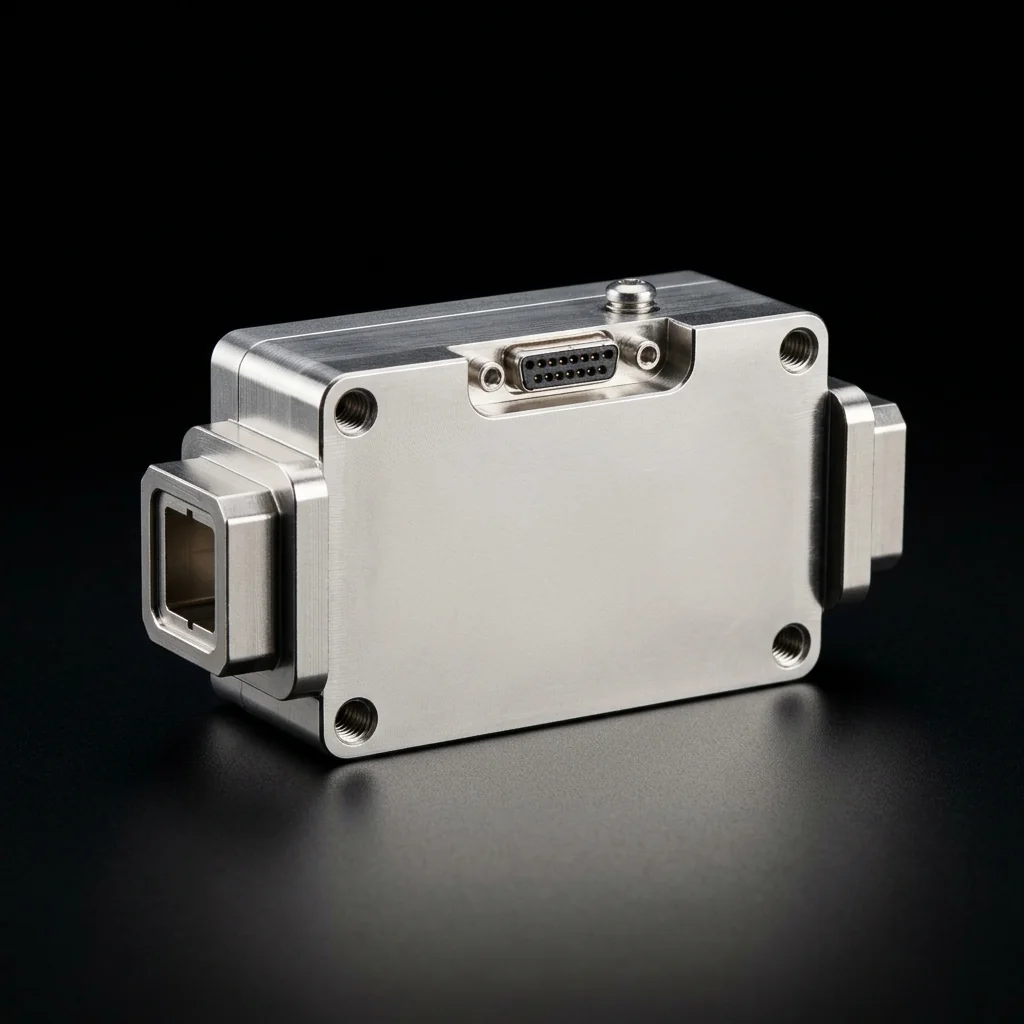
Low Noise
Amplifiers
GaAs pHEMT and InP MMIC-based low noise amplifier modules with waveguide interfaces. Optimized for minimum noise figure, stable gain, and high receiver sensitivity across mmWave and microwave bands.
Maximum Sensitivity for Receiver Front Ends
RF Essentials low noise amplifiers are engineered for receiver systems where preserving signal-to-noise ratio is the primary design objective. Each module uses carefully selected low-noise MMIC devices with optimized matching networks, bias circuits, and waveguide transitions to minimize added noise at the front end of the signal chain.
Our LNAs cover the standard waveguide bands from WR-42 (18 GHz) through WR-10 (110 GHz). GaAs pHEMT MMICs are the standard for noise figures below 4 dB across most bands. At the highest frequencies, InP HEMT technology provides the lowest achievable noise figures for W-band and beyond. Every module is built in split-block machined housings with gold-plated waveguide channels.
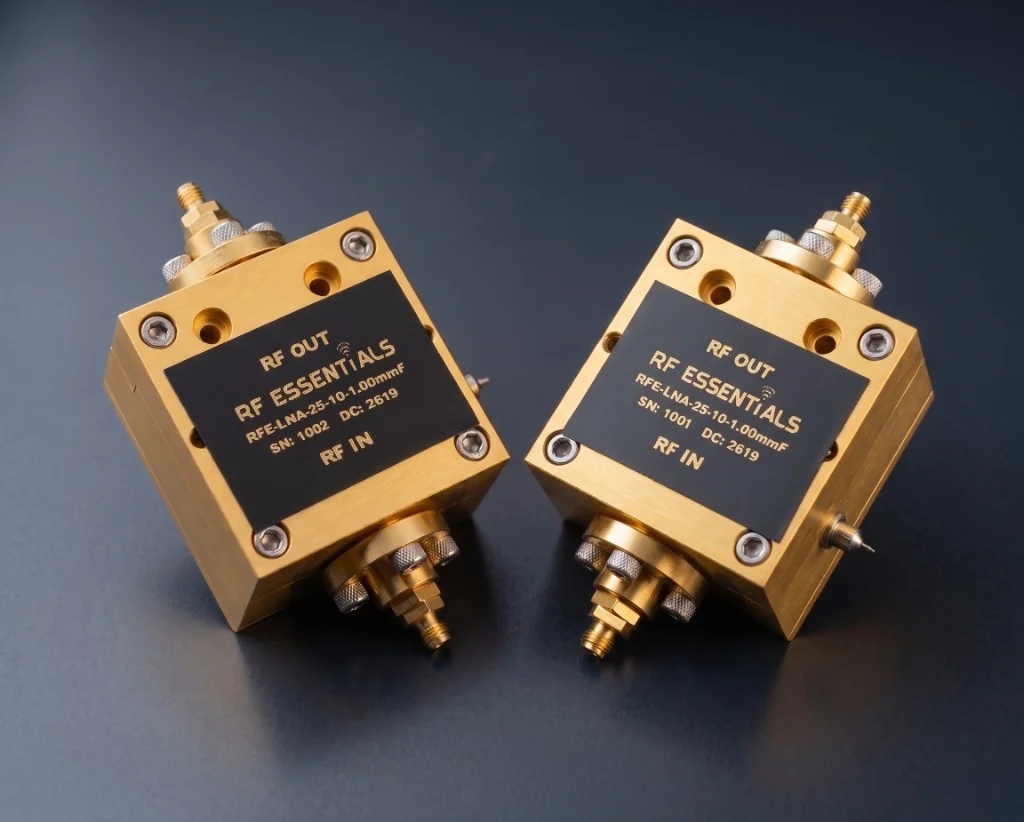
Low Noise Amplifiers by Waveguide Band
Each row is a standard low noise amplifier model spanning Ka-band through W-band, from DC to 110 GHz. Specifications shown are typical for standard configurations. Custom frequency ranges, noise optimization, and packaging options are available on request.
33 Models| Description | Low Freq (GHz) | High Freq (GHz) | Gain (dB) | Noise Figure (dB) | Output Power (dBm) | Output Power Psat (dBm) | Input/Output Connector | DC Bias |
|---|---|---|---|---|---|---|---|---|
| DC - 60GHz Low Noise Amplifier | 1 | 60 | 30 | 5 | 12 | 10 | 1.85 mm Female Coaxial Connector | +8V |
| Ka-band Low Noise Amplifier | 26.5 | 40 | 20 | 3.5 | WR-28 waveguide, UG-599/U Flange | |||
| Ka-band Low Noise Amplifier | 26.5 | 40 | 20 | 3 | 10 | 2.92mm K Female Coaxial Connector | +8V | |
| Ka-band Low Noise Amplifier | 26.5 | 40 | 30 | 3 | 18 | WR-28 waveguide, UG-599/U Flange | +8V | |
| Ka-band Low Noise Amplifier | 26.5 | 40 | 40 | 4.5 | 10 | 2.4mm Female Coaxial Connector | +8V | |
| Q-band Low Noise Amplifier | 33 | 50 | 10-15 | 5.5 | 8 | WR-22 Waveguide with UG-383/U Flanges | +8-12V | |
| Q-band Low Noise Amplifier | 33 | 50 | 20 | 5.5 | 10 | WR-22 Waveguide with UG-383/U Flanges | +8V | |
| Q-band Low Noise Amplifier | 33 | 50 | 30 | 5.5 | 10 | WR-22 Waveguide with UG-383/U Flanges | +8V | |
| Q-band Low Noise Amplifier | 33 | 50 | 40 | 6 | 10 | WR-22 Waveguide with UG-383/U Flanges | +8V | |
| U-band Low Noise Amplifier | 40 | 60 | 15 | 5 | 10 | WR-19 Waveguide, UG-383/U-M Flange | +12-15V | |
| U-band Low Noise Amplifier | 40 | 60 | 20 | 5 | 10 | WR-19 Waveguide, UG-383/U-M Flange | +8V | |
| U-band Low Noise Amplifier | 40 | 60 | 30 | 4.5 | 15 | WR-19 Waveguide, UG-383/U-M Flange | +6V | |
| U-band Low Noise Amplifier | 40 | 60 | 30 | 5 | 15 | WR-19 Waveguide, UG-383/U-M Flange | +6V | |
| U-band Low Noise Amplifier | 40 | 60 | 40 | 5 | 13 | WR-19 Waveguide, UG-383/U-M Flange | +6V | |
| U-band Low Noise Amplifier | 50 | 66 | 22 | 5 | 22 | WR-19 Waveguide, UG-383/U-M Flange | +6V | |
| V-band Low Noise Amplifier | 50 | 68 | 35 | 18 | WR-15 Waveguide, UG-385/U Flange | +6V | ||
| V-band Low Noise Amplifier | 50 | 75 | 35 | 18 | WR-15 Waveguide, UG-385/U Flange | +6V | ||
| V-band Low Noise Amplifier | 50 | 75 | 35 | 5 | 13 | 1.85mm Female Coaxial Connector | +6V | |
| V-band Low Noise Amplifier | 50 | 75 | 20 | 5 | 15 | WR-15 Waveguide, UG-385/U Flange | +6V | |
| V-band Low Noise Amplifier | 50 | 75 | 30 | 5 | 10 | WR-15 Waveguide, UG-385/U Flange | +6V | |
| V-band Low Noise Amplifier | 50 | 75 | 40 | 5 | 9 | WR-15 Waveguide, UG-385/U Flange | +6-+8V | |
| E-band Low Noise Amplifier | 60 | 90 | 15 | 4.5 | 8 | WR-12 Waveguide, UG-387/U Flange | +8V | |
| E-band Low Noise Amplifier | 60 | 90 | 20 | 5.5 | 10 | WR-12 Waveguide, UG-387/U Flange | +8V | |
| E-band Low Noise Amplifier | 60 | 90 | 20 | 5 | 12 | WR-12 Waveguide, UG-387/U Flange | +8V | |
| E-band Low Noise Amplifier | 60 | 90 | 25 | 4.5 | 8 | WR-12 Waveguide, UG-387/U Flange | +8V | |
| E-band Low Noise Amplifier | 60 | 90 | 30 | 4.5 | 8 | WR-12 Waveguide, UG-387/U Flange | +8V | |
| E-band Low Noise Amplifier | 72 | 82 | 30 | 4 | 14 | 8 | WR-12 Waveguide, UG-387/U Flange | +8V |
| W-band Low Noise Amplifier | 75 | 110 | 10 | 5.5 | 10 | WR-10 Waveguide, UG-387/U-M Flanges | +8V | |
| W-band Low Noise Amplifier | 75 | 110 | 20 | 5.5 | 10 | WR-10 Waveguide, UG-387/U-M Flanges | +8V | |
| W-band Low Noise Amplifier | 75 | 110 | 20 | 12 | 10 | WR-10 Waveguide, UG-387/U-M Flanges | +8V | |
| W-band Low Noise Amplifier | 75 | 110 | 25 | 5.5 | 10 | WR-10 Waveguide, UG-387/U-M Flanges | +8V | |
| W-band Low Noise Amplifier | 75 | 110 | 30 | 3 | 10 | WR-10 Waveguide, UG-387/U-M Flanges | +8V | |
| W-band Low Noise Amplifier | 75 | 110 | 35 | 5 | 10 | WR-10 Waveguide, UG-387/U-M Flanges | +8V |
All specifications are typical and subject to change. Contact engineering for detailed datasheets and custom requirements.
Need a specific noise figure or custom configuration?
Our engineering team can provide pricing, datasheets, and custom configurations for any low noise amplifier in the catalog. Custom sub-band noise optimization and ruggedized packaging available.
Design & Construction
GaAs pHEMT MMICs are selected for their inherently low noise characteristics. InP HEMT devices are used at W-band and above where the lowest achievable noise figures are required for sensitive receiver front ends.
Input and output matching networks are individually tuned for minimum noise figure across the operating band. Careful impedance optimization at the MMIC-to-waveguide transition preserves noise performance.
Precision CNC-machined split-block construction with gold-plated waveguide channels. Ensures low insertion loss, repeatable performance, and hermetic sealing where required.
Every unit ships with measured noise figure, gain, VSWR, and S-parameter data across the full operating band. Detailed noise temperature and Y-factor measurement reports are available on request.
Built-in bias sequencing and gate voltage regulation ensure safe power-up and stable operating point. Low-current bias networks minimize thermal noise contribution from the DC supply path.
Custom noise optimization for specific sub-bands, multi-stage LNA cascades, modified flange interfaces, and integrated receiver sub-assemblies tailored to your system noise budget.
Where Our LNAs Perform
RF Essentials low noise amplifiers are deployed in receiver front ends across satellite downlinks, radar receivers, radio astronomy, and high-sensitivity communications systems. Each module is designed to minimize system noise figure at the point where it matters most.
- Satellite Downlink Receivers
- Radar Receiver Front Ends
- SIGINT & EW Receivers
- 5G / 6G FR2 Base Stations
- Radio Astronomy & Radiometry
- Test & Measurement Systems
- VSAT & Ground Terminals
- Spectrum Monitoring Systems

Other Amplifier Categories
High Power Amplifiers
GaN and GaAs MMIC-based solid-state power amplifier modules with waveguide interfaces. Split-block construction for maximum output power across mmWave bands.
View CategoryMedium Power Amplifiers
Versatile MMIC-based amplifier modules for driver stages, transmit chains, and signal conditioning across mmWave bands.
View CategoryFrequently Asked Questions
Noise figure (NF) measures how much additional noise an amplifier adds to the signal. In a receiver chain, the first amplifier's noise figure dominates the overall system noise performance (per the Friis equation). A lower noise figure at the front end means better receiver sensitivity and the ability to detect weaker signals at greater distances.
RF Essentials offers low noise amplifier modules across 9 standard waveguide bands from WR-42 (18 GHz) through WR-6 (170 GHz). Noise figures range from as low as 2 dB at K-band to 6-8 dB at D-band. Custom sub-band optimization is available for applications with specific noise budgets.
GaAs pHEMT technology provides excellent noise performance from K-band through V-band (18-75 GHz) and is the industry standard for most LNA applications. InP HEMT technology achieves lower noise figures at W-band and above (75+ GHz) due to superior electron mobility at the highest frequencies. RF Essentials selects the optimal technology for each frequency band.
The LNA should be placed as close to the antenna or receiver input as possible, before any lossy components like filters, switches, or long cable runs. Any insertion loss ahead of the LNA directly degrades the system noise figure. At mmWave frequencies, even 1 dB of loss before the LNA can significantly reduce receiver sensitivity.