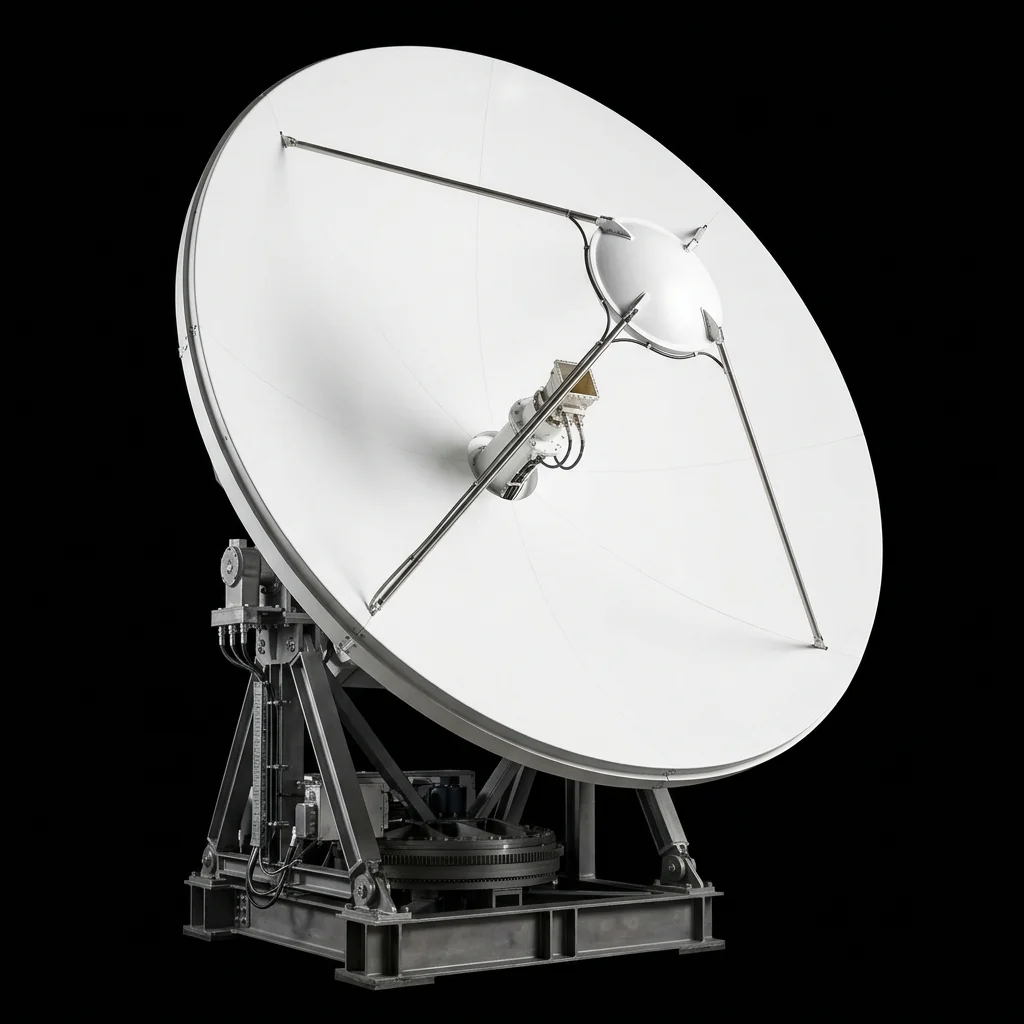
Cassegrain
Antennas
Dual-reflector antenna systems combining a primary parabolic dish with a hyperbolic sub-reflector. Compact feed integration, higher aperture efficiency, and reduced feed blockage for satellite communications, radar, and precision measurement from 5 GHz to 110 GHz.
Dual-Reflector Architecture for Maximum Efficiency
RF Essentials Cassegrain antennas use a primary parabolic reflector paired with a secondary hyperbolic sub-reflector. Incoming RF energy reflects from the main dish to the sub-reflector, which redirects it into the feed assembly mounted behind the primary aperture. This geometry keeps the feed and receiver hardware compact, reduces waveguide run lengths, and minimizes aperture blockage.
Compared to prime focus designs, the Cassegrain configuration delivers higher aperture efficiency, improved feed accessibility for maintenance, and better thermal management for active receiver or transmitter integration. Available in aluminum for lab precision and fiberglass for outdoor durability.
Cassegrain Antennas by Diameter
Each row represents a standard Cassegrain reflector configuration offered by RF Essentials. Gain values are typical at representative mid-band frequencies. Custom diameters, frequency optimization, sub-reflector geometry, and feed configurations are available on request.
6 Standard Configurations| Diameter | Frequency Range | Typical Gain | Beamwidth | Polarization | Material | Feed Interface |
|---|---|---|---|---|---|---|
| 10" | 18 - 110 GHz | 34 - 48 dBi | 2.5° - 0.5° | Linear | Aluminum | WR-42 / WR-10 |
| 12" | 18 - 110 GHz | 36 - 49 dBi | 2° - 0.4° | Linear | Aluminum / Fiberglass | WR-42 / WR-10 |
| 18" | 5 - 75 GHz | 38 - 51 dBi | 1.3° - 0.3° | Linear | Aluminum / Fiberglass | WR-187 / WR-15 |
| 24" | 5 - 50 GHz | 40 - 52 dBi | 1° - 0.25° | Linear | Aluminum / Fiberglass | WR-187 / WR-22 |
| 36" | 5 - 40 GHz | 44 - 54 dBi | 0.7° - 0.2° | Linear | Fiberglass | WR-187 / WR-28 |
| 48" | 5 - 40 GHz | 47 - 56 dBi | 0.5° - 0.15° | Linear | Fiberglass | WR-187 / WR-28 |
All specifications are typical at representative mid-band frequencies. Contact engineering for detailed patterns, datasheets, and custom sub-reflector configurations.
Need a specific diameter or frequency configuration?
Our engineering team can provide pricing, datasheets, custom sub-reflector geometry, and feed integration for any Cassegrain configuration in the catalog.
Design & Construction
Primary parabolic reflector combined with a precision-shaped hyperbolic sub-reflector. This folded optical path improves aperture illumination and reduces feed blockage compared to single-reflector designs.
Feed assembly mounts behind the primary reflector, shortening waveguide runs and simplifying integration with LNAs, HPAs, OMTs, and receiver sub-assemblies.
The Cassegrain geometry achieves 55-75% aperture efficiency, typically exceeding prime focus designs. Sub-reflector shaping further optimizes illumination taper and spillover control.
Every antenna ships with measured gain, VSWR, beamwidth, sidelobe levels, and radiation pattern data. E-plane, H-plane, and cross-polarization cuts provided as standard.
Aluminum reflectors for lab-grade surface accuracy and dimensional stability. Metallized fiberglass for reduced weight, corrosion resistance, and long-term outdoor deployment.
Custom diameters, sub-reflector profiles, polarization schemes (linear/circular), specialized mounting, and integrated receiver or transmitter sub-assemblies available on request.
Where Our Cassegrains Perform
RF Essentials Cassegrain antennas are deployed where compact feed integration, high aperture efficiency, and narrow beamwidth are critical. The dual-reflector design is preferred for systems that benefit from rear-mounted feeds and reduced waveguide complexity.
- SATCOM Ground Terminals
- Telemetry & Tracking Systems
- Radar Cross-Section (RCS) Testing
- Antenna Measurement Ranges
- Point-to-Point Microwave Links
- 5G / 6G mmWave Research
- Defense & Surveillance Radar
- Radio Astronomy Receivers

Other Antenna Categories
Prime Focus Antennas
Single-reflector parabolic antennas with feed at the focal point. Simple design for high gain across mmWave bands.
View CategoryStandard Gain Horns
Pyramidal horn antennas with rectangular waveguide interfaces for calibration, gain measurement, and reference applications.
View CategoryFrequently Asked Questions
A Cassegrain antenna is a dual-reflector design using a primary parabolic dish and a secondary hyperbolic sub-reflector. RF energy reflects from the main dish to the sub-reflector, which redirects it into a feed assembly mounted behind the primary aperture. This folded optical path delivers high gain with compact feed integration and reduced aperture blockage.
A prime focus antenna places the feed directly at the focal point of the reflector, which can cause aperture blockage from the feed and support struts. A Cassegrain uses a secondary sub-reflector to redirect energy to a rear-mounted feed, reducing blockage, shortening waveguide runs, and enabling more compact receiver integration. Cassegrain designs typically achieve higher aperture efficiency.
RF Essentials offers Cassegrain antennas in 6 standard diameters from 10 inches to 48 inches, covering frequencies from 5 GHz to 110 GHz. Larger diameters provide higher gain and narrower beamwidths for long-range links and satellite terminals. Custom diameters and sub-reflector configurations are available on request.
Aluminum reflectors provide rigid construction with excellent surface accuracy for lab and indoor use. Metallized fiberglass composite reflectors offer reduced weight, corrosion resistance, and environmental durability for outdoor ground stations and field installations. Both materials maintain their parabolic and hyperbolic geometry over extended service life.