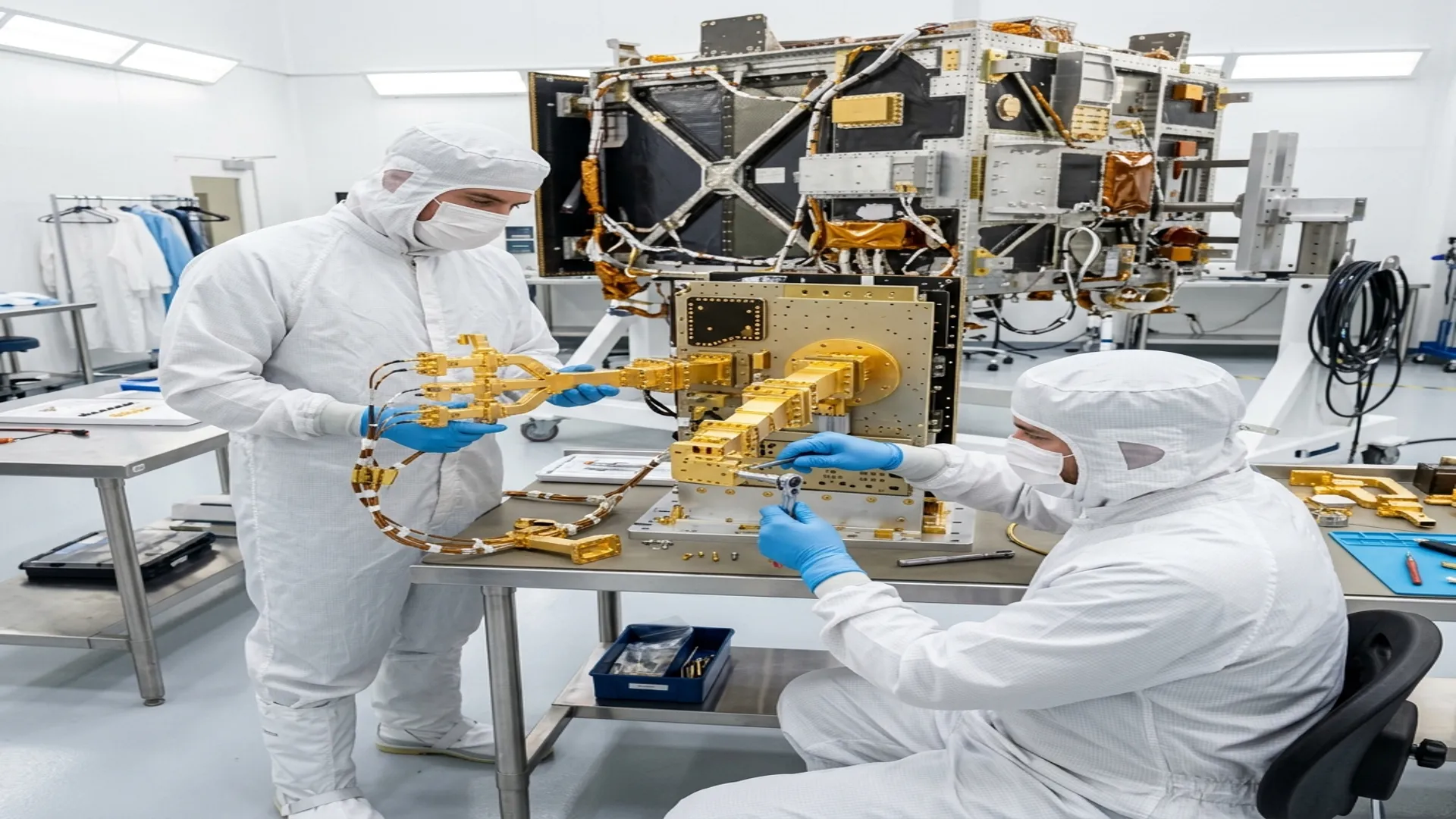
An RF component that works flawlessly on a test bench in St. Petersburg, Florida may fail catastrophically in orbit 600 km above the Earth. Space is not just a vacuum. It is a radiation bath, a thermal furnace on one side and a deep freeze on the other, and a vibration environment during launch that would destroy most commercial hardware. "Space-qualified" is not a marketing label. It is a specific set of environmental tests, material certifications, and manufacturing controls that prove a component will survive and perform for 15 or more years in the most hostile operating environment humans have ever engineered for.
This article covers what space qualification means for passive and active RF components, the specific hazards that drive the qualification requirements, and the standards and test protocols that govern the process.
1. The Space Environment: What Kills RF Hardware
Radiation
The space radiation environment consists of trapped charged particles (the Van Allen belts), solar particle events, and galactic cosmic rays. These particles cause two categories of damage to electronic components:
- Total Ionizing Dose (TID): Cumulative radiation exposure that degrades semiconductor performance over time. Measured in krad(Si). A GEO satellite accumulates approximately 10 to 50 krad over a 15-year mission. LEO satellites in low-inclination orbits see 5 to 20 krad over 5 years.
- Single Event Effects (SEE): A single high-energy particle strikes a transistor junction and deposits enough charge to cause a bit flip (single event upset), a latch-up (potentially destructive), or a gate rupture (permanently destructive). SEE affects digital circuits, ADCs, DACs, and phase-locked loops in active RF components.
Passive waveguide components (terminations, couplers, bends, twists) are inherently radiation tolerant because they contain no semiconductor junctions. Their absorber materials (carbon-loaded epoxy, ferrite) are stable under radiation. Active components (LNAs, BUCs, frequency converters) require radiation-hardened semiconductor processes or radiation-tolerant design techniques.
Thermal Cycling
A satellite in LEO passes through the Earth's shadow every 90 minutes, cycling between full sun (+120°C surface temperature) and eclipse (-150°C) approximately 5,800 times per year. Over a 7-year LEO mission, that is 40,000+ thermal cycles. RF components must survive this cycling without mechanical failure of solder joints, wire bonds, brazed joints, or adhesive bonds.
Vacuum and Outgassing
In the vacuum of space, many materials release trapped gases and volatile compounds. This outgassing causes two problems: mass loss (degrading material properties) and recontamination (outgassed molecules can condense on optical surfaces, solar cells, and RF windows, degrading system performance).
ASTM E595 Standard: The outgassing test standard for space materials. Components must demonstrate Total Mass Loss (TML) less than 1.0% and Collected Volatile Condensable Material (CVCM) less than 0.1%. Any adhesive, potting compound, gasket, O-ring, or absorber material used in a space-qualified RF component must pass ASTM E595. NASA maintains a public database of tested materials at outgassing.nasa.gov.
2. Qualification Standards
| Standard | Scope | Key Tests |
|---|---|---|
| MIL-STD-883 | Microcircuits and semiconductors | TID, SEE, thermal shock, moisture resistance, die shear |
| MIL-PRF-38534 | Hybrid microcircuits | Hermetic seal, thermal cycle, vibration, DPA |
| ECSS-Q-ST-60C | European space components (ESA) | Procurement, screening, qualification lots |
| NASA GSFC S-311 | NASA-specific component qualification | Extended TID, lot-specific testing, DPA |
| ASTM E595 | Outgassing of materials | TML < 1.0%, CVCM < 0.1% |
| MIL-STD-1540 | System-level environmental test | Thermal vacuum, vibration, acoustic, shock |
3. Passive RF Components: What Gets Tested
Waveguide components (terminations, couplers, bends, filters, transitions) are mechanically simple, but space qualification still requires extensive testing:
- Thermal vacuum cycling: 100+ cycles from -55°C to +100°C under vacuum (10⁻⁵ Torr or lower). RF performance (VSWR, insertion loss) measured at temperature extremes.
- Random vibration: 14.1 g-rms across 20 to 2000 Hz for 2 minutes per axis (3 axes). Simulates launch environment. Functional test before and after.
- Sine vibration: Swept sine from 5 to 100 Hz at up to 25g. Searches for mechanical resonances that could cause fatigue failure.
- Outgassing test: ASTM E595 on all non-metallic materials (absorbers, adhesives, gaskets).
- Hermetic seal test (if pressurized): Helium fine leak rate below 1 × 10⁻⁸ atm·cc/sec.
4. The Path to Flight Heritage
Flight heritage, the documented record of a component successfully operating in space, is the most valuable qualification credential in the satellite industry. A component with flight heritage on a major GEO platform or a large LEO constellation has a proven track record that no amount of ground testing can fully replicate.
For new suppliers, the path to flight heritage typically follows this sequence:
- Material characterization: ASTM E595 outgassing, thermal conductivity, CTE measurement
- Component-level qualification: Environmental testing per MIL-STD-1540 or program-specific requirements
- Proto-flight testing: Qualification-level testing on the actual flight unit (higher vibration levels than acceptance, shorter duration than full qualification)
- Mission acceptance: Acceptance testing at lower levels to screen for workmanship defects
- On-orbit performance: Telemetry confirmation that the component is performing to specification in space
RF Essentials manufactures waveguide components using space-compatible materials and processes. Our aluminum alloy housings, silver-plated interiors, and low-outgassing absorbers are designed for demanding environments. Contact us to discuss your space qualification requirements.
Frequently Asked Questions
What does space-qualified actually mean for an RF component?
It is not a marketing label but a specific set of environmental tests, material certifications, and manufacturing controls that prove a component will survive and perform for 15 or more years in orbit. That covers total ionizing dose and single-event radiation effects, thermal-vacuum cycling between extreme hot and cold, launch vibration and shock, and low outgassing. It is what separates true flight hardware from a bench part that works fine on Earth.
Why are passive waveguide components inherently radiation tolerant?
Passive parts like terminations, couplers, bends, and twists contain no semiconductor junctions, so the total ionizing dose and single-event effects that degrade or destroy transistors, ADCs, and phase-locked loops simply do not affect them. Their absorber materials, carbon-loaded epoxy and ferrite, are stable under radiation. Active components such as LNAs and block upconverters instead require radiation-hardened semiconductor processes or radiation-tolerant design techniques.
What is the outgassing requirement for space materials?
Under vacuum, many materials release trapped gases that cause mass loss and recontaminate optical surfaces, solar cells, and RF windows. The ASTM E595 standard requires a total mass loss below 1.0 percent and collected volatile condensable material below 0.1 percent. Any adhesive, potting compound, gasket, O-ring, or absorber used in a space-qualified RF component must pass it, and NASA maintains a public database of tested materials.