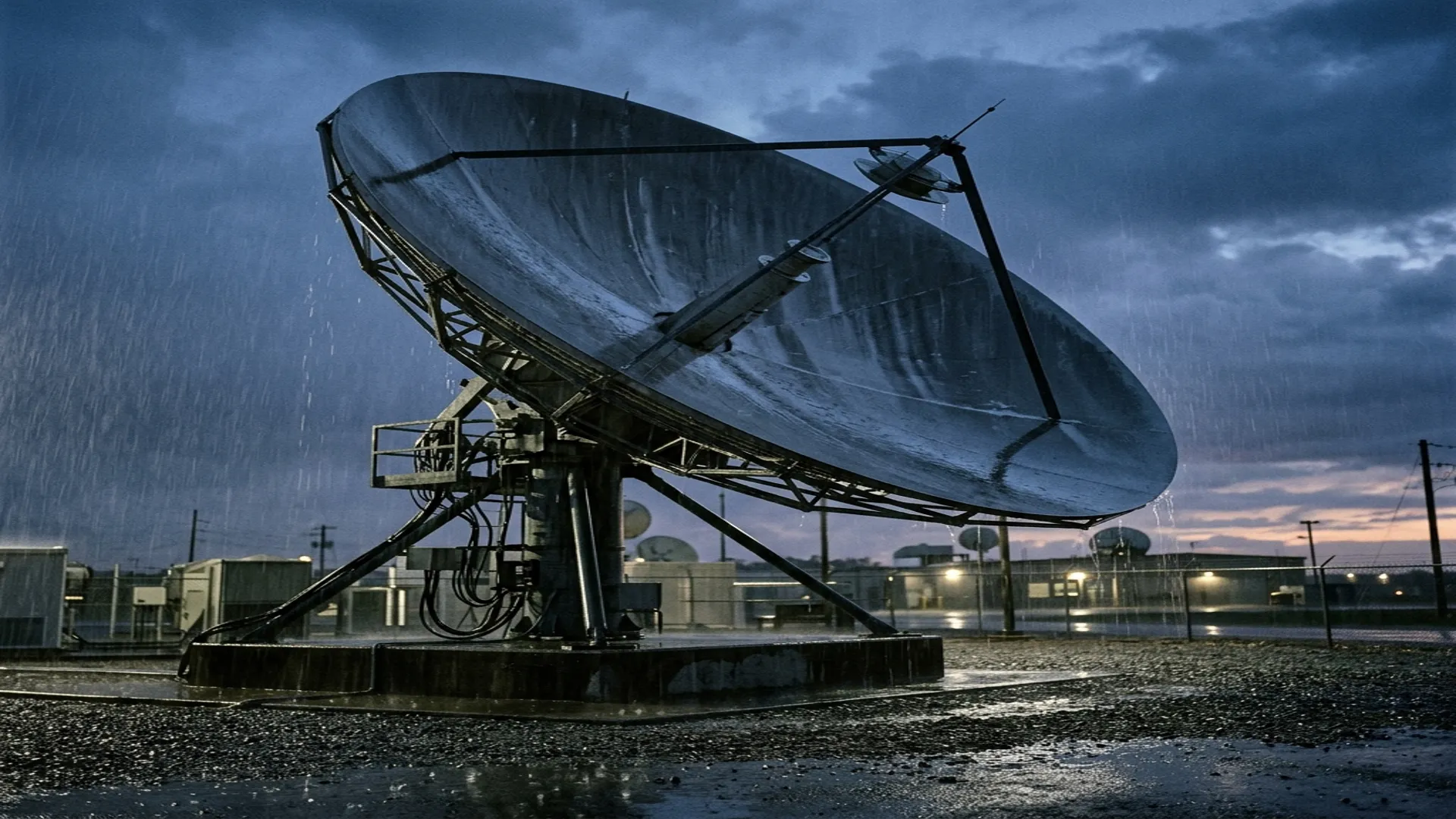
Ka-band satellite communications offer twice the bandwidth of Ku-band in half the antenna aperture. The trade-off is rain. Water droplets between 0.5 and 5 mm in diameter are resonant absorbers and scatterers at Ka-band frequencies (26.5 to 40 GHz), and a moderate thunderstorm can add 10 to 30 dB of path loss to a satellite link that already operates with single-digit link margins. Rain fade is not a nuisance at Ka-band. It is the dominant design constraint.
This article covers the physics of rain attenuation, the ITU prediction models, and the four engineering techniques used to maintain 99.9% or better link availability in rain-prone regions.
1. The Physics of Rain Attenuation
Rain attenuation at microwave frequencies is caused by two mechanisms: absorption (water converts RF energy to heat) and scattering (water drops redirect RF energy away from the receiver). The total attenuation depends on the rain rate (mm/hr), the drop size distribution, the path length through the rain cell, and the frequency.
| Frequency | Attenuation at 25 mm/hr | Attenuation at 50 mm/hr | Attenuation at 100 mm/hr |
|---|---|---|---|
| 12 GHz (Ku-band) | 1.5 dB/km | 3.5 dB/km | 7.5 dB/km |
| 20 GHz (Ka-band downlink) | 5.0 dB/km | 10.0 dB/km | 20.0 dB/km |
| 30 GHz (Ka-band uplink) | 8.5 dB/km | 17.0 dB/km | 34.0 dB/km |
| 50 GHz (Q-band) | 13.0 dB/km | 24.0 dB/km | 45.0 dB/km |
The uplink (30 GHz) is hit harder than the downlink (20 GHz) because attenuation increases with frequency. This asymmetry is a critical factor in ground station design: the uplink fades first and fades deeper.
2. ITU Rain Zone Model
The ITU-R P.837 and P.618 recommendations provide the standard method for predicting rain attenuation exceeded for a given percentage of time. The model uses climate zone data to determine the expected rain rate for a given availability target, then calculates the path attenuation through a rain cell of estimated height and horizontal extent.
Key Takeaway: A ground station in Miami (ITU rain zone N) must budget approximately 15 dB more fade margin at Ka-band than a station in Phoenix (zone B) for the same 99.9% availability target. Site selection is the single most impactful rain fade mitigation technique, and it costs nothing in hardware.
3. Mitigation Technique 1: Adaptive Coding and Modulation (ACM)
ACM dynamically adjusts the modulation order and forward error correction (FEC) code rate in response to changing link conditions. When the link is clear, the system uses high-order modulation (16-APSK, 32-APSK) for maximum throughput. When rain fade degrades the SNR, the system drops to lower-order modulation (QPSK, 8-PSK) with stronger FEC coding to maintain the link at reduced throughput.
DVB-S2X, the current broadcast satellite standard, supports ACM with modulation/coding combinations ranging from QPSK 1/4 (requiring only 0.5 dB SNR) to 256-APSK 3/4 (requiring 16+ dB SNR). This gives the system approximately 15 dB of dynamic range to absorb rain fade without dropping the link entirely.
4. Mitigation Technique 2: Uplink Power Control (UPC)
UPC increases the ground station transmit power when rain fade is detected on the uplink. A beacon receiver at the ground station monitors the satellite downlink signal level; when the downlink attenuates (indicating rain in the path), the uplink transmitter power is increased by a corresponding amount to maintain constant signal level at the satellite transponder input.
Typical UPC range is 5 to 10 dB for standard BUCs and up to 15 dB for high-power systems. The BUC (block upconverter) must have sufficient power headroom to support UPC, which means the nominal operating power is 5 to 15 dB below the P1dB compression point. GaN BUCs are increasingly preferred for UPC applications because their broader dynamic range and higher saturated power allow deeper UPC without linearity degradation.
5. Mitigation Technique 3: Site Diversity
Site diversity exploits the fact that rain cells are localized. Two ground stations separated by 20 to 50 km rarely experience simultaneous deep fades. Traffic is routed to whichever station has the better link at any given moment. Site diversity can provide 10 to 15 dB of effective fade margin improvement.
The cost is obvious: you need two complete ground stations plus a high-speed terrestrial interconnect between them. Site diversity is standard practice for gateway stations serving GEO HTS (High Throughput Satellite) systems and is becoming common for LEO constellation gateways where per-gateway throughput is high enough to justify the redundancy.
6. Mitigation Technique 4: Antenna Oversizing
A larger antenna aperture provides more gain, which directly offsets rain attenuation. Increasing the antenna diameter from 2.4m to 3.7m adds approximately 3.8 dB of gain. This is the brute-force approach: no software, no dynamic control, just more metal collecting more signal. Combined with a low-noise front end (cryogenic LNA or cooled LNB), antenna oversizing can add 5 to 8 dB of effective margin.
7. RF Hardware Implications
- BUCs with UPC headroom: GaN-based BUCs rated for 20 to 80W with 10 to 15 dB UPC dynamic range.
- Low-noise receive chain: LNAs with noise figures below 1.5 dB to maximize clear-sky margin, leaving more headroom for rain fade absorption.
- Waveguide with low insertion loss: Every 0.1 dB of waveguide loss reduces the rain fade budget. Precision WR-28 and WR-42 runs with polished interiors and properly torqued flanges are essential.
- Pressurizable waveguide: Outdoor waveguide runs must be pressurized to prevent moisture ingress, which would add dielectric loss on top of the atmospheric rain loss.
RF Essentials manufactures precision Ka-band waveguide components, feed assemblies, and pressurizable runs for satellite ground station applications. Low insertion loss, full VSWR test data, and short lead times.
Frequently Asked Questions
Why is rain the dominant design constraint at Ka-band?
Water droplets between 0.5 and 5 mm across are resonant absorbers and scatterers at Ka-band frequencies of 26.5 to 40 GHz, so a moderate thunderstorm can add 10 to 30 dB of path loss to a link that already runs on single-digit margins. The asymmetry matters too: the uplink near 30 GHz fades first and fades deeper than the 20 GHz downlink, because rain attenuation increases with frequency.
What is the simplest and cheapest way to reduce Ka-band rain fade?
Site selection. A ground station in Miami, ITU rain zone N, must budget roughly 15 dB more fade margin at Ka-band than one in Phoenix, zone B, for the same 99.9 percent availability target. Choosing a drier site costs nothing in hardware yet is the single most impactful mitigation. Beyond that, adaptive coding and modulation, uplink power control, site diversity, and antenna oversizing each add further margin.
How do adaptive coding and uplink power control fight rain fade?
Adaptive coding and modulation drops from high-order schemes like 32-APSK down to robust QPSK with stronger forward error correction as the SNR falls, which gives DVB-S2X about 15 dB of dynamic range while trading throughput rather than dropping the link. Uplink power control raises the block upconverter's transmit power when a beacon receiver detects downlink fade, typically by 5 to 15 dB, which requires the BUC to normally run that far below its compression point.