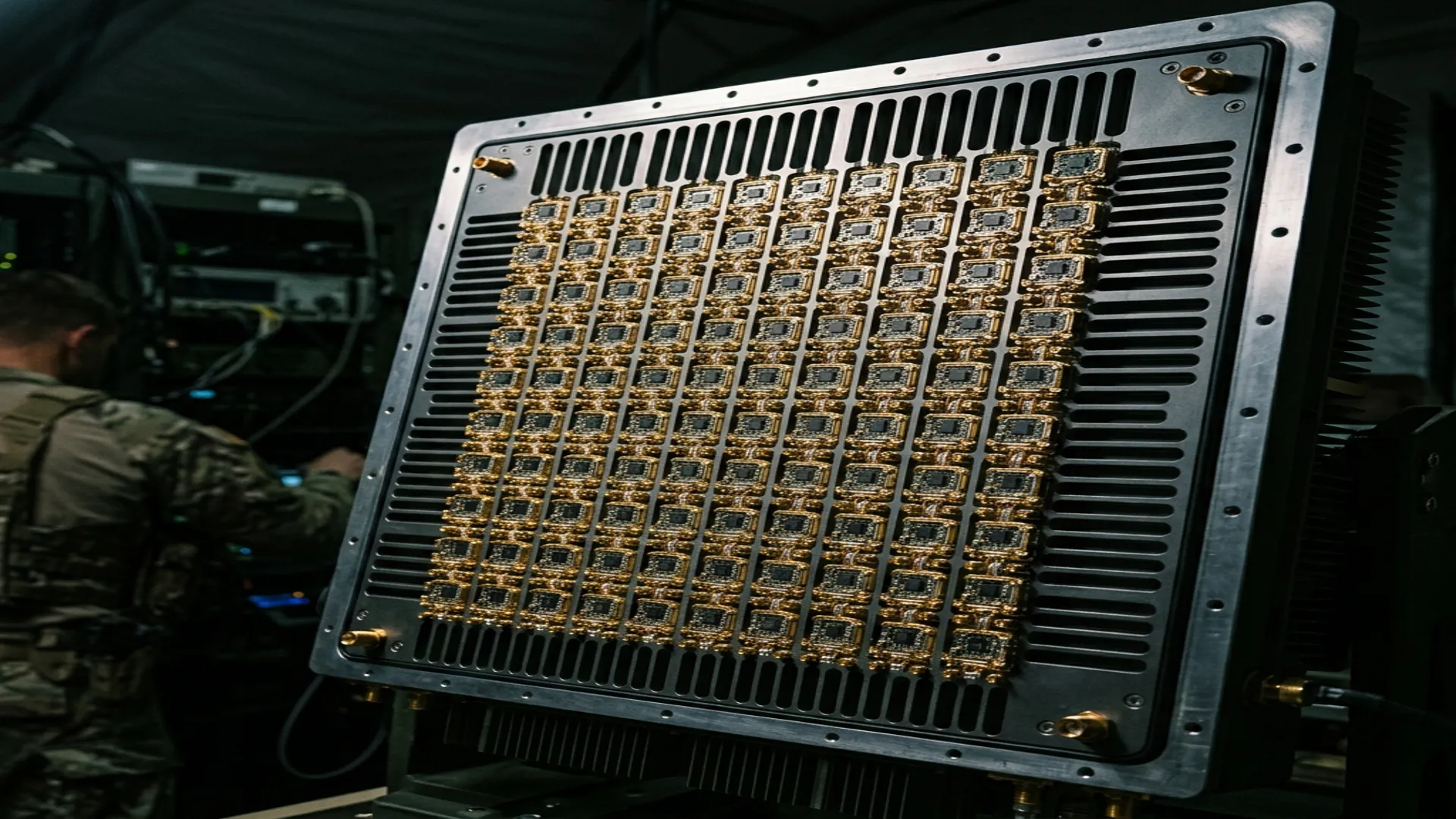
An Active Electronically Scanned Array radar is, at its core, a collection of transmit/receive modules. Each TR module is a self-contained RF front end: it amplifies the transmit signal, shifts its phase to steer the beam, switches between transmit and receive modes, amplifies the received echo, and manages its own thermal load. A modern fighter-aircraft radar like the AN/APG-81 contains over 1,200 TR modules. A ground-based air defense radar may contain 10,000 or more.
The TR module is the most replicated, most volume-produced, and most expensive single component in a modern radar system. Understanding its architecture is essential for anyone designing, supplying, or maintaining AESA radar hardware.
1. TR Module Signal Chain
The signal path through a TR module follows a specific sequence on both transmit and receive:
Transmit Path
- Phase shifter: Sets the element phase for beam steering. Typically 6-bit (5.6° resolution) digital phase shifter implemented in GaAs or SiGe.
- Variable gain amplifier (VGA): Sets the element amplitude for sidelobe control and array tapering.
- Driver amplifier: Pre-amplifies the signal before the final PA stage.
- High-power amplifier (HPA): The GaN MMIC power amplifier. This is the highest-value component in the module, producing 5 to 20 watts per element depending on the band.
- Circulator: Routes the transmit signal to the antenna element while isolating the receive path. A ferrite circulator with 20+ dB isolation.
Receive Path
- Circulator: Routes the received signal from the antenna to the receive chain.
- Limiter: Protects the LNA from high-power signals (own transmit leakage, enemy jamming). PIN diode limiter with recovery time under 100 ns.
- Low-noise amplifier (LNA): First-stage amplification with noise figure of 1.5 to 3.0 dB. Sets the system noise floor.
- Phase shifter: Same phase shifter used for transmit (or a separate receive phase shifter in dual-channel designs).
- VGA: Receive amplitude control for calibration and tapering.
| Parameter | X-Band (9-10 GHz) | S-Band (3-4 GHz) | Ka-Band (34-36 GHz) |
|---|---|---|---|
| PA output power | 10-20 W | 20-50 W | 2-5 W |
| LNA noise figure | 2.0-3.0 dB | 1.5-2.5 dB | 3.0-4.5 dB |
| Phase shifter bits | 6 | 6 | 6-7 |
| T/R switch time | < 100 ns | < 200 ns | < 50 ns |
| Module size | 15x15x40 mm | 40x40x60 mm | 8x8x25 mm |
| Module weight | 20-40 g | 80-150 g | 5-15 g |
2. The GaN Transition
First-generation AESA radars (AN/APG-77, 1990s) used GaAs MMIC PAs producing 4 to 8 watts per element at X-band. Current-generation systems use GaN-on-SiC MMICs producing 10 to 20 watts per element, a 2 to 5x improvement in output power from the same module footprint. This translates directly to longer detection range (range scales as the fourth root of power) and higher effective radiated power for electronic attack modes.
Thermal Challenge: A 20W GaN PA in a 15x15 mm module dissipates approximately 40W of heat (at 33% PAE). Across 1,200 modules, the array generates 48 kW of heat. The thermal management system (liquid cooling loops, cold plates, thermal interface materials) is as critical to AESA performance as the RF electronics. Every degree of junction temperature reduction extends PA lifetime and improves linearity.
3. Packaging and Interconnects
The TR module package must accomplish three things simultaneously: provide hermetic sealing for the GaN die, provide a low-loss RF path from the module to the antenna element, and provide an efficient thermal path from the PA die to the cooling system.
- Module housing: Typically machined from Kovar or aluminum with gold-plated interior surfaces. Hermetically sealed with a brazed or seam-welded lid. The housing serves as both the RF ground plane and the primary heat conduction path.
- RF interconnect to antenna: Coaxial (SMPM, GPPO) or waveguide (WR-90 at X-band) connection from the module to the array manifold. The interconnect must maintain low VSWR across the full operating bandwidth while surviving thousands of thermal cycles.
- DC and control interface: A multi-pin connector carrying DC power, phase/amplitude control data, and T/R timing signals. Typical power consumption per module: 15 to 50W DC.
4. Passive Components Inside the Module
Inside every TR module, surrounding the active MMICs, are passive components that are just as critical to performance:
- Circulators: Ferrite junction circulators providing T/R isolation. Must handle the full transmit power with less than 0.3 dB insertion loss.
- Matched loads: Precision terminations on the circulator's third port absorbing reflected power. Size-constrained to fit within the module envelope.
- Waveguide transitions: Coax-to-waveguide or microstrip-to-waveguide transitions at the module RF ports.
- Filters: Bandpass filters for rejecting out-of-band interference before the LNA.
RF Essentials manufactures precision waveguide components, terminations, circulators, and assemblies used in AESA radar systems. All products are made in the USA with defense-grade quality systems.
Frequently Asked Questions
What is a TR module and what does it do in an AESA radar?
Each transmit/receive module is a self-contained RF front end that amplifies the transmit signal, shifts its phase to steer the beam, switches between transmit and receive modes, amplifies the received echo, and manages its own thermal load. A fighter radar like the AN/APG-81 contains over 1,200 of them, and a ground-based air defense radar may contain 10,000 or more, which makes the TR module the most replicated and most expensive single component in the system.
What did the GaAs-to-GaN transition do for AESA radar?
First-generation arrays used GaAs MMIC amplifiers producing 4 to 8 watts per element at X-band. Current GaN-on-SiC MMICs deliver 10 to 20 watts per element from the same footprint, a 2 to 5 times gain. Because detection range scales as the fourth root of power, that translates directly into longer range and higher effective radiated power for electronic attack, though a 20 watt GaN amplifier dissipating roughly 40 watts each makes thermal management critical.
What passive components sit inside a TR module?
Around the active MMICs are several precision passives: a ferrite circulator that provides 20 dB or more of transmit/receive isolation at under 0.3 dB insertion loss, a matched load termination on the circulator's third port to absorb reflected power, coax-to-waveguide or microstrip-to-waveguide transitions at the RF ports, and bandpass filters that reject out-of-band interference before the LNA. All of them must fit within the tight module envelope.