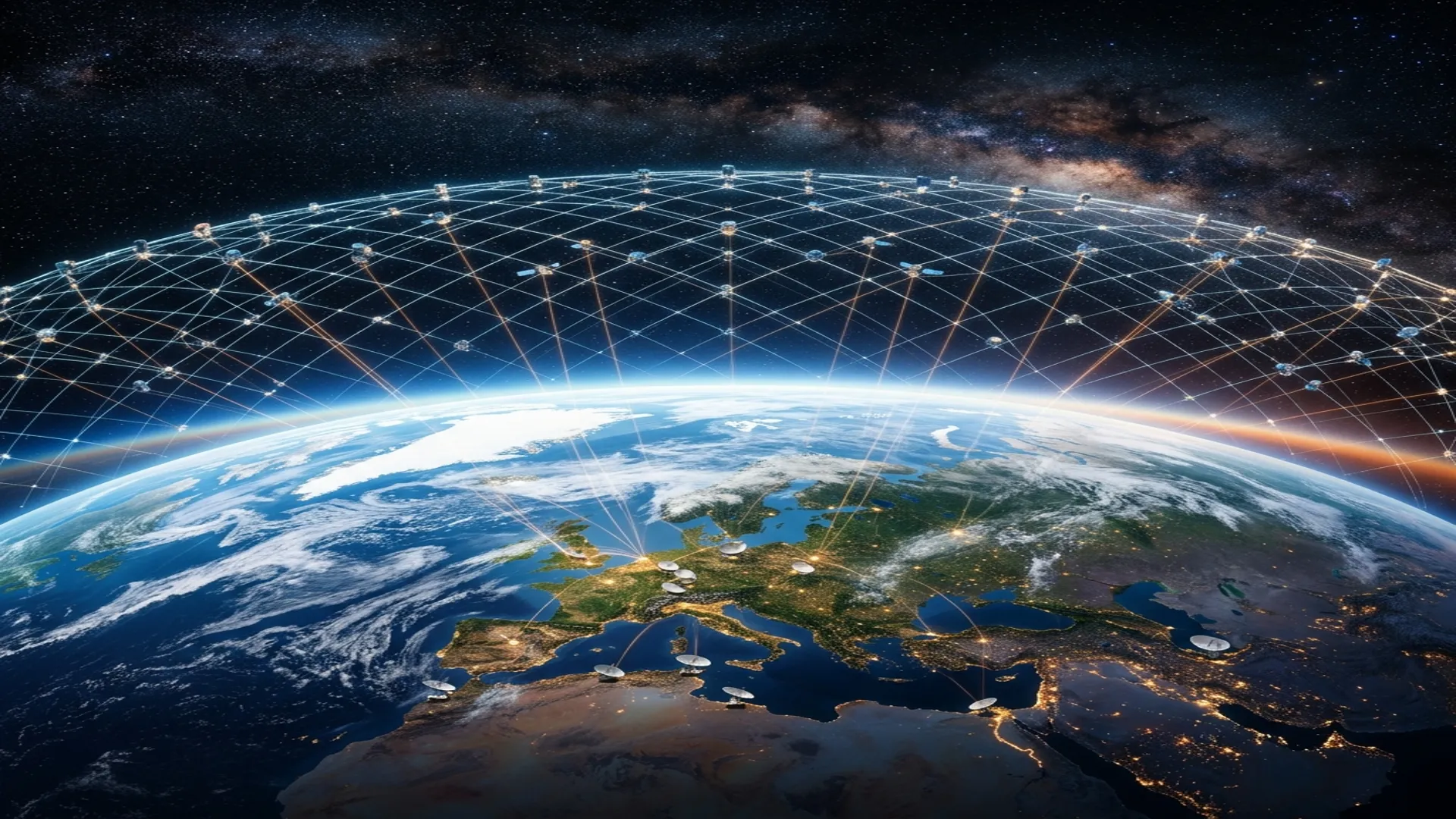
The satellite industry has a math problem. SpaceX has authorization for 12,000 Starlink satellites and has applied for 30,000 more. Amazon's Project Kuiper is deploying 3,236 satellites. OneWeb has 648. Telesat Lightspeed is building 298. The combined authorized constellation count exceeds 50,000 spacecraft, all in low Earth orbit, all requiring continuous ground connectivity, all needing to hand off traffic at orbital speed.
The satellites get all the attention. But the bottleneck is not in orbit. It is on the ground. Every one of those satellites must connect to a terrestrial gateway station to route traffic onto the fiber backbone. Each gateway needs multiple tracking antennas, each antenna needs a full RF chain (feed, LNA, BUC, upconverter, downconverter, waveguide runs), and each RF chain must operate at Ku, Ka, or V-band with performance specifications that were once reserved for military earth stations and radio telescope receivers.
1. The Scale of the Ground Problem
A geostationary satellite sits at 35,786 km and serves an entire hemisphere from one position. A single gateway station with two to four antennas can manage all the traffic for a GEO bird. LEO is fundamentally different. Each satellite is visible from a given ground station for only 5 to 10 minutes per pass. To maintain continuous service, a gateway must simultaneously track multiple satellites, handing off traffic as one satellite sets below the horizon and the next rises.
| Constellation | Satellites | Gateway Sites (est.) | Antennas per Site | Total Antennas |
|---|---|---|---|---|
| Starlink | 12,000+ | 100+ | 8 to 32 | 1,500+ |
| Kuiper | 3,236 | 30 to 50 | 8 to 16 | 400+ |
| OneWeb | 648 | 40+ | 4 to 8 | 200+ |
| Telesat Lightspeed | 298 | 15 to 20 | 4 to 8 | 100+ |
Conservative estimates put the total number of LEO gateway antennas needed worldwide at over 2,000, each with a full RF front end operating at Ka-band or above. For comparison, the entire global GEO earth station market deployed roughly 3,000 Ku/Ka-band gateway antennas over the past 30 years. The LEO buildout is attempting to deploy a comparable number in under a decade.
2. The RF Chain: What Each Antenna Needs
Every gateway antenna is a complete RF system. The component list for a single Ka-band LEO gateway terminal includes:
- Antenna and feed system: 2 to 5 meter reflector with a dual-band (Tx/Rx) corrugated feed horn, orthomode transducer (OMT) for polarization separation, and tracking mount capable of 5°/sec slew rate for LEO tracking.
- Low-noise amplifier (LNA): Cryogenic or ambient-temperature LNA at the feed for the downlink band (17.7 to 20.2 GHz for Ka-band), with noise figure below 1.5 dB and gain of 35+ dB.
- Block upconverter (BUC): Solid-state or GaN-based BUC for the uplink band (27.5 to 30.0 GHz for Ka-band), power levels from 10W to 80W depending on link margin requirements.
- Waveguide components: WR-42 and WR-28 waveguide runs, bends, twists, transitions, and filters connecting the feed to the LNA and BUC. Total waveguide run length per antenna is typically 3 to 10 meters.
- Frequency converters: Upconverters and downconverters for translating between IF/baseband and the Ka-band RF frequencies.
- Diplexer/triplexer: Combining transmit and receive paths to share a single feed horn and waveguide run to the reflector.
The V-Band Transition: The next wave of LEO ground stations will operate at V-band (40 to 75 GHz) to access the wider bandwidths available at these frequencies. V-band ground stations require WR-19 and WR-15 waveguide components with surface finish tolerances measured in micrometers. The manufacturing precision required for V-band waveguide is an order of magnitude tighter than Ka-band, and the global supply chain for these components is extremely thin. This is where domestic manufacturers with precision machining capabilities will have a significant competitive advantage.
3. The Supply Chain Bottleneck
The LEO ground segment buildout is straining the RF component supply chain in ways the industry has not experienced before. The demand is not for one or two custom earth stations per year, which is the traditional GEO ground segment pace. It is for hundreds of near-identical gateway terminals per year, each needing the same set of precision waveguide components, feeds, LNAs, and BUCs.
This creates a manufacturing challenge. Waveguide components at Ka-band and above require CNC machining with tight tolerances (±0.001" or better for WR-28), clean surface finishes (16 microinch Ra or better for low insertion loss), and precision flange interfaces that must mate with components from multiple suppliers. Scaling this from prototype quantities (10 to 50 units) to production quantities (500 to 5,000 units) requires investment in tooling, fixturing, and quality systems that many small waveguide manufacturers have not historically needed.
4. Flat Panel and Electronically Steered Antennas
The long-term solution to the LEO tracking problem may be flat-panel electronically steered antennas (ESAs) that eliminate the mechanical tracking mount entirely. Companies including Kymeta, ThinKom, and SpaceX's own Dishy terminal are developing phased array or metamaterial-based flat panels that can track LEO satellites electronically.
For gateway-class applications (high throughput, multiple simultaneous beams), flat-panel technology is still maturing. The power requirements, thermal management challenges, and cost per unit of aperture area are not yet competitive with traditional reflector antennas for the gateway use case. But the trajectory is clear: as flat-panel ESAs reach gateway-class performance in the 2028 to 2032 timeframe, they will create demand for a different set of RF components (corporate feed networks, phase shifters, TR module building blocks) while reducing demand for traditional reflector feed systems.
5. The Opportunity for Domestic Manufacturing
Three factors are converging to favor U.S.-based RF component manufacturers in the LEO ground segment market:
- ITAR and security requirements: Many LEO constellations serve government and military customers alongside commercial users. Gateway stations handling classified or government traffic must use ITAR-compliant, domestically manufactured RF hardware.
- Supply chain resilience: The COVID-era supply chain disruptions demonstrated the risk of relying on overseas suppliers for critical RF components. Constellation operators are actively diversifying their supply chains toward domestic sources.
- Speed to market: LEO constellation timelines are measured in months, not years. Domestic manufacturers with shorter lead times and direct engineering access have a competitive advantage over offshore suppliers whose lead times can extend to 20+ weeks.
RF Essentials manufactures precision waveguide components, feed assemblies, and integrated subsystems for satellite ground stations from Ku-band through V-band. All products are made in the USA with short lead times and full dimensional inspection.
Frequently Asked Questions
Why is the ground segment, not the satellites, the bottleneck for LEO constellations?
A geostationary satellite serves a whole hemisphere from one position, but each low-orbit satellite is visible from a given ground station for only 5 to 10 minutes per pass, so a gateway must track several at once and hand off traffic continuously. With more than 50,000 authorized spacecraft, the industry needs an estimated 2,000-plus gateway antennas worldwide, each a full Ka-band or higher RF front end, deployed in under a decade.
What RF components does a single LEO gateway antenna need?
A complete Ka-band terminal includes a 2 to 5 meter reflector with a dual-band corrugated feed and an orthomode transducer, a downlink LNA with noise figure below 1.5 dB and over 35 dB of gain, a 10 to 80 W block upconverter for the uplink, 3 to 10 meters of WR-42 and WR-28 waveguide with bends, twists, and transitions, up and down converters, and a diplexer to share the feed. V-band stations push this to WR-19 and WR-15.
Why does the LEO buildout strain the waveguide supply chain?
Traditional GEO work meant one or two custom earth stations a year, but LEO needs hundreds of near-identical gateway terminals annually, each requiring the same precision Ka-band waveguide. Scaling from prototype quantities of 10 to 50 units up to production runs of 500 to 5,000 demands tooling, fixturing, and quality systems many small waveguide shops never needed, and the move to V-band makes the required machining precision an order of magnitude tighter.